
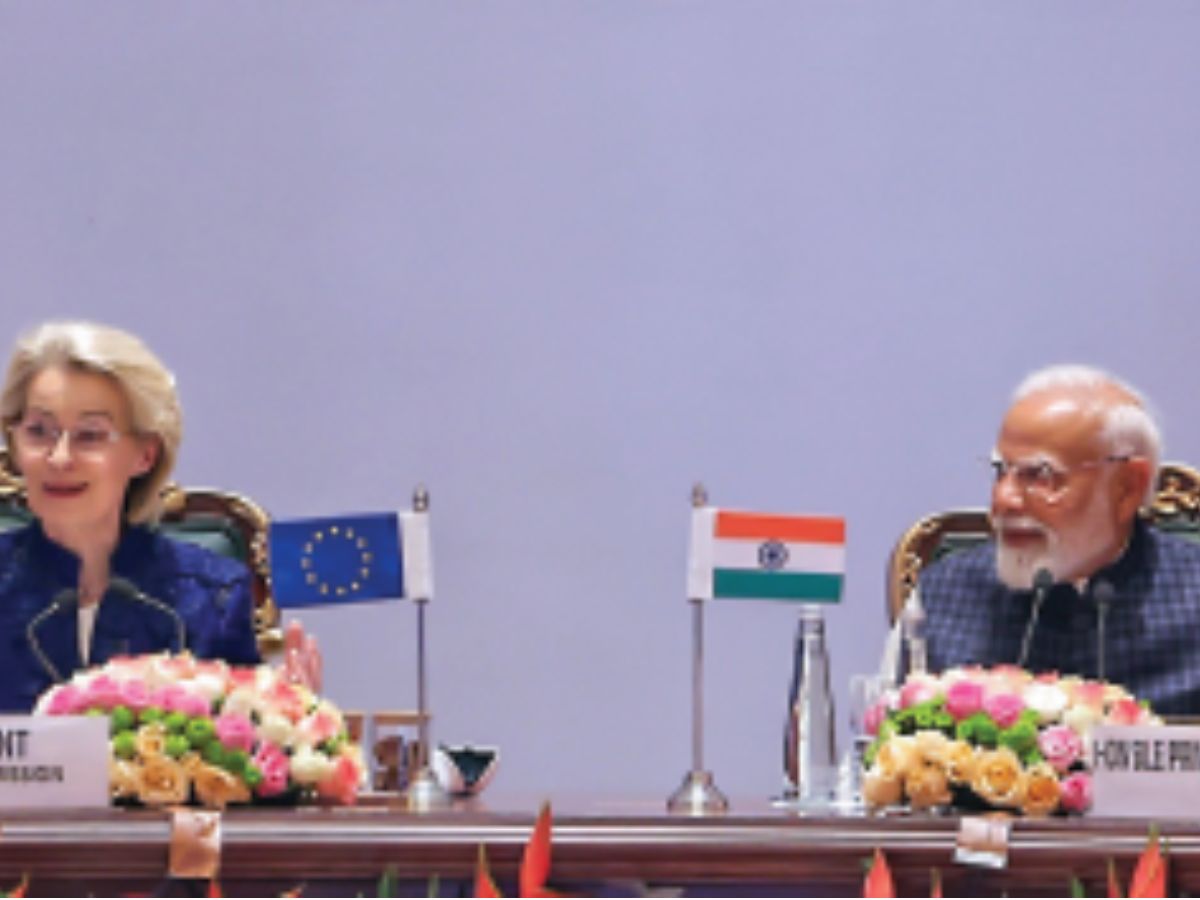
This week, India demonstrated the strength of silence. The India-EU Free Trade Agreement (FTA), finalized on January 27, 2026, marks a pivotal moment in the economic relations between two of the largest democracies in the world. Alongside the concurrent signing of the inaugural comprehensive Security and Defence Partnership, this dual framework indicates a fundamental shift in India-EU relations from mere transactional interactions to a thorough strategic partnership. This agreement indeed signifies a new phase in the geopolitical landscape. Also, amid this positive development, additional encouraging news is emerging globally. Putin has extended an invitation to Zelenskyy to engage in discussions in Russia aimed at resolving the conflict. Meanwhile, Netanyahu has declared that Israel will reduce its reliance on the US and strengthen its connections with India. This illustrates India’s influence in every aspect.
The India-EU FTA, referred to as the “mother of all deals” by European Commission President Ursula von der Leyen during a recent World Economic Forum meeting in Davos, marks the conclusion of seven years of rigorous negotiations that were re-initiated in 2019. This agreement emerges at a pivotal moment in global geopolitics, as both India and the EU confront increasing challenges to their strategic autonomy and economic interests. The simultaneous signing of the Security and Defence Partnership highlights a significant acknowledgment: in today’s international landscape, economic alliances and security collaboration are fundamentally interconnected. Collectively, these frameworks form what could be described as a comprehensive strategic architecture, which extends well beyond traditional trade agreements to include defenceindustrial collaboration, technology exchange, and intelligence sharing.
Under the agreement, the EU will abolish duties on more than 99% of Indian exports by value, thereby providing a substantial enhancement to labourintensive industries such as textiles, leather, and gems. In exchange, India will grant duty-free access for approximately 92-97% of EU products over a phased timeline, which includes considerable tariff reductions on machinery, chemicals, and high-end automobiles (decreasing from 110% to 10% under specific quotas). In addition to goods, the agreement encompasses an ambitious framework for services and mobility, allowing India access to 144 EU sub-sectors and simplifying visa processes for skilled professionals and students. Although sensitive sectors such as dairy and cereals are safeguarded through exclusions, the agreement also tackles contemporary trade issues by incorporating a Trade and Sustainable Development chapter that includes commitments related to climate and labour rights.
On the other hand, the security and defence partnership represents the inaugural comprehensive framework for defence collaboration between India and the EU. This partnership, which will be the EU’s third such agreement in Asia, following those with Japan and South Korea, initiates annual Security and Defence Consultations and establishes institutional mechanisms for sectoral dialogues in areas such as maritime security, cyber security, counterterrorism, and non-proliferation. A notably important aspect of this defence framework pertains to defence-industrial cooperation. The partnership facilitates opportunities for Indian companies to engage in the EU’s “Readiness 2030” initiative and the proposed Euro 800 billion ReArm Europe plan, which was introduced in March 2025. This signifies a substantial transformation in the EU’s defence procurement strategy, indicating Brussels’ intention to broaden its defenceindustrial sourcing beyond transatlantic suppliers.
For India, this opportunity is in line with the government’s agenda for strategic autonomy and the “Make in India” initiative focused on defence manufacturing. In recent years, Indian defence manufacturers, including those in the public sector, have increased their production capacity. The partnership with the EU offers essential pathways for integration into European supply chains and co-production agreements, thereby enhancing India’s potential as a global hub for defence manufacturing.
The provisions of the framework regarding a Security of Information Agreement (SOIA) deserve special attention. The SOIA, which is currently being negotiated, aims to create legal protections that will facilitate the exchange of classified information between India and the EU. Such frameworks are essential for fostering substantial defence-industrial and technology collaboration, suggesting that both parties perceive the relationship as sufficiently developed for deeper strategic integration.
The timing of the FTA and the Defence Framework aligns with the increasing trends of major powers seeking strategic autonomy. Both India and the EU are under growing pressure to broaden their international partnerships: the EU faces uncertainties concerning the transatlantic security framework in the wake of the protectionist policies of the Trump administration and ambiguous commitments from NATO. Meanwhile, India is navigating the competition among great powers in the Indo-Pacific while managing intricate relationships with both China and Russia. The partnership between India and the EU offers both sides alternatives to binary alignments. For the EU, India’s pursuit of strategic autonomy, its non-aligned stance, and its technological capabilities, especially in information technology and manufacturing, provide complementary advantages. For India, collaborating with a unified economic bloc that accounts for 25% of global GDP serves as a counterbalance to the pressures from great powers and grants access to advanced technologies.
Collectively, these frameworks indicate structural transformations within the international system: the expansion of partnerships beyond conventional alignments, the acknowledgment of India as a crucial pivot point, and the establishment of alternative institutional frameworks to tackle global challenges. This new India-EU partnership presents a model of thorough strategic engagement that is well-suited to the multipolar intricacies of the modern international landscape. The importance of this partnership goes beyond mere bilateral relations. It illustrates that in a time of intense power rivalry and strategic ambiguity, democracies that share similar values and complementary strengths can forge partnerships that are marked by both economic interdependence and strategic collaboration, as well as mutual advantage and a common strategic vision.