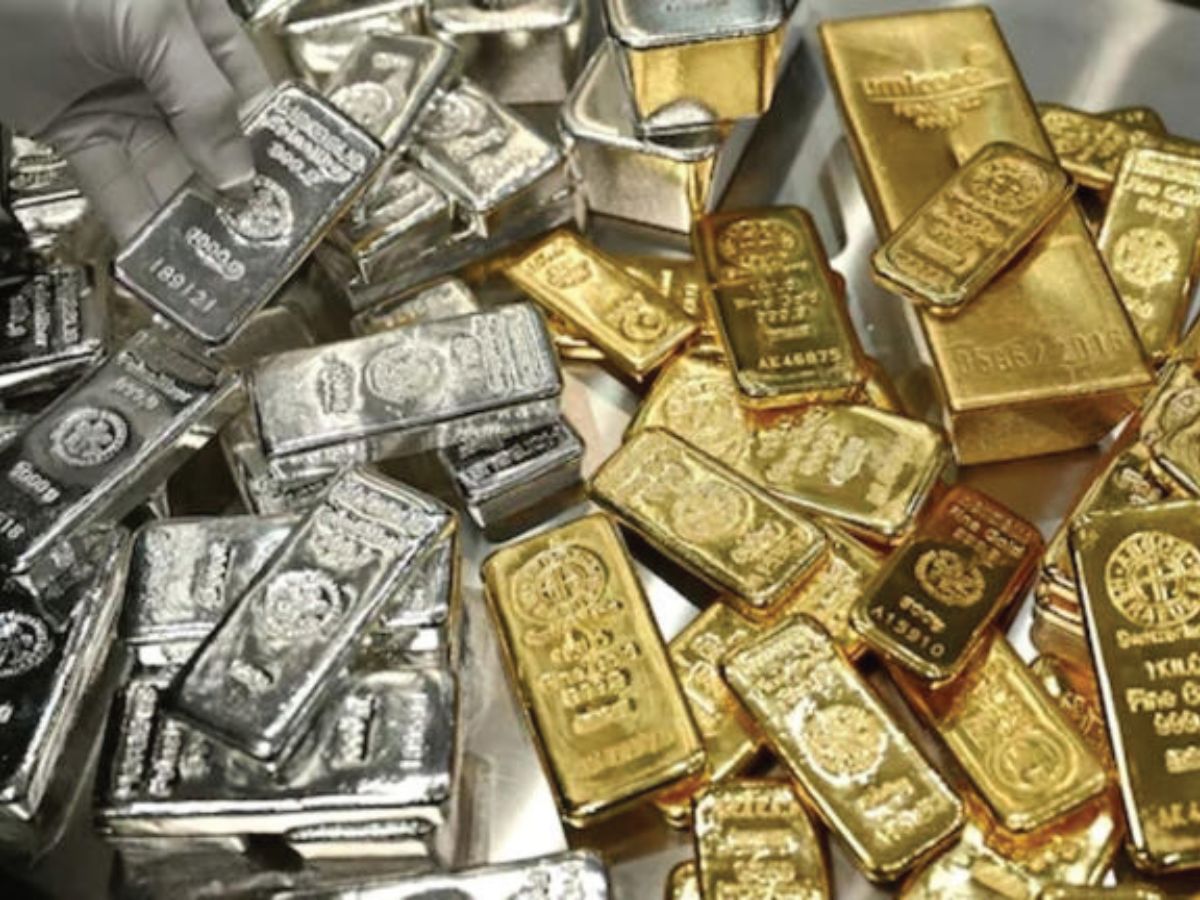
Global financial markets witnessed dramatic swings on January 30, 2026, as gold and silver prices fell sharply after reaching historic peaks. Silver, which recently surged to Rs 4,20,000 per kg in India and $121 per ounce internationally, experienced an 11–12% intraday decline, while gold dropped nearly $500 per ounce. The sudden corrections triggered panic selling and affected both commodity and equity markets worldwide.
The Market Moves
Earlier this week, gold and silver rallied to record highs, with gold nearing $5,600 per ounce and silver climbing over $121 per ounce. On Thursday and Friday, both metals experienced steep corrections:
- Gold prices fell close to $5,100 per ounce, wiping out gains from the recent record peaks.
- Silver saw a decline of nearly 12%, retreating sharply from $121 before recovering partially.
- In India, MCX gold dropped from Rs 1,80,779 per 10 grams to an intraday low of Rs 1,57,808, while silver fell from Rs 4,20,000 to significantly lower levels before bouncing back.
The volatility also reverberated through U.S. equity markets, with an estimated $9 trillion in market capitalisation changing hands across commodities and equities in just a few hours. The S&P 500 erased $780 billion intraday before recovering $530 billion, while Nasdaq saw a $760 billion wipeout before adding back $580 billion.
Causes Behind the Sell-Off
Profit-Taking and Speculation: One major factor driving the correction was profit booking. After straight-line rallies, traders and investors opted to lock in gains, particularly in silver, which surged by Rs 25,000–40,000 in just fifteen days. Margin calls on leveraged positions and algorithmic trading triggered additional sell-offs, intensifying downward pressure.
Macro and Monetary Factors: Global economic uncertainty fuelled the volatility. A stronger U.S. dollar and shifting expectations of Federal Reserve policy caused investors to reassess the attractiveness of non-yielding assets like gold and silver. As interest rate cut expectations waned, precious metals, traditionally considered safe havens, faced downward pressure.
Equity Market Links: The correction coincided with declines in U.S. technology and AI stocks, including Microsoft, Oracle, and Nvidia. Weakness in tech stocks influenced global risk sentiment, prompting capital rotation between equities and commodities.
India’s Market Impact
Domestic markets mirrored global trends. Gold dropped nearly 12% from its record levels, touching a low of Rs 1,57,808 per 10 grams before recovering to Rs 1,69,600.
- Silver followed similar patterns, reflecting high volatility and strong intraday fluctuations.
- Experts highlighted that Indian prices are particularly sensitive to global trends due to import dependence, currency movements, and active trading on exchanges.
Why Silver was hit hardest
Silver’s volatility was more pronounced due to its dual role as both an industrial and financial asset:
- Industrial Demand: High usage in electronics, solar panels, and EVs keeps global demand elevated.
- Speculation: Lower liquidity and leveraged positions amplify price swings in futures markets.
- Global Supply Constraints: Export restrictions by China and the U.S., classifying silver as a critical mineral, support high price sensitivity to market sentiment.
Experts said that silver’s meteoric rise in January was unsustainable, warning investors to expect interim corrections before potential long-term growth.
Expert Opinions
Financial experts describe the episode as a classic case of market uncertainty: “These swings are a symptom of extreme uncertainty across all asset classes. Money moves erratically when global economic direction is unclear.” Analysts emphasized that the correction is likely a healthy pullback, rather than the start of a long-term bear market. Strategic investors should view this as an opportunity to enter at lower levels rather than panic-sell.
Global Implications
- The recent volatility underscores the interconnectedness of modern financial markets:
- Capital flows between equities, commodities, and bonds can trigger rapid shifts in valuations.
- Algorithmic and high-frequency trading exacerbate intraday swings.
Investor sentiment reacts swiftly to economic indicators, corporate earnings, and geopolitical news, influencing both commodity and equity prices globally. Experts suggest that global investors maintain diversified portfolios and exercise caution, especially with leveraged positions in metals futures.
For Investors
Long-Term Holders: Precious metals remain a viable hedge against inflation and geopolitical uncertainty. Corrections are normal in markets following rapid gains. Short-Term Traders: Must practice disciplined risk management, as intraday volatility can lead to sudden losses. Diversification: Spreading investments across assets, including equities, bonds, and commodities, reduces exposure to extreme price swings.
Expected
Gold and silver prices are expected to remain volatile in the short term, influenced by global monetary policy, tech sector performance, and investor sentiment. Analysts caution that while prices may touch record highs again, interim corrections to lower levels are likely. For instance, silver could fluctuate between Rs 2.5 lakh and Rs 7 lakh before stabilizing over the next few years. Market participants, both domestic and global, will be closely monitoring the upcoming U.S. economic data, Federal Reserve signals, and Indian Union Budget cues, which may influence asset allocation decisions further.