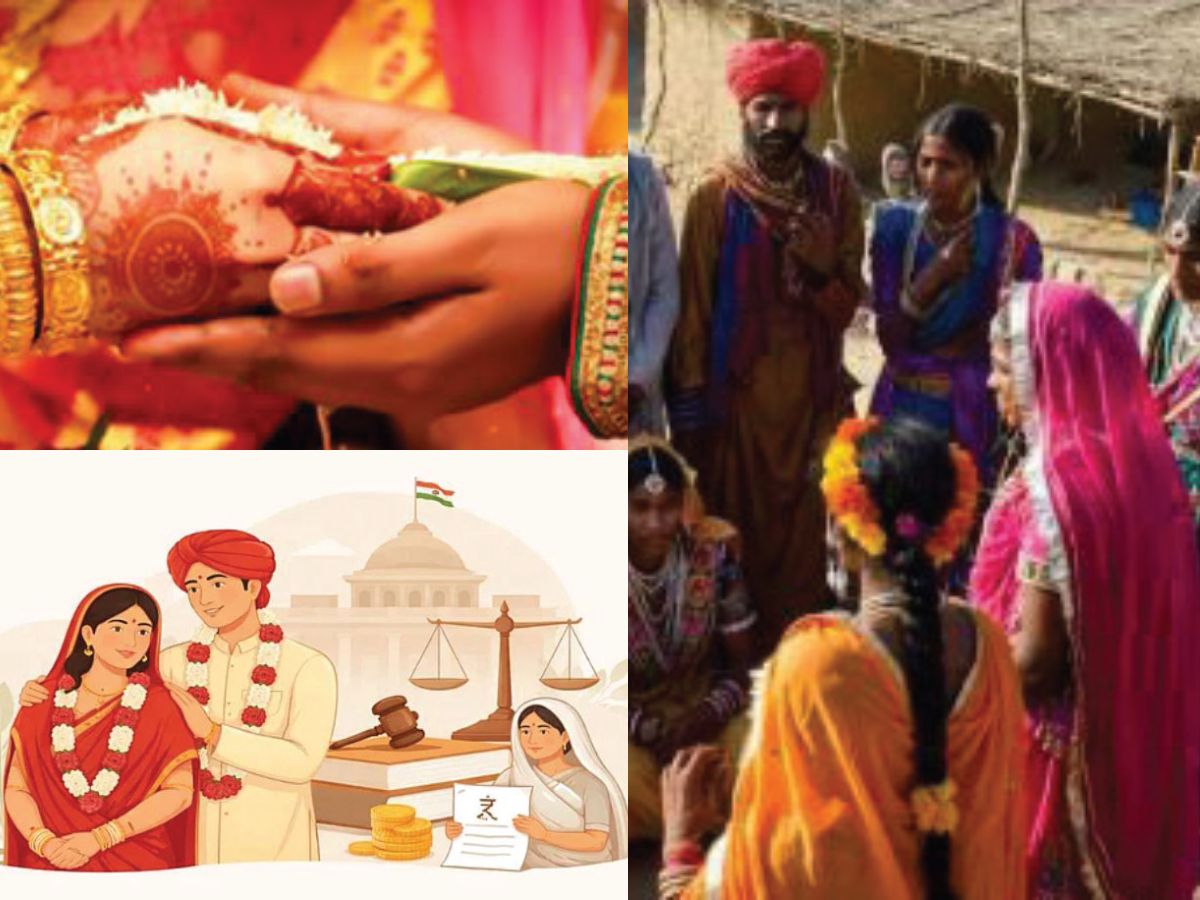
In a landmark ruling, the Rajasthan High Court recently recognized Nata Vivah, a customary form of marriage practiced in some rural areas of Rajasthan, for the purpose of granting a family pension to a woman who had entered such a marriage with a deceased government employee. This decision carries important implications for customary practices, women’s rights, and the legal recognition of non-formalized marital arrangements in India.
What is Nata Vivah?
Nata Vivah, also called Nata Pratha, is a traditional, non-formalized form of remarriage or cohabitation followed in rural and tribal areas of Rajasthan, and observed in parts of Madhya Pradesh, Uttar Pradesh, and Gujarat. It is primarily prevalent among certain Hindu communities, especially nomadic, tribal, or lower-income rural groups. Unlike conventional Hindu marriages, Nata Vivah does not involve elaborate rituals or ceremonies; it is recognized by community consent and social acceptance. Historically, it emerged as a practical response to life’s challenges, including death, separation, poverty, and land scarcity, enabling widows, divorced, or abandoned women to enter new marital relationships for social and economic survival. In essence, Nata Vivah resembles a modern-day live-in relationship, though it operates under the framework of custom and tradition.
Key Features of Nata Vivah
-
Practiced primarily in rural Rajasthan and neighboring regions.
-
The woman may be a widow, divorced, or abandoned.
-
No formal rituals or religious ceremonies are required.
-
Relationships are recognized socially and sometimes economically.
-
Historically arose as a survival mechanism in harsh socio-economic conditions.
While Nata Vivah offered women practical survival, it often denied legal rights, inheritance, and official recognition. Concerns have been raised over misuse, including exploitation, child marriage, and coercion.
The Rajasthan High Court Case
The ruling arose when a woman petitioned the Rajasthan High Court seeking a family pension following the death of her husband, Puran Lal Saini, a government employee. She claimed their union under Nata Vivah produced a child and was socially recognized. The State initially denied her claim, arguing that Nata Vivah was not a legally valid marriage.
Court’s Findings
-
The deceased had acknowledged the Nata Vivah in maintenance cases filed by the petitioner.
-
Payments of maintenance indicated recognition of the relationship.
-
Society had accepted her as the deceased’s wife.
-
Section 7 of the Hindu Marriage Act, 1955 recognizes customary marriages performed according to community rites.
Based on these, Justice Ashok Kumar Jain ruled that Nata Vivah is a form of marriage in rural Rajasthan, entitling the petitioner to family pension and other dependent spouse benefits. The Court clarified that this ruling does not legalize Nata Vivah in general, but recognition can be granted where a customary marriage is proven, showing stability, dependence, and social acceptance.
Legal Context
-
Section 7, Hindu Marriage Act, 1955: Recognizes marriages performed according to customary rites.
-
Section 125, CrPC: Ensures maintenance to wives, children, and parents, broadly interpreted to include women in relationships akin to marriage.
Relevant Case Laws
-
Roopsi @ Roop Singh vs State of Rajasthan – Customary marriages can constitute valid marriage.
-
Boli Narayan vs Shiddheswari Morang – Social and moral obligations matter for maintenance, beyond ceremonial proof.
-
Chanmuniya vs Virender Kumar Singh Kushwaha – “Wife” under Section 125 includes women in marital-like relationships.
-
D. Velusamy vs D. Patchaiammal – Domestic Violence Act includes relationships in the nature of marriage.
Social Context and Origins
Nata Vivah developed out of social and economic necessity, providing widows and abandoned women social legitimacy, continuity of household labor, and opportunities to form new unions without expensive ceremonies. Criticisms include gender inequity, exploitation, payments for widow transfer, and child marriages.
Maintenance and Family Pension
The High Court ruling clarifies that women in proven Nata Vivah relationships can claim:
-
Family pension (for government employees)
-
Death gratuity
-
Arrears and interest
This aligns with social justice principles under Articles 15(3) and 39 of the Constitution. The ruling does not automatically grant inheritance or property rights.
Modern-Day Relevance
The ruling highlights the need to:
-
Document customary marriages to prevent disputes.
-
Ensure social and legal protection for women and children.
-
Bridge the gap between traditional practices and constitutional rights.
Conclusion
The Rajasthan High Court’s judgment is a significant step in recognizing customary marriages like Nata Vivah for welfare purposes. While it does not legalize the practice broadly, it ensures that women are not denied family pensions, maintenance, or social security due to lack of formal registration, acknowledging the lived realities and survival needs of women in rural India.