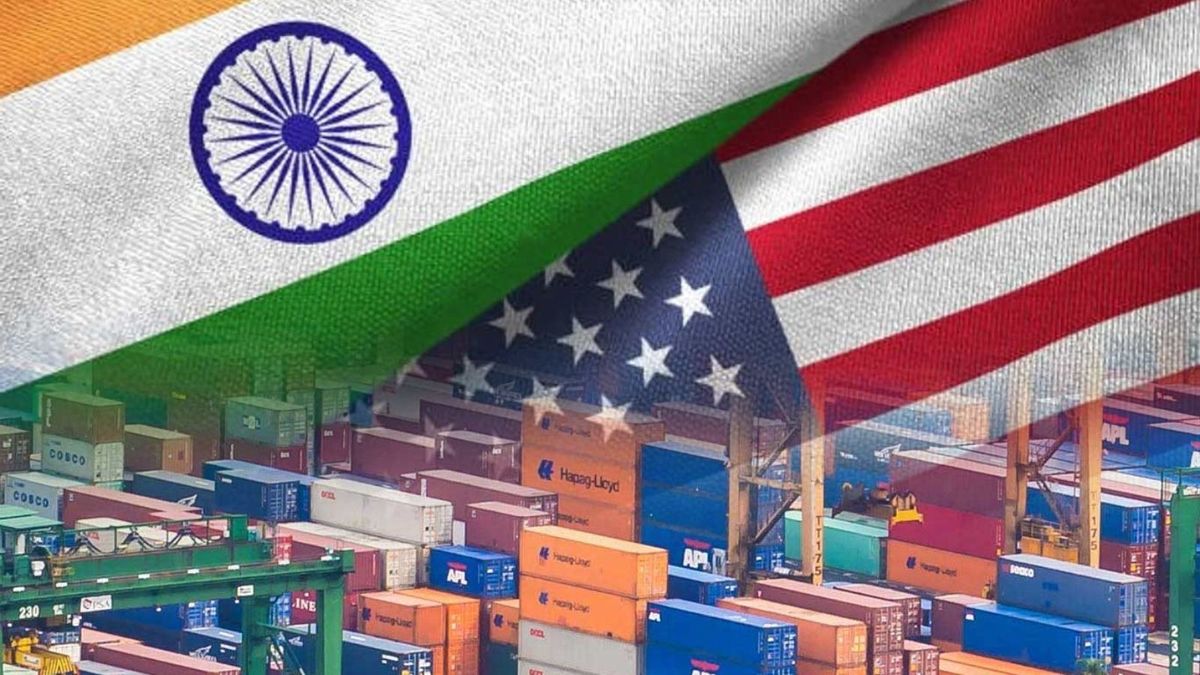
NEW DELHI: India will now face a lower reciprocal tariff of 10 per cent, down from 25 per cent, after US President Donald Trump announced a new global levy on items imported into America in the wake of the Supreme Court verdict against his sweeping duties on several nations.
According to Trump’s proclamation, the temporary import surcharge of 10 per cent is for a period of 150 days from February 24.
A proclamation, dated February 20, was issued by the White House.
Here is a list of key pointers to explain the meaning of this announcement for Indian companies.
TARIFF: These are customs or import duties which a country imposes on goods bought from other nations. An importer has to pay this duty to the government.
Normally, companies pass on these taxes to end users or consumers.
Import duty makes goods expensive in the importing country. Besides, a few other factors also play a role in this.
RECIPROCAL TARIFFS (RT): The term, reciprocal tariff, was first used by the US. The Trump administration, on April 2, 2025, announced these duties on about 60 nations, including India. It was aimed at providing a level playing field to US exporters.
For example, if a country charges X per cent duty on US goods, America will charge the same on imports of that country.
These are additional import duties, which are imposed over and above the existing or MFN (most favoured nation) levies.
NOW WHAT IS RT ON INDIA
On April 2, 2025, the US announced 25 per cent reciprocal tariffs. Later in July, the US announced a 25 per cent RT on Indian goods entering American markets from August 7, 2025. In August last year, the Trump administration announced additional 25 per cent tariffs on India for purchasing Russian crude oil, taking the total RT on India to 50 per cent.
Following agreement on a framework for an interim trade deal in February, the US announced that it will reduce the RT on India to 18 per cent and remove the additional 25 per cent punitive tariffs.
So at present, India’s goods in the US are facing 25 per cent RT.
With the US Supreme Court striking down President Donald Trump’s global tariffs and Washington issuing a new order imposing a temporary 10 per cent import surcharge, Indian goods will now face only a 10 per cent reciprocal levy from February 24, 2026.
For instance, if a product faces a 5 per cent MFN duty in America, an additional 10 per cent will be imposed now, taking the effective duty to 15 per cent. Earlier, this was 5 plus 25 per cent.
Trump’s proclamation, dated February 20, said: “I impose, for a period of 150 days, a temporary import surcharge of 10 per cent ad valorem on articles imported into the United States, effective February 24, 2026” at 12:01 a.m. Eastern Standard Time.
“Instead of different RTs on different countries, it is 10 per cent now on everyone for the goods which were covered under RTs,” a source said.
From February 7 to February 24, 2026, the Russia-oil penalty was removed, reducing the additional duty to 25 per cent. The February 6 joint statement proposed lowering this reciprocal tariff to 18 per cent, but the change has not yet been implemented.
Beginning February 24, 2026, a temporary across-the-board 10 per cent tariff will apply for 150 days in addition to MFN duties, replacing the earlier reciprocal tariff structure.
AFTER 150 DAYS:
There is no clarity yet about what the reciprocal tariff imposed by the US will be on countries, such as India, after the 150-day period.
INDIA-US TRADE PACT
To finalise the legal text for the first phase of the bilateral trade agreement, the Indian team is scheduled to meet its counterparts in Washington from February 23, 2026.
Commerce and Industry Minister Piyush Goyal, on February 20, said that India and the US are expected to sign the deal next month, and it may be operationalised in April.
EXPERT’S TAKE
Think tank GTRI said that, as the RT on Indian goods has come down to 10 per cent from 25 per cent, India should re-evaluate the trade pact with the US.
India agreed to reduce tariffs for the US based on Washington’s decision to cut RT on India to 18 per cent, but now the US has reduced the RT for all nations to 10 per cent. “Deals are not charity. Both sides must gain. Now, India’s gains need fresh evaluation,” GTRI founder Ajay Srivastava said.
TRUMP ON DEAL WITH INDIA:
Trump said nothing changes in the trade deal with India in the wake of the Supreme Court verdict against his sweeping tariffs, as he responded to the ruling by announcing an additional 10 per cent global levies on items imported into the US.
GOODS UNDER EXEMPTED CATEGORY:
A fact sheet issued by the White House noted that some goods will not be subject to the temporary import duty because of the needs of the US economy or in order to ensure the duty more effectively addresses the fundamental international payments problems facing the United States.
The goods include certain critical minerals, metals used in currency and bullion, energy, and energy products; natural resources and fertilisers that cannot be grown, mined, or otherwise produced in the United States or grown, mined, or otherwise produced in sufficient quantities to meet domestic demand; certain agricultural products, including beef, tomatoes, and oranges; pharmaceuticals and pharmaceutical ingredients.
Other items are certain electronics goods; passenger vehicles, certain light trucks, certain medium and heavy-duty vehicles, buses, and certain parts of passenger vehicles, light trucks, heavy-duty vehicles, buses and certain aerospace products.
SECTORAL TARIFFS ON INDIA:
The sectoral tariffs (steel, aluminium, copper at 50 per cent, and a few auto components attracting 25 per cent) will continue.
WHY IS THE US IMPOSING TARIFFS:
The US has alleged that it faces a significant trade deficit with India, blaming New Delhi for imposing high tariffs on American goods, which it says restricts US exports to the Indian market.
BILATERAL TRADE:
During 2021-22, the US was India’s largest trading partner in goods. The US accounts for about 18 per cent of India’s total exports, 6.22 per cent in imports, and 10.73 per cent in bilateral trade. In 2024-25, the bilateral trade touched USD 126 billion (USD 80.5 billion exports and USD 45.5 billion imports).
With America, India had a trade surplus (the difference between imports and exports) of USD 35 billion in 2024-25. It was USD 35.32 billion in 2023-24 and USD 27.7 billion in 2022-23.
In services, India exported an estimated USD 28.7 billion and imported USD 25.5 billion, adding a USD 3.2 billion surplus.
Altogether, India ran a total trade surplus of about USD 44.4 billion with the US.
MAJOR TRADED PRODUCTS BETWEEN COUNTRIES
In 2024, India’s main exports to the US included drug formulations and biologicals (USD 6.1 billion), telecom instruments (USD 6.5 billion), precious and semi-precious stones (USD 5.3 billion), petroleum products (USD 4.1 billion), vehicle and auto components (USD 2.8 billion), gold and other precious metal jewellery (USD 3.2 billion), ready-made garments of cotton, including accessories (USD 2.8 billion), and products of iron and steel (USD 2.7 billion).
Imports included crude oil (USD 4.5 billion), petroleum products (USD 3.6 billion), coal, coke (USD 3.4 billion), cut and polished diamonds (USD 2.6 billion), electric machinery (USD 1.4 billion), aircraft, spacecraft and parts (USD 1.3 billion), and gold (USD 1.3 billion).
As per estimates, US services imports from India amounted to USD 40.6 billion in calendar year 2024, with computer/information services imports at USD 16.7 billion and business management/consulting at USD 7.5 billion.
TRUMP’S RESPONSE TO THE SC RULING ON TARIFFS
Following the decision of the US Supreme Court invalidating his emergency tariff measures, Trump has taken an assertive stance, signaling his intention to continue pursuing an aggressive trade policy through alternative legal mechanisms rather than scaling back tariff actions. For India-focused businesses and investors, the developments indicate a shift from legally contested emergency tariffs toward alternative statutory mechanisms that preserve tariff leverage while remaining within congressional authorization.
RECALIBRATION OF COUNTRY-SPECIFIC US TARIFF ARRANGEMENTS
The White House clarified that previously negotiated tariff concessions with partner economies, including India, the United Kingdom, and the European Union, would no longer guarantee preferential rates. Instead, these regions are now subject to the global 15 percent tariff framework unless new arrangements are negotiated. Earlier negotiated tariff hardware had placed Indian exports under an 18 percent tariff band, reflecting US concerns over market access and trade asymmetry. With the new proclamation, Indian exporters face uncertainty as negotiated concessions may effectively be overridden by temporary global tariffs. Notably, the tariff order does not identify specific countries, reinforcing a universal baseline approach. Certain goods categories, including pharmaceuticals, select electronics, fertilizers, and critical minerals, remain exempt, though exemption definitions are broadly drafted and operational clarity remains limited.
Canada and Mexico retain exemptions for goods compliant with the USMCA framework, underlining the regional trade integration.
ESCALATORY SIGNALING AND NEGOTIATION LEVERAGE
Trump has publicly warned that countries seeking to renegotiate trade terms following the Court’s decision could face higher tariffs, indicating that tariffs will continue to function as negotiation instruments rather than purely revenue measures. Meanwhile, US lawmakers are signaling resistance to extending tariffs beyond the statutory 150-day window without legislative approval, introducing an additional layer of policy uncertainty.