
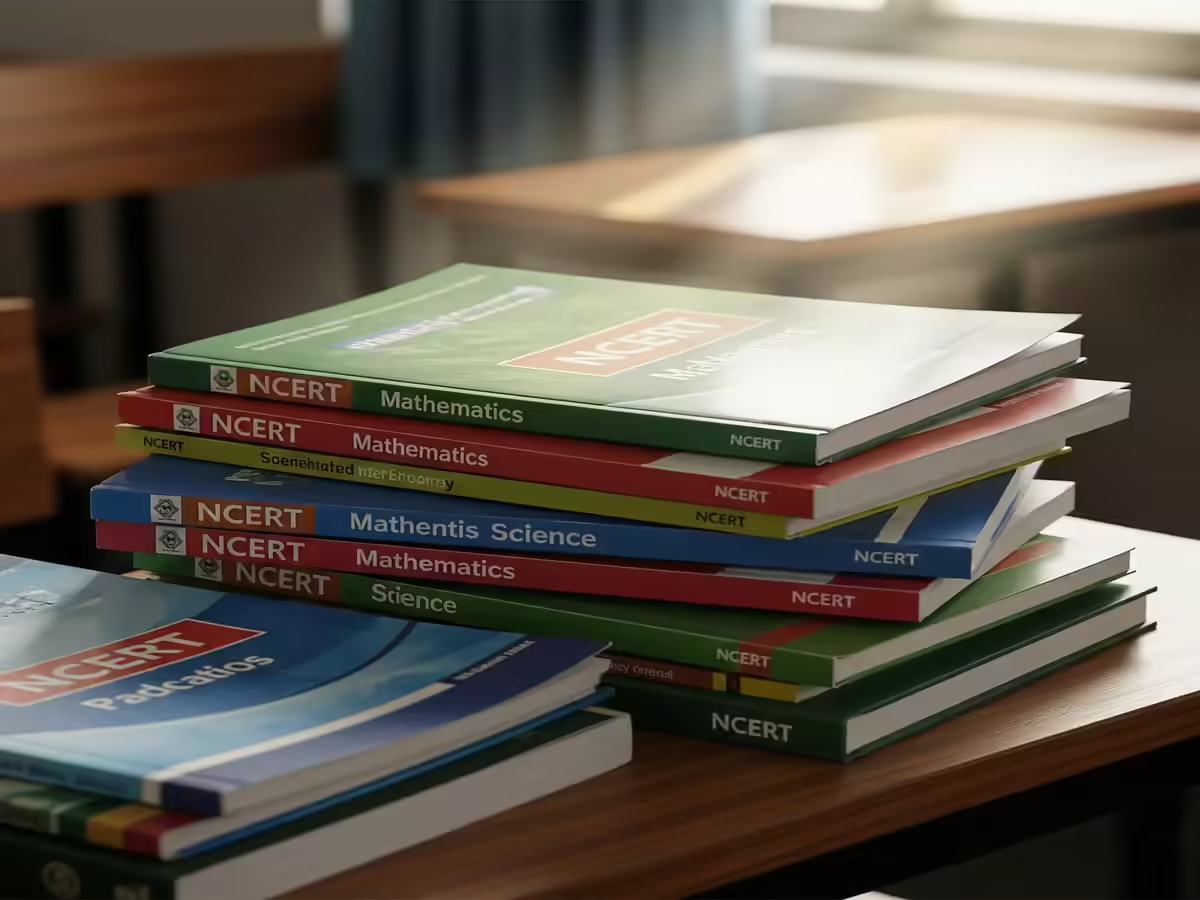
NEW DELHI: School textbooks shape how generations understand history, science, society and citizenship. In India, one of the most influential sources of school learning material is the National Council of Educational Research and Training (NCERT). Its textbooks are used by millions of students across Central Board of Secondary Education (CBSE) schools and are also widely adopted or adapted by several state boards.
But how exactly are these books written? Who decides what goes into them, who reviews them, and how are they finally approved for classrooms across the country?
The process is far more complex than a single author writing a textbook. Instead, it involves multiple committees, layers of academic review, consultations with experts and periodic revisions. Understanding this system is essential to grasp how educational knowledge is created and disseminated to millions of Indian students.
THE INSTITUTION BEHIND THE TEXTBOOKS
NCERT was established in 1961 as an autonomous organisation under the Ministry of Education, Government of India to improve the quality of school education. Its mandate includes curriculum development, teacher training, research and the preparation of textbooks for schools across the country.
NCERT textbooks are considered foundational learning materials because they align with national curriculum frameworks and are used by CBSE-affiliated schools as the primary course content. They are also frequently used by students preparing for competitive exams due to their structured and conceptual approach to subjects.
The development of these textbooks follows a systematic and consultative process involving educators, researchers and subject experts.
STEP 1: IDENTIFYING THE CURRICULUM AND SUBJECT REQUIREMENTS
Before any textbook is written, the academic framework guiding the content must be determined. This usually begins with the national curriculum, such as the National Curriculum Framework (NCF), which defines the educational goals, themes and competencies students should learn at different stages.
Based on this framework, NCERT identifies the subjects and topics that need to be covered in textbooks for each class. The goal is not simply to compile information but to present knowledge in a way that matches the cognitive level and learning needs of students.
The curriculum outlines key concepts, skills and values that textbooks must communicate. For instance, science textbooks aim to promote inquiry-based learning, while social sciences books emphasise constitutional values, democratic participation and historical understanding.
STEP 2: FORMATION OF CURRICULAR AREA GROUPS
Once the curriculum requirements are clear, NCERT forms Curricular Area Groups (CAGs) for each subject area.
A CAG consists of specialists with expertise in a particular field—such as historians for history textbooks, economists for economics textbooks or scientists for science textbooks. These groups are responsible for guiding the overall development of the textbook.
Their responsibilities include:
-
Identifying suitable authors and contributors
-
Ensuring alignment with the curriculum framework
-
Determining the scope and structure of the book
The selection of experts is based on academic qualifications, teaching experience and subject expertise. The aim is to bring together individuals who understand both academic research and classroom pedagogy.
In other words, the CAG acts as the intellectual backbone of the textbook development process.
STEP 3: CREATING THE TEXTBOOK DEVELOPMENT COMMITTEE (TDC)
After identifying experts through the CAG, NCERT forms a Textbook Development Committee (TDC) for each subject.
The TDC is responsible for writing the actual content of the textbook. Its members may include:
-
Academicians from universities
-
School teachers with classroom experience
-
Curriculum experts
-
Pedagogy specialists
-
Sometimes industry experts with domain knowledge
These committees ensure that textbooks combine academic accuracy with practical teaching methods. For example, a mathematics textbook must present formulas correctly but also explain them in a way students can easily grasp.
The diversity of contributors is meant to ensure that the textbook reflects both scholarly depth and classroom relevance.
In some cases, a single textbook may involve dozens of contributors. One recently withdrawn NCERT book reportedly had more than 60 contributors, highlighting the collaborative nature of textbook development.
STEP 4: DRAFTING THE CHAPTERS
Once the TDC is established, the process of drafting chapters begins.
-
Each member may write or contribute to specific sections depending on their expertise. For example:
-
A historian may write chapters on ancient India
-
A political scientist may draft sections on democracy
-
A teacher may develop exercises and classroom activities
The goal is to produce content that is not only accurate but also pedagogically effective. Textbooks typically include:
-
Concept explanations
-
Illustrations and diagrams
-
Case studies
-
Activities and exercises
-
Questions for assessment
During this phase, authors must ensure that the language is clear and accessible for students of the targeted age group.
The drafting stage is often iterative, with multiple versions of chapters being created before moving to the review phase.
STEP 5: MULTI-LEVEL INTERNAL REVIEW
After the chapters are drafted, they undergo a multi-level internal review process within NCERT.
Subject experts examine the material to check:
-
Accuracy of facts and data
-
Alignment with the curriculum
-
Clarity of explanations
-
Age-appropriateness of language
-
Editors also review the text for coherence, structure and readability.
This stage is crucial because textbooks are expected to provide reliable information to millions of students. Even minor factual errors or ambiguous explanations can affect learning outcomes.
NCERT officials describe this process as rigorous and consultative, involving repeated checks before the manuscript moves forward.
STEP 6: EXTERNAL CONSULTATIONS AND EXPERT FEEDBACK
In addition to internal reviews, NCERT sometimes consults external experts or institutions when required.
-
For example:
-
Industry specialists may be consulted for technical subjects
-
Government departments may provide data or policy perspectives
-
Academic peers may review specific chapters
These consultations help ensure that the content reflects the latest developments in knowledge and public policy.
However, such consultations are not mandatory for every textbook. They are typically used when specialised expertise is required.
STEP 7: FINAL ACADEMIC APPROVAL
Once the internal reviews and consultations are complete, the manuscript is sent back to the Curricular Area Group (CAG) for final evaluation.
At this stage, the CAG assesses whether the textbook:
-
Meets curriculum objectives
-
Maintains factual accuracy
-
Is suitable for the intended age group
After this, the manuscript is submitted to another important body—the National Syllabus and Teaching-Learning Material Committee (NSTC).
This committee gives the final academic approval for the textbook before publication. The evaluation considers both educational goals and national values embedded in the curriculum.
Only after clearing this stage can the book move toward printing and distribution.
STEP 8: PRINTING AND NATIONWIDE DISTRIBUTION
Once approved, the textbook enters the publication phase.
NCERT prints millions of copies each year through its publishing division and distributes them through:
-
Regional NCERT offers
-
Online portals
-
Bookstores and authorised vendors
The scale of this operation is massive because NCERT books are used by students across the country.
Many state boards also adopt or adapt NCERT textbooks as part of their own curriculum systems, increasing their reach even further.
PERIODIC REVISIONS AND UPDATES
Textbooks are not static documents. Over time, they are revised to reflect new knowledge, social developments and policy changes.
Whenever feedback or criticism arises regarding a textbook, NCERT may form review committees to reassess the material and recommend revisions.
In recent years, the Ministry of Education has also encouraged the council to review textbooks more frequently so that new editions reflect updated information before each academic session.
This system helps ensure that textbooks remain relevant in rapidly changing fields such as science and technology.
-
Controversies and accountability
-
Despite the elaborate process, textbook content occasionally becomes controversial.
For instance, courts, political groups or scholars may question certain passages or interpretations in social science textbooks. When such disputes arise, authorities may direct NCERT to revise or withdraw specific chapters.
Such incidents often trigger renewed debate about how textbooks are written and who should oversee their content.
While NCERT operates with academic autonomy, it remains accountable to the national education system and functions under the broader oversight of the Ministry of Education.
WHY THE PROCESS MATTERS
Textbooks are more than just academic resources—they shape how students understand their country, society and the world.
Because millions of children rely on them for foundational learning, ensuring accuracy and balance is essential. The multi-layered process involving committees, reviews and approvals aims to maintain high academic standards while making knowledge accessible to young learners.
The system is also designed to prevent any single individual or group from controlling textbook content. Instead, collaborative authorship and institutional review provide checks and balances.
THE FUTURE OF TEXTBOOK DEVELOPMENT
As education evolves, NCERT’s textbook development process is also likely to change.
Digital learning platforms, interactive content and artificial intelligence are gradually becoming part of the educational ecosystem. This may influence how textbooks are designed, reviewed and distributed in the coming years.
However, the core principles—academic rigor, expert consultation and multi-stage review—are likely to remain central to the process.
CONCLUSION
The journey of an NCERT textbook—from curriculum planning to classroom use—is a long and carefully structured process.
It involves multiple committees, subject experts, educators and reviewers working together to produce material that meets national educational standards. The goal is not just to transmit knowledge but to nurture critical thinking, curiosity and informed citizenship among students.
Understanding how these textbooks are created reveals the immense institutional effort behind the seemingly simple books that millions of students open every day in classrooms across India.