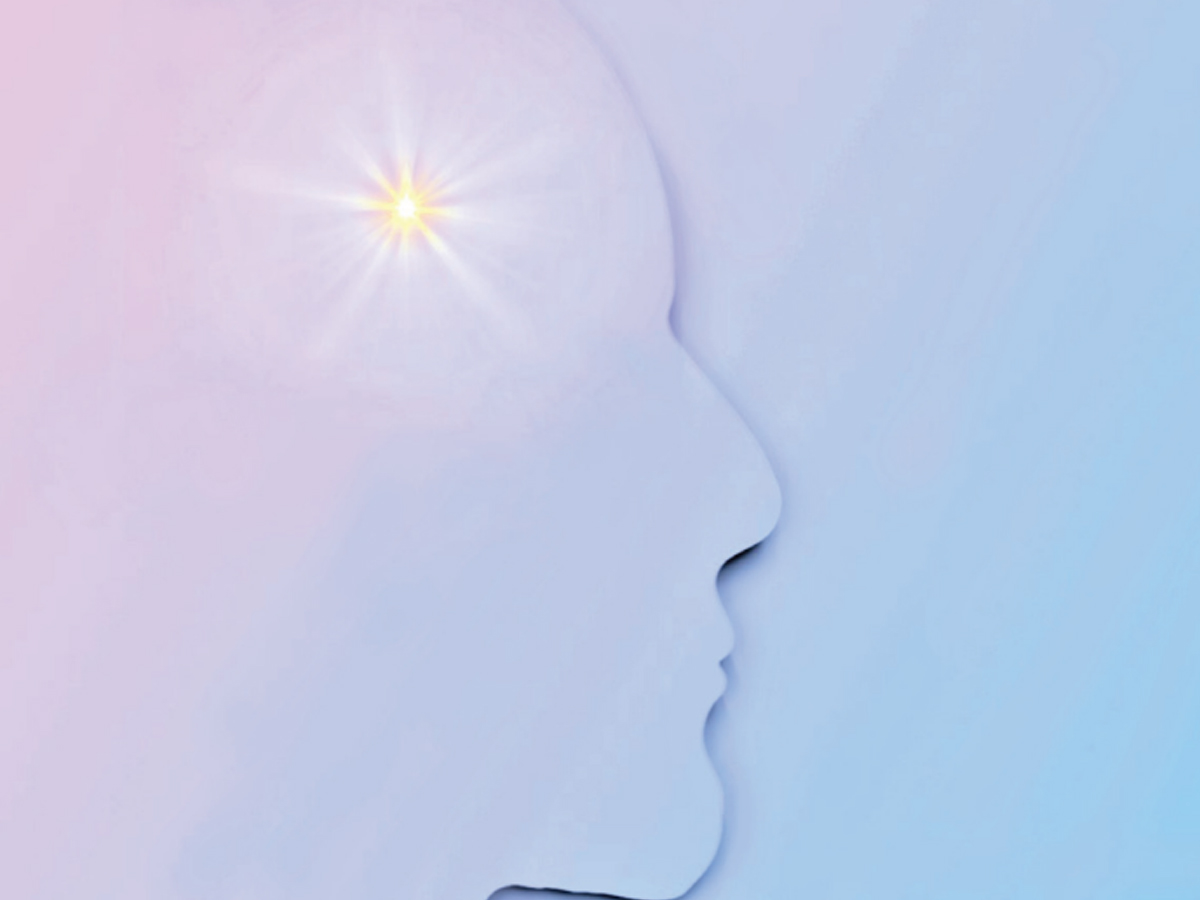
To reach the heights of peace, love and joy of which the human being is capable, it is said that we need to step back regularly into a state of “no self”, or pure being, beyond thought and feeling. The question “Who am I?” lies at the heart of most traditions of spiritual understanding and inquiry.
Some teachings emphasise that we find the deepest reality when we lose all sense of the self as an individual entity. This is based on the idea that our individuality (our “ego self”) emerges from the package of thoughts and feelings with which our brains become equipped to enable us to live as human beings. It enables us to engage with one another in distinctive ways while we play our parts on the stage of the world, but it is also the source of suffering, because it pins our sense of who we are and what we want into the physical dimension, which is constantly changing.
face appearances in our selfunderstanding, and engage with the core of our being. When the mind becomes still, unlimited love, peace, joy, and timeless wisdom are to be found. Those who experience this state – sometimes accidentally, sometimes through intense spiritual effort – find it liberating, and uplifting. It makes everyday worries shrink into insignificance.
Science at the frontiers is lending some support to this way of thinking. A new paradigm called post-materialism holds that consciousness is the primary reality, and that it is unitive: there is a mind-like quality behind everything we see manifesting in the physical world, from a particle to a galaxy. Our consciousness is not a “thing”; it is who we are, and we know this truth when we stop thinking of ourselves in limited ways. This idea also appeals to those who equate God with an omnipresent energy
We are certainly interconnected in much more complex ways than previously understood. For example, laboratory research has shown that the electromagnetic field generated by a person’s heart can be detected by animals nearby, and the nervous systems of other people. Some researchers believe the magnetic field of the earth itself connects all living systems, distributing biologically relevant information, including effects on human health and behaviour.
These ideas and discoveries point to reality being far more subtle than many of us realise. But do they mean that the “no self” concept is right? Or that God is omnipresent?
An aspect of Brahma Kumaris teachings that I have found particularly valuable is the notion of the self, or soul, as a unique and eternal entity.
According to these teachings, it is true that the egoistic sense of identity associated with our bodily existence is illusory, and the source of our suffering. But there is also an original and eternal self, offspring of a Supreme Being, who also has a unique part to play in the drama of existence.
The original self is pure consciousness, with none of the narrowness of outlook that creates our conflicts and sorrows. It is not just part of an amorphous field. It is individual, with its own unique part to play, perhaps spanning many births.
As it takes successive human births, it gradually changes. It begins with a purity of outlook that is experienced and expressed through fullness of heart and generosity of spirit. This is the condition of the deities – remembered vividly in Bharat as the occupants of a golden age. Over time, however, the soul loses sight of its divinity, and at that point the egoistic self takes over. Neediness develops, giving rise to the vices. The decline is progressive and despite the wisdom inherent in the great religions, it cannot be reversed until the end of the play approaches.
At that point, when corruption in our thoughts, feelings and behaviours reach a peak, the Supreme Soul – incorporeal Shiva – enters the drama to reintroduce us to what purity of consciousness feels like, explain how we lost it, and how it can be regained – essentially, through remembering that One.
Coming from a western background, this story seemed farfetched when I first heard it. Forty years on, however, having shifted from a “religious” belief in scientific materialism to an experience of God as my guide, I feel I do now know with certainty who I am, and am gradually recovering that true sense of self.
Neville Hodgkinson is a UK-based author and journalist, and a longtime student of Rajyoga.