If Mahamagham represented spiritual order, Mamankam embodied political tension within ethical boundaries. Held every twelve years at the same sacred geography, Mamankam was both a festival and a referendum on sovereignty. The Zamorin of Kozhikode presided, but his authority was continually contested by rival claimants, most famously through the Chaver tradition.
The Chavers’ attempts to assassinate the Zamorin were not acts of anarchy. They were ritualised challenges rooted in a belief that sovereignty must be periodically tested through sacrifice. The climactic Mamankam of 1755, with the daring assault by the teenage Putumanna Kandaru Menon, symbolised the last flicker of this ethical-political order. The subsequent Mysoryan invasions shattered the delicate balance that sustained Mamankam. Without sovereignty, ritual collapses. Without ritual, memory fades.
VALLUVANAD: A CRADLE OF KNOWLEDGE AND CULTURE
The region surrounding Thirunavaya—Valluvanad—was far more than a political unit. Nourished by the Bharathapuzha, it served as a knowledge corridor linking gurukulas, yajña-lands and artistic traditions. This was the land of Thunchaththu Ezhuthachan, whose Adhyatma Ramayanam shaped Kerala’s devotional imagination, and of Vellinezhi, the cradle of Kathakali and ritual performance. Kalari institutions trained both body and mind, while centres like Koodalloor functioned as proto-universities. The Mahamagham did not arise in a vacuum; it was the natural outcome of a region where education, spirituality and governance were seamlessly interwoven.
PARAYI PETTA PANTHIRUKULAM: A SOCIAL PHILOSOPHY IN NARRATIVE FORM
The legend of Parayi Petta Panthirukulam, rooted in this same river basin, offers an ethical counterpoint to Mamankam’s politics. Through the lives of twelve siblings raised across castes, professions and faiths, the narrative asserts a radical idea: divinity distributes talent without regard for social hierarchy.
In an era often caricatured as rigidly stratified, this legend reveals a more nuanced reality. Kerala’s civilisational memory preserved stories that subverted birth-based determinism long before modern reform movements articulated similar ideals. That this story culminates with the consecration of Vayillakunnilappan—the deity without a mouth—serves as a profound metaphor: ultimate truth often lies beyond speech and social labels.
COLONIAL DISRUPTION AND CIVILISATIONAL AMNESIA
The cessation of Mahamagham and Mamankam was not accidental. Large Hindu assemblies have historically been prime targets for disruptive forces precisely because they recharge collective consciousness. Colonial administrators understood this instinctively, as did earlier invaders. Fragment the ritual calendar, and the civilisation gradually loses its temporal compass. By the early nineteenth century, Thirunavaya’s temples lay neglected, its gurukulas silent, and its spiritual authority diminished. What survived did so as folklore and fragmented ritual, awaiting a moment of reassembly.
2026: RESTORATION, NOT REINVENTION
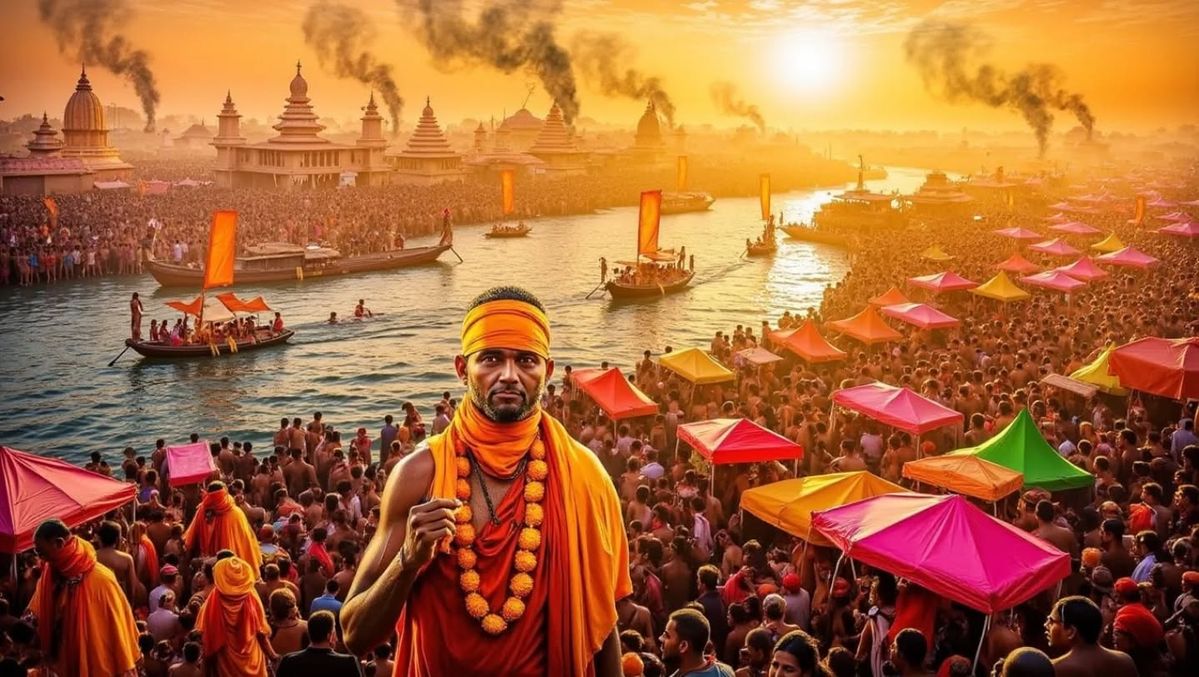
The proposed Kerala Kumbh Mela at Thirunavaya in January-February 2026 must be understood in this context. Led by the Juna Akhara and supported by Kerala’s sannyasa lineages, including Mata Amritanandamayi, it seeks to restore the Mahamagham’s spiritual grammar—rooted in Magha Masa, tirtha-snana, discourse and collective sadhana. It will mark a return after 271 years, reconnecting Kerala to a Pan-Indian sacred rhythm that was never truly lost, only paused.
WHY THIRUNAVAYA MATTERS TO BHARAT TODAY
In contemporary Bharat, discussions on civilisation often oscillate between nostalgia and nationalism. Thirunavaya offers a third path: institutional remembrance. It reminds us that Sanatana Dharma thrived not because it resisted change, but because it embedded change within cyclical frameworks. The revival of Mahamagham challenges modern society to reconsider forgotten questions: Can governance be ethically audited by spiritual authority? Can diversity coexist without fragmentation? Can festivals serve as instruments of civilisational continuity rather than mere celebration?
THE RIVER REMEMBERS
Rivers outlive regimes. They witness yajñas, coronations, invasions and silences, carrying memory even when humans forget. The Bharathapuzha has waited centuries for the return of its full ritual voice. As preparations unfold at Thirunavaya, one senses not invention, but recognition—as if the land itself is responding to a long-delayed call.
From Prayagraj to Thirunavaya, from Kumbh to Mamankam, the story is ultimately one of unbroken flow. Sanatana civilisation does not march in straight lines; it circles back, renews itself, and continues. And when it does, it reminds us that dharma, like a river, may be obstructed but it never forgets its course.
Shri Siddhartha Dave is an alumnus of United Nations University, Tokyo, an eminent columnist and a former Lok Sabha Research Fellow. He writes on Foreign Affairs and National Security.