Jaipur: In the Indian worldview, there are some festivals that are more of a dialogue than a celebration. Basant Panchami is one of them. This festival not only heralds the change of seasons but also questions our educational consciousness, cultural memory, and intellectual responsibility.
This day of Magh Shukla Panchami, when nature smiles in yellow, actually reminds us that knowledge is also a season in life—one that, if not brought on time, leaves society stunted. The yellow hue of mustard fields, the soft fragrance of mango blossoms, and the first note of the cuckoo—these are not merely natural scenes but symbols of the aesthetics of knowledge. Indian culture has established Goddess Saraswati among these symbols as the goddess of knowledge, who not only imparts information but also awakens wisdom.
SARASWATI NOT A GODDESS, BUT A VISION
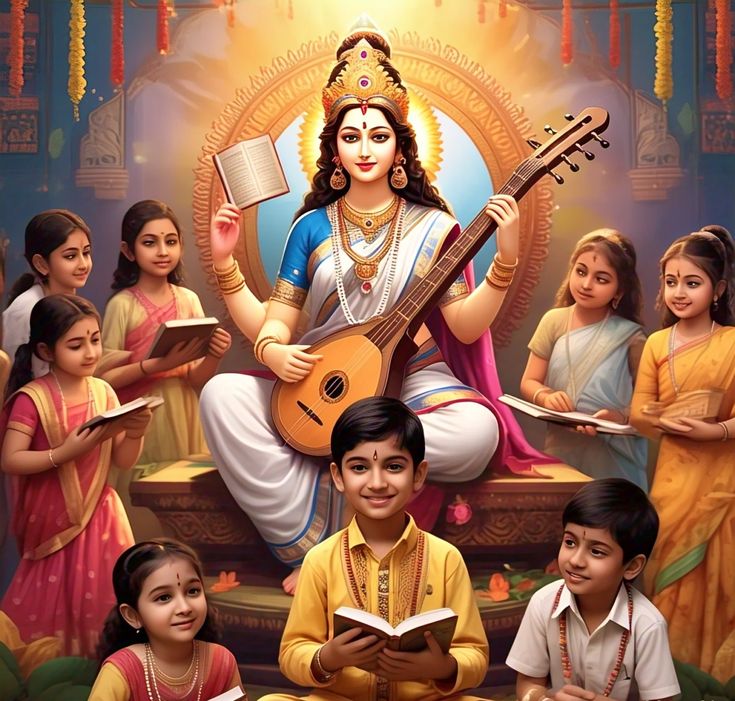
In Indian philosophy Goddess Saraswati is not merely a supernatural fantasy; She is an educational vision. The veena in her hands suggests that knowledge requires tone and balance. The book suggests that study is essential, but silence is equally important. The white robes teach that true knowledge purifies oneself, not imposes superiority on others.
It is no coincidence that knowledge and humility were not seen as separate entities in the Indian tradition. Where egoism increased, knowledge became a burden, and where humility prevailed, even ordinary education proved life-giving.
VIDYARAMBH: A SANSKAAR, A PLEDGE
Basant Panchami was once considered the day of the Vidyarambh Sanskaar. It was not merely a process of teaching a child the alphabet, but a moment to acknowledge that society was about to forge a new consciousness. Writing the first letter while sitting in front of the teacher was, in effect, an acknowledgment that knowledge is not acquired alone; it is linked to tradition, discipline, and conduct.
EDUCATION AT A CROSSROADS
The question today is unavoidable: have our educational institutions preserved this sacred tradition, or has learning been reduced to syllabi, examinations, and grades alone? Modern education has expanded rapidly; resources have multiplied, opportunities have widened, and technology has erased boundaries. Yet alongside this progress arises an uneasy concern: is education truly shaping us into better human beings?
We are producing skilled professionals with impressive abilities, but are we nurturing sensitive, responsible citizens as well? Is there space in our classrooms for moral courage, social compassion, and thoughtful wisdom? Basant Panchami confronts us with this reflection. It reminds us that the true worth of knowledge lies not in its utility or market value, but in its humanity, ethics, and capacity to uplift society as a whole.
TEACHERS, STUDENTS, AND SOCIETY
Basant Panchami is not just a festival for students; it is also a day of introspection for teachers. A teacher is not just a purveyor of curriculum, but an architect of society. Their single vision can shape the course of generations. For students, this festival is a reminder that education is not merely a means to score marks, but a process of self-understanding. And for society, it is a warning that if education is left solely to the market, culture will become hollow.
TRADITION OR RELEVANCE
We often dismiss festivals as mere traditions, overlooking their deeper relevance. But Basant Panchami is not a ritual bound by time; it is an inspiration that urges reflection on our priorities. If it is reduced to wearing yellow or performing formal worship, we betray its spirit. Its true essence lives in our education policies, intellectual outlook, and everyday social conduct.
THE SPRING OF CONSCIOUS LEARNING
When will the spring of knowledge truly arrive? It comes when learning gives us courage to question, space to disagree, and strength to defend truth. This is the living worship of Goddess Saraswati. Basant Panchami reminds us that education blossoms only when intellect is guided by sensitivity, culture, and character. Knowledge without values is information; knowledge with values becomes wisdom.
Today, let us resolve to shape education not merely as a ladder to personal success, but as the foundation for building a just society. In a society where knowledge is alive, seasons transform not only into festivals, but into awakened consciousness. This awakening is our offering.
The Author is an Educationalist.