
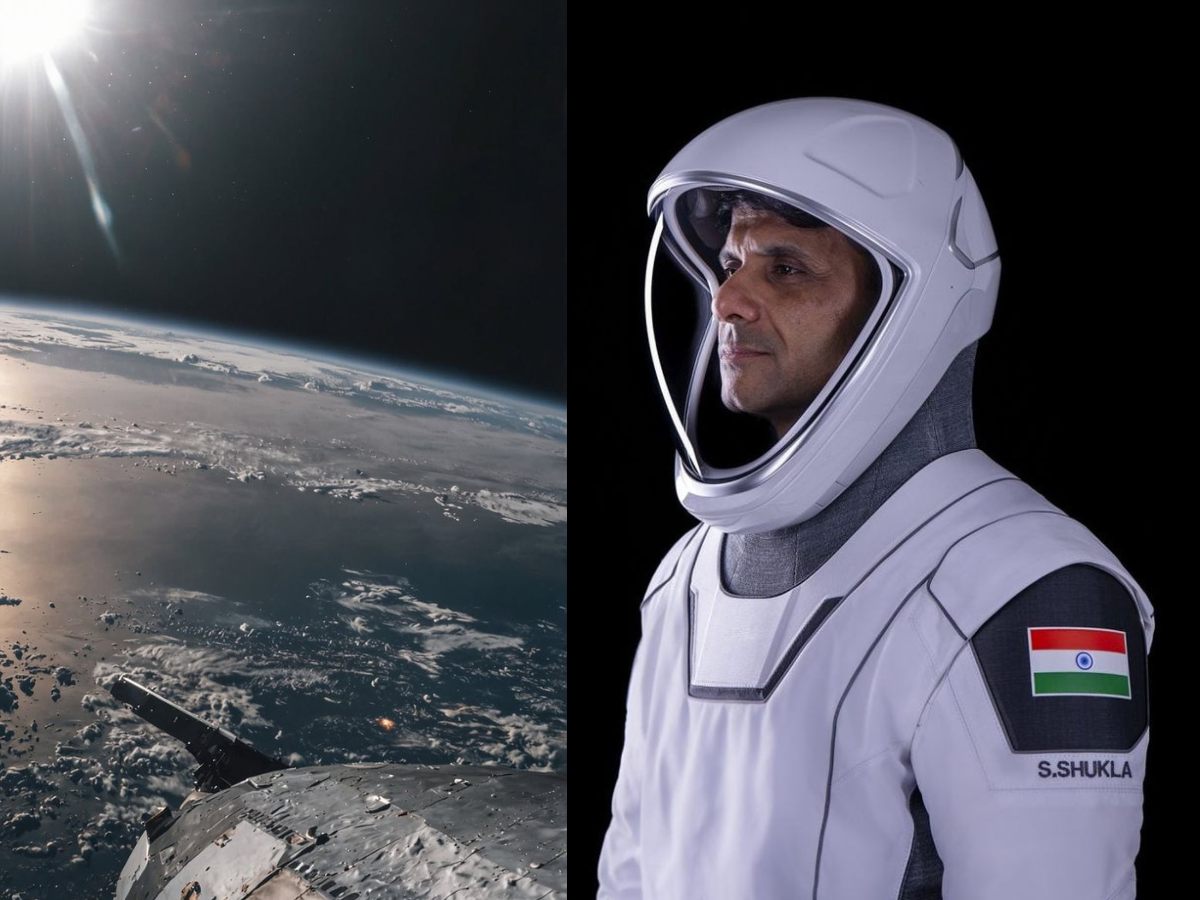
Indian astronaut Shubhanshu Shukla recently shared a captivating discovery from his 18-day Axiom-4 space mission an astronomical phenomenon named white nights. In contrast to the terrestrial white nights experienced in the polar regions during summer these white nights in orbit arise due to more complex orbital mechanics than planet tilt.
He laid out why the International Space Station (ISS) sometimes experiences exposure to sunlight for hours or even days on end in a post on X (formerly Twitter).
ALSO READ: What is the Scientific Name of Rice? Meaning, Origin & Importance
What is the Science of an Eternal Day?
For every 90 minutes the ISS takes to complete a single orbit around Earth and its crew members witness up to 16 sunrises and sunsets. The Continuous daylight depends on a lesser known very important parameter beta angle which is defined as the angle between the sun’s rays and the orbital plane of the station. When the beta angle nears zero, half of it remains in darkness for half of the orbit. As the beta angle nears 90°, the sun stays and the station gets lit up for 24 hours. He explained that in his case, the beta angle had crossed 60° most of the time with nearly constant daylight on the ISS.
What Engineering Challenges Brought by Continuous Sunlight?
There comes a huge engineering challenge with very high beta angles which make it difficult for the station to cool off, since there is no darkness in the orbit to radiate the accumulated heat. The one would rather postpone important maneuvers like docking and undocking to prevent a thermal overload.
Shukla mentioned that back in the day, during the Space Shuttle days, they employed a domestic Pubescent cooling technique called barbecue mode, where the spacecraft would rotate gently to even out solar heating of the spacecraft, but it would not work for the minute timing of ISS docking.
ALSO READ: Why is the Sky Blue: The Science Behind Nature’s Most Beautiful Illusion
How Training the Next Generation of Spacefarers?
This was not only a four-day extension for Shukla, but it also taught several lessons for India’s future Gaganyaan mission. The Future astronauts must understand how the beta angle affects mission planning, thermal management and structural integrity.
As Shukla concluded humbly, “I am not the one complaining.” This very calm observation emphasizes how the geometry governs even the aspect of sunlight in space.
What is Difference between Beta Angle & Barbecue Mode
The angle-beta is a geometric measure to quantify sunlight received by the spacecraft during its orbit higher angles meaning continuous exposure of the spacecraft. Barbecue mode is a thermal control maneuver whereby the spacecraft slowly rotates to dissipate heat evenly thereby preventing one face from getting too hot in case of extended sunlight.
ALSO READ: What Happens If Earth Stops Spinning? The Science Behind the Catastrophic Effects