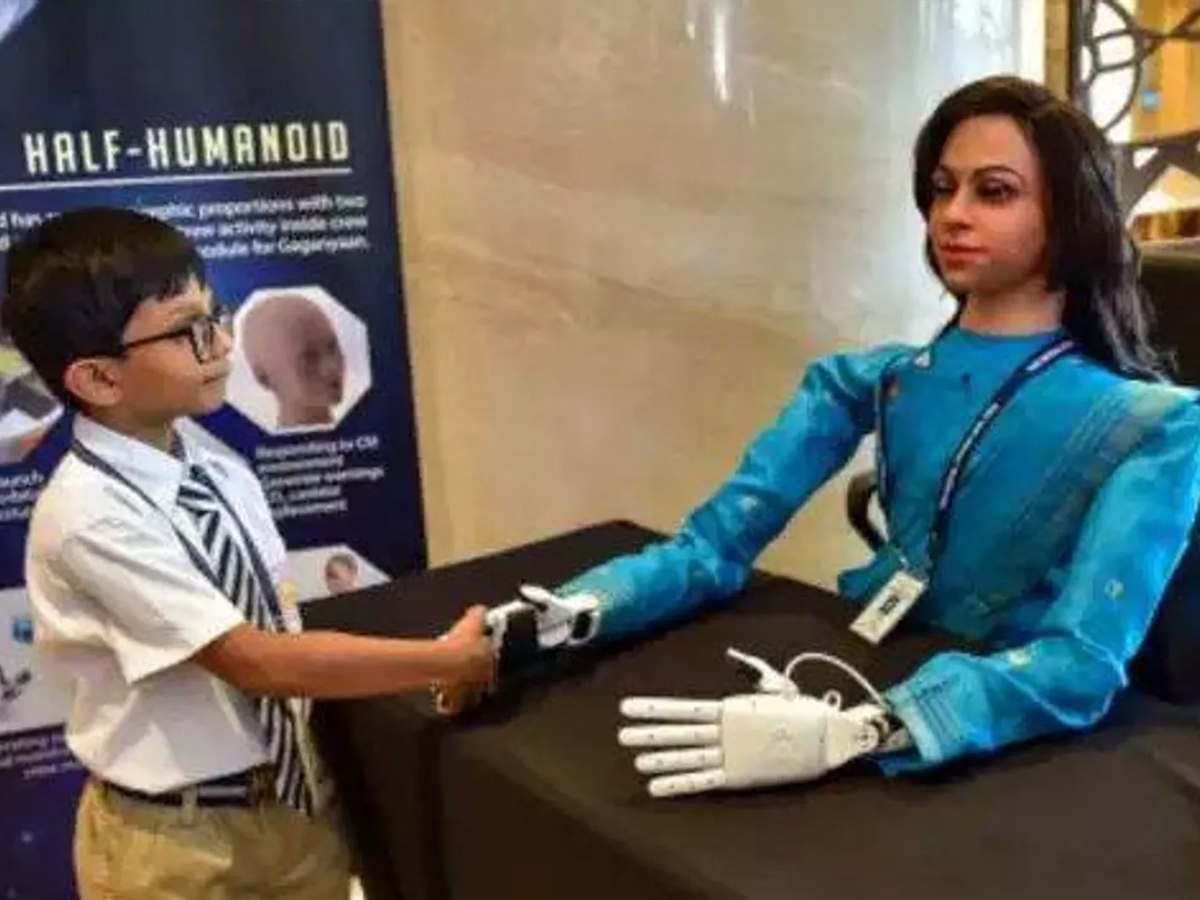
India is preparing for a historic human space mission, and ISRO is ready to launch Vyommitra, an AI-powered half-humanoid robot, as part of the Gaganyaan Spaceflight Mission. This uncrewed mission is a big step for India, putting it among countries like the US, Russia, and China that can send humans to space.
What Is Vyommitra?
Vyommitra means “space friend” in Sanskrit. It is a humanoid robot with a female appearance, built mostly from aluminium alloy to withstand pressure and vibrations in space. The robot will act as a scout, checking safety and other conditions before astronauts travel.
Space analyst Girish Linganna said, “The operational scope of this robot extends far beyond simple monitoring. The humanoid is designed to replicate human-like activities and functions in space, communicate seamlessly with the Life Support System, handle queries and six-panel operations, and convey alert messages in a matter of need time.”
Key Features of Vyommitra
Vyommitra is a half-humanoid because it has no legs but can bend forward and sideways. It can show facial expressions, speak in Hindi and English, and see its surroundings. Its skull weighs 800 grams and measures 200mm x 220mm.
The robot will check the spacecraft’s temperature, pressure, humidity, and carbon dioxide levels, and it will monitor life support systems and issue alerts if needed, making it a key safety validator before humans board the spacecraft.
Vyommitra Compared to Other Space Robots
Other countries have used humanoid robots in space. NASA sent Robonaut 2 to the International Space Station in 2011, which could perform simple tasks like replacing air filters. China has Xiao Hang and Taikobot to help astronauts with experiments on the Tiangong Space Station.
Unlike them, Vyommitra will focus mainly on pre-flight safety checks, ensuring the spacecraft is ready for humans.
ISRO’s Preparations
ISRO has done 7,700 ground tests and plans 2,300 more before March 2026. Safety systems, including nine parachutes and an escape system, are ready to ensure the spacecraft returns safely. The first uncrewed mission, Gaganyaan-G1, will launch in December, followed by two more uncrewed missions. India will send its first astronaut, called Gaganyatri, in early 2027.
Vyommitra will also study how materials and systems behave in microgravity. This will help with the human spaceflight mission and India’s future space station plans. ISRO’s careful approach focuses on safety and long-term success, rather than rushing, setting it apart from other nations.