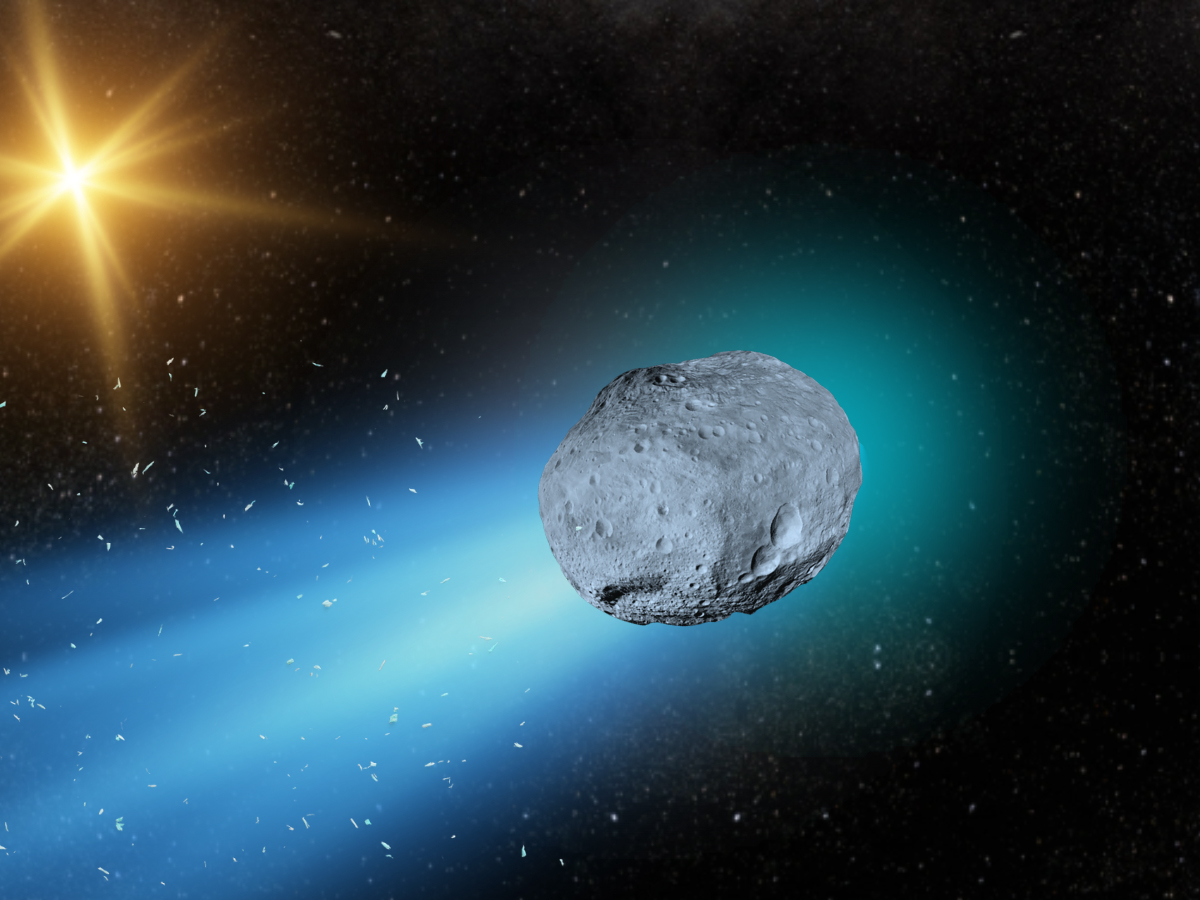
A mysterious object from beyond our Solar System is baffling scientists. Named 3I/ATLAS, it is the third confirmed interstellar visitor after ‘Oumuamua and 2I/Borisov. Unlike typical comets, this one is showing strange behavior, including a tail that points towards the Sun, not away from it.
The bizarre find is raising new questions about what 3I/ATLAS really is and how such an object behaves as it travels through space. Scientists are still studying whether it’s simply a comet from another star system or if there’s something truly unexpected behind its behavior.
Interstellar Origin Confirmed
Observations from NASA and the Minor Planet Center confirm that 3I/ATLAS came from outside our Solar System. Its speed of 57 kilometers per second and orbital eccentricity of about 6 prove that the Sun’s gravity cannot trap it.
Astronomers estimate the object’s nucleus size between 0.44 km and 5.6 km in diameter. Because it moves so fast and follows a hyperbolic path, it’s clear this object entered our Solar System from deep space.
Scientists across observatories worldwide are now tracking it closely, watching for even the slightest deviations in its path. Every movement matters, as even minor changes can reveal much about its origin and structure.
The Sun-Facing Tail Surprise
One of the biggest surprises so far is 3I/ATLAS’s sunward-pointing tail, known as an anti-tail. Normally, radiation from the Sun pushes dust and gas away, forming a tail that trails behind. But this object showed the opposite.
High-resolution telescope images captured this strange tail when the comet was about 4 astronomical units (AU) from the Sun. A scientific model suggests this may happen if CO₂ sublimation releases water-ice grains on the comet’s sunlit side. These grains scatter sunlight and create the illusion of a tail pointing toward the Sun.
As 3I/ATLAS moved closer, the ice grains vaporized faster, and larger dust particles began to dominate, turning the tail in the normal antisolar direction. This behavior, though odd, offers valuable insight into how solar radiation interacts with comet materials.
What the Tail Teaches Scientists
This transformation provides scientists with a rare window into the physics of comet activity. Each stage of 3I/ATLAS’s journey reveals how ice, gas, and dust behave under solar heating.
It doesn’t mean the comet is artificial — natural explanations fit well. But its unique evolution helps improve theoretical and computational models of cometary outgassing and dust behavior.
Studying how this interstellar object reacts to sunlight could also help us understand the early conditions of planetary systems in other galaxies.
Unusual Chemical Composition
Spectroscopic studies reveal that 3I/ATLAS contains an unusually high amount of carbon dioxide (CO₂) compared to water (H₂O) — one of the highest ratios seen in any comet so far.
It also shows high nickel content and lower iron concentration than typical comets. These characteristics don’t break any known laws of chemistry, but they’re rare enough to intrigue researchers.
Some teams, including one co-authored by astrophysicist Avi Loeb, have explored whether the comet’s behavior could be a technosignature — a possible sign of artificial origin. They stress that there’s no direct evidence for that idea. Still, they use it as a thought experiment to expand scientific discussion.
Most experts, however, believe 3I/ATLAS is a naturally occurring interstellar comet, with its peculiar composition reflecting its unique birthplace and journey through space.
Why Scientists Care
Whatever its true nature, 3I/ATLAS is a rare scientific opportunity. Because it comes from another star system, studying its materials and motion helps astronomers learn about how other planetary systems form.
Its strange dust dynamics, CO₂ dominance, and metal makeup reveal how interstellar chemistry might differ from what we see in our own Solar System. Each new observation adds data to improve our understanding of interstellar matter and comet evolution.
Looking Ahead: What Comes Next
As 3I/ATLAS moves toward its closest approach to the Sun (perihelion), scientists will keep observing how its tail and brightness evolve. They will monitor whether its path shows any unexplained accelerations, similar to the mysterious behavior once seen in ‘Oumuamua.
These studies could confirm existing comet models — or challenge them entirely. Either way, 3I/ATLAS is rewriting what we know about interstellar visitors and how icy bodies behave in deep space.
The Bigger Picture
3I/ATLAS may not be proof of alien technology, but it’s a clear reminder that space still holds mysteries beyond imagination. Whether it’s a natural comet shaped by cosmic forces or something far more complex, its journey through our Solar System gives humanity a rare chance to study the unknown — up close and in real time.
The truth, as scientists say, may be closer than we think.