
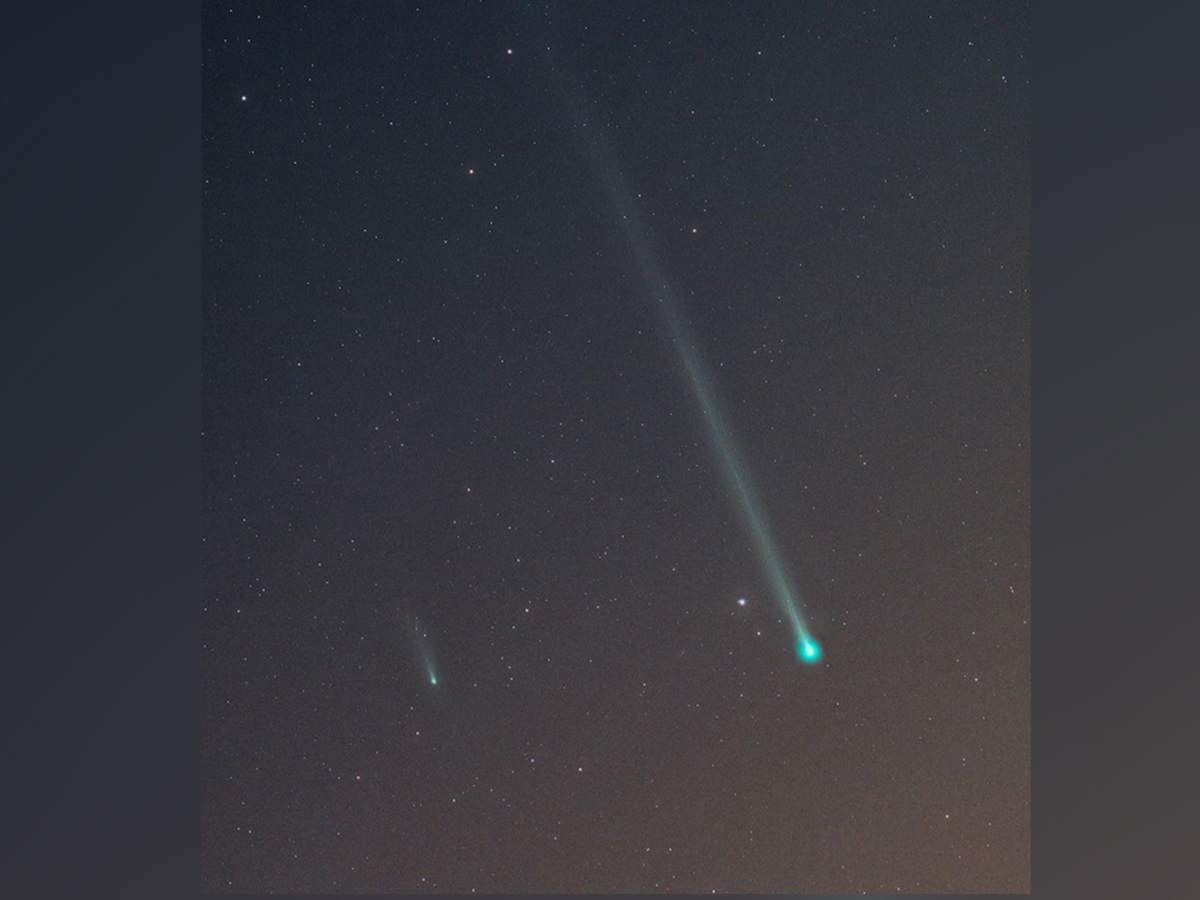
An astrophotographer on Reunion Island captured a stunning moment in the sky. Two comets — C/2025 K1 ATLAS and C/2025 R2 SWAN — looked like they were racing side-by-side. The amazing photo, shared on X, shows their glowing trails shining as they passed close to Earth.
One from Beyond, One from Our Sun
The special thing about this picture is the type of comets it shows. C/2025 K1 ATLAS is not from our solar system. It is an interstellar comet that came from far beyond the Sun’s pull. The other one, C/2025 R2 SWAN, belongs to the Sun’s family of comets. Even though they have very different origins, they looked like a pair from Earth’s view.
In the photo, ATLAS is on the left and SWAN is on the right. Both comets show a glowing coma and a bright tail lit by sunlight. This kind of side-by-side view is extremely rare because comets usually move in very different orbits. Their speed and paths depend on the Sun and planets, so seeing them appear together is almost impossible.
Why ATLAS is Special
Comet ATLAS follows a hyperbolic path, which means it comes from outside the solar system. For scientists, this is a rare chance to study material that formed around another star. Its journey gives clues about how comets form and change in other star systems.
Comet SWAN is very different from ATLAS. It is a regular visitor inside our solar system. The Solar Wind ANisotropies instrument first discovered it, and that is how it got the name SWAN. It follows a bound orbit around the Sun and belongs to the family of comets that often return after many years.
A Treat for Stargazers
This rare double-comet sight was not only exciting for astrophotographers but also for everyone who loves the night sky. Reunion Island’s dark skies gave the perfect view of this event. As ATLAS and SWAN continue their journeys, people around the world are encouraged to look up on clear nights.
These comets may appear for only a short time, but their glowing trails remind us how active and beautiful our universe is.
ALSO READ: Astronomers Capture First-Ever Photo of Baby Planet Growing Around Young Star