
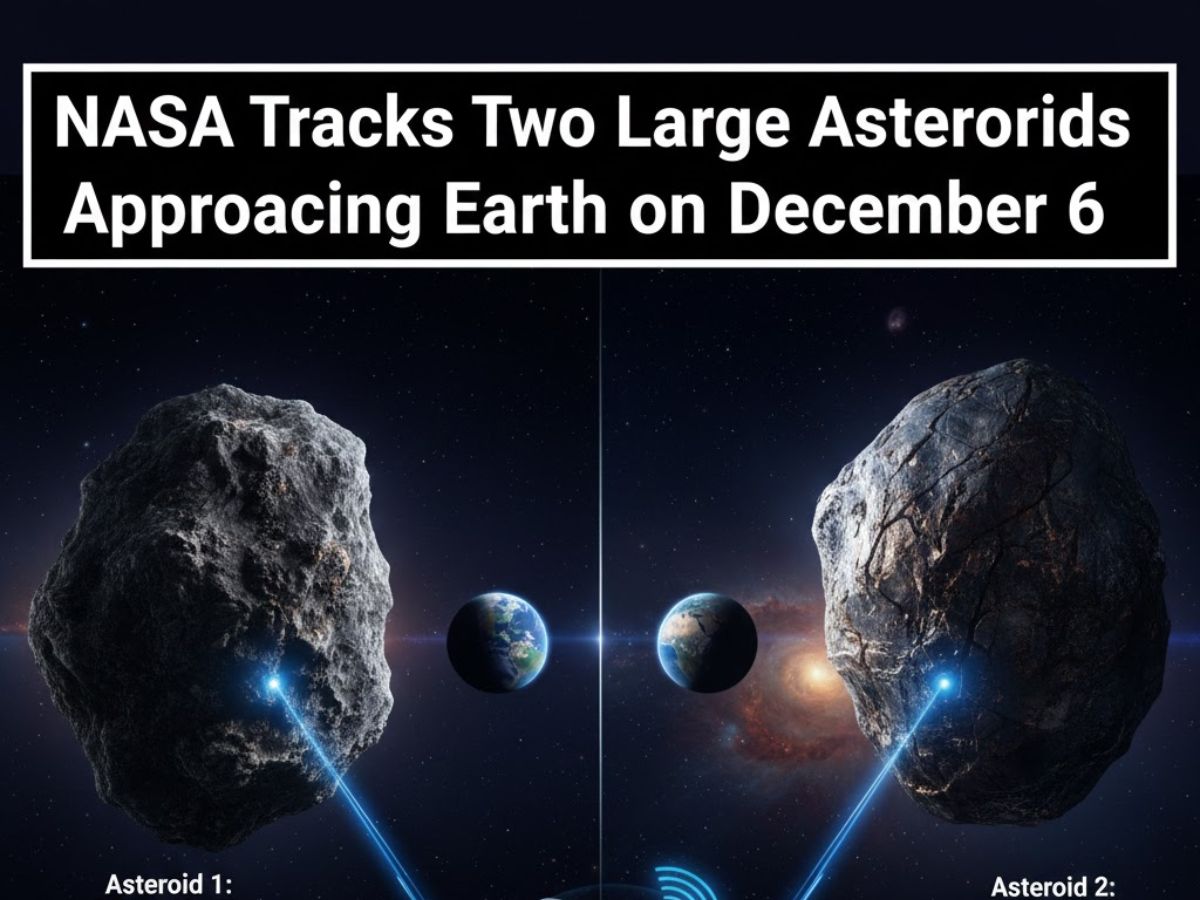
Space enthusiasts and astronomers are set for a notable celestial event today as two sizable asteroids make close approaches to Earth within hours of each other. NASA has confirmed the flybys of Asteroid 2025 WD5 and Asteroid 2025 WF10. While both are large and will pass relatively close by cosmic standards, the space agency assures there is no risk of impact.
What Are the Details of the First Asteroid?
The first visitor, Asteroid 2025 WD5, is the larger and faster of the pair. Classified as an airplane-sized object, it measures approximately 150 feet (about 46 meters) in diameter.
Key details of its approach:
- Speed: Traveling at a high velocity of 80,955 km/h.
- Closest Approach: It will make its nearest pass to Earth at 5:18 AM IST on December 6.
- Distance: It will come within 2.99 million kilometers of our planet—a close pass in astronomical terms that warrants careful monitoring.
What About the Second Asteroid?
Following a few hours later, Asteroid 2025 WF10 will make its approach. This space rock is slightly smaller but still substantial.
Its flyby parameters are:
- Size: Roughly 120 feet (about 37 meters) across.
- Speed: Moving at a comparatively slower 15,522 km/h.
- Closest Approach: Scheduled for 3:10 PM IST on December 6.
- Distance: It will pass at a farther distance of 7.01 million kilometers from Earth.
Should the Public Be Concerned?
NASA clearly says neither asteroid is a threat to Earth. They also don’t qualify as “Potentially Hazardous Objects” since that label applies only to objects over 140 meters that approach within 7.5 million kilometers.
These flybys are routine events in the dynamic environment of our solar system. NASA’s Planetary Defense Coordination Office, along with its network of ground-based telescopes and radar systems, continuously tracks such Near-Earth Objects (NEOs) long in advance. The close passes provide valuable observational opportunities rather than reasons for alarm.
Also Read: Who Are Greg & Dawn Williams? The Couple Behind MSU’s Record $401 Million Donation
Why Are These Flybys Significant for Science?
Though harmless, the two back-to-back asteroid flybys are important for science.They give astronomers a rare chance to:
Refine Trajectory Models: Scientists can enhance forecasting models for future asteroid orbits by tracking their precise trajectories.Study Physical Properties: Scientists can gather data on the asteroids’ size, rotation, and surface composition using radar and optical telescopes.
Test Tracking Capabilities: Such events serve as real-world tests for NASA’s global detection and tracking networks, crucial for planetary defense preparedness against any future object that might pose a genuine threat.
Your Questions Answered: Asteroid Flyby FAQs
Q: Can I see these asteroids from Earth?
A: No. Despite their close approach, they will be too distant and faint to be seen with the naked eye or standard binoculars. Professional telescopes will be used for observation.
Q: What does “close approach” mean in space terms?
A: In astronomy, a “close approach” is a relative term. While millions of kilometers sound vast, it is considered a close pass relative to the vast distances between planets. The Moon, for comparison, is only about 384,400 km away.
Q: How does NASA know they won’t hit Earth?
A: The orbits of asteroids are calculated years or decades in advance by NASA’s NEO observation program. 2025 WD5 and WF10 will pass by safely because their trajectories are known with extreme precision.
Q: What is a “Potentially Hazardous Asteroid”?
A: It is a formal classification for asteroids larger than 140 meters that can come within 7.5 million km of Earth’s orbit. Neither of today’s visitors meets both size and distance criteria.
Q: How often do asteroids of this size come this close?
A: Objects of this size pass within similar distances several times a year. Their simultaneous close approach on the same day is what makes this event somewhat uncommon and notable.