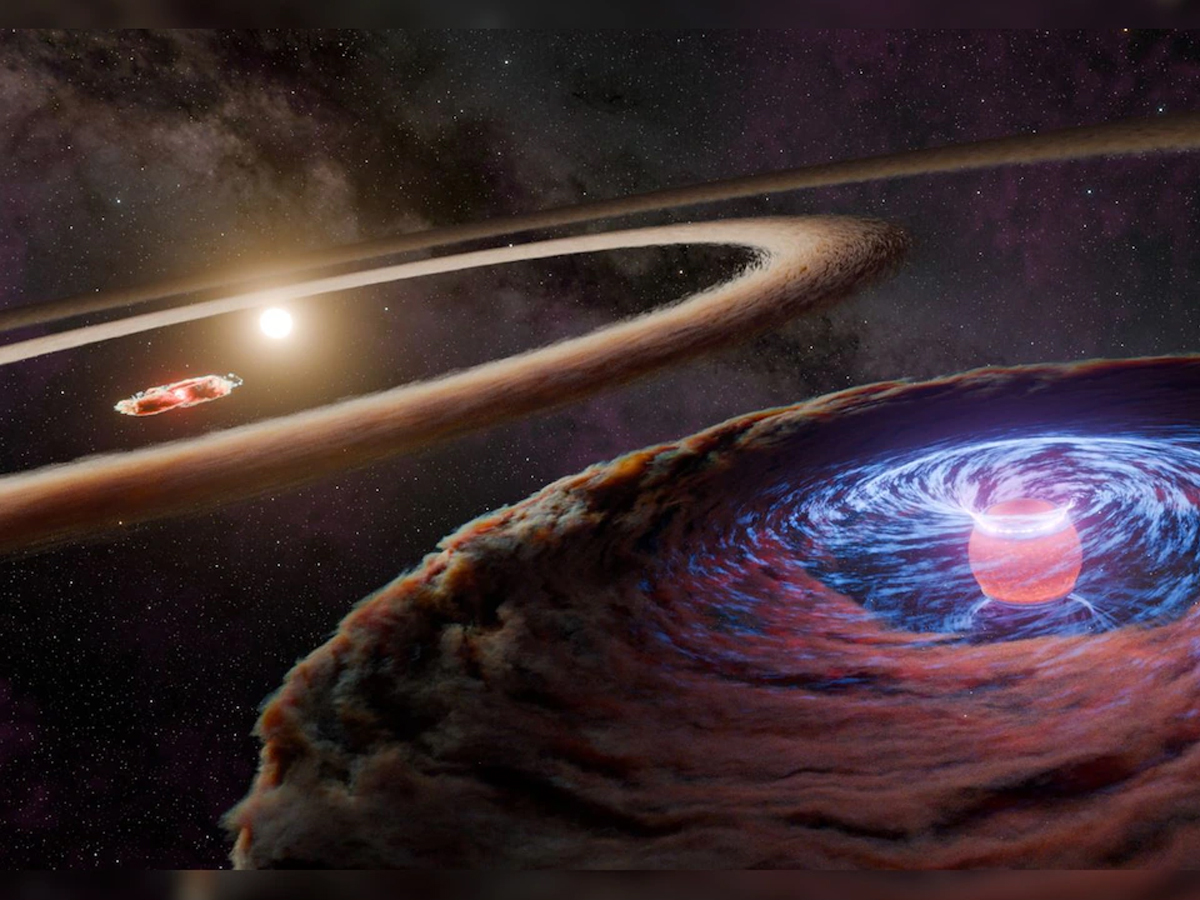
Astronomers have made a breakthrough in observing planet formation. They directly imaged WISPIT 2b, a gas giant still forming inside a gap in a protoplanetary disk. This marks the first time a planet has been confirmed inside one of those suspected gaps.
The Discovery and Its Significance
The newly spotted planet is WISPIT 2b, orbiting a young star named WISPIT 2. The system lies about 437 light-years from Earth. WISPIT 2b is massive, about five times the mass of Jupiter. Yet it is extremely young, only around 5 million years old.
Protoplanetary disks are made of gas and dust surrounding newborn stars. They often show dark rings or gaps. Scientists have long suspected that these gaps are carved by planets in formation. But until now, no planet had ever been directly seen inside such a gap.
The imaging was done using powerful telescopes and instruments. Astronomers first observed the disk with the Very Large Telescope (VLT) in Chile.
Then, they used MagAO-X, an advanced adaptive optics instrument on the Magellan Clay Telescope, to capture WISPIT 2b in Hydrogen-alpha light — a telltale signal of active planet formation.
Infrared observations from the Large Binocular Telescope added more detail. In addition, the team detected a second candidate planet closer to the star inside another gap. This hints that the WISPIT 2 system might host multiple forming planets.
How the Planet Was Seen in a Gap
WISPIT 2’s disk shows multiple rings and gaps. Researchers targeted one of the gaps where theory predicted a planet could be. In April 2025, they captured H-alpha emission from WISPIT 2b. That emission comes from hydrogen gas falling onto the forming planet — a clear sign of active growth.
They measured its position: about 309.4 milliarcseconds from the star, corresponding to ~54 astronomical units (AU) in deprojected distance. The planet’s mass estimate, based on models, is about 5.3 Jupiter masses.
This detection is supported by the match between the width of the disk gap and the planet’s gravitational influence, as predicted by hydrodynamic models. Because WISPIT 2b lies inside a disk gap and shows signs of accretion, it gives direct evidence that planets can carve out these gaps as they grow.
Implications for Planet Formation Theory
This is more than a rare photograph — it is a proof point for theories of planet formation. The fact that a planet is directly detected in a disk gap validates the idea that gaps are real signs of forming planets.
The WISPIT 2 system now becomes a laboratory for studying how planets interact with their disks: how they draw in gas, how they migrate, and how gaps evolve.
The presence of a second candidate planet also suggests that complex planetary systems may emerge even in these early stages. With this observation, astronomers move closer to understanding how systems like our own solar system began. It’s possible that Jupiter and Saturn formed in similar gaps billions of years ago.