
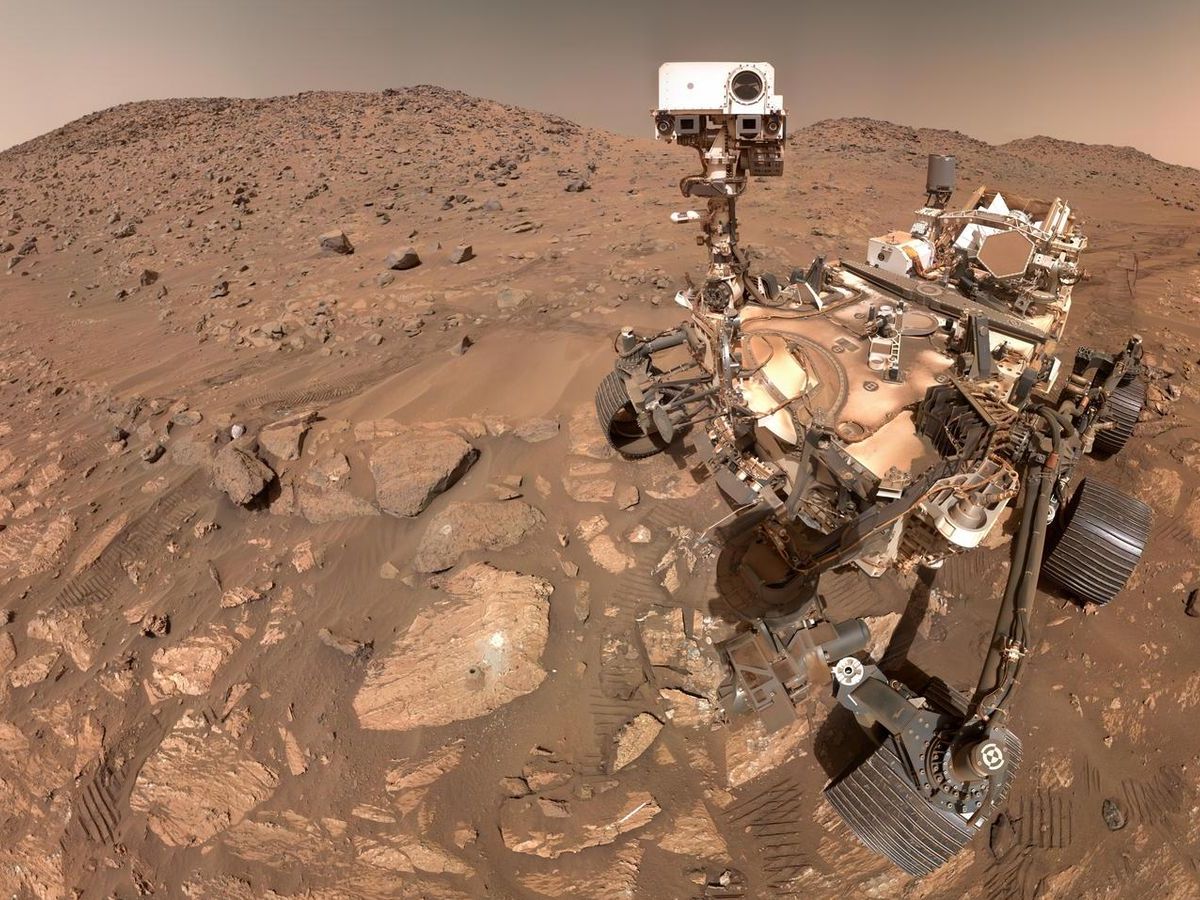
NASA scientists revealed that strange “leopard markings” on a Martian rock might have been formed by ancient life, a finding that might completely reinterpret our place in the cosmos. Published in the esteemed journal Nature, the discovery is hailed as the most promising possible proof of extinct life on Mars ever discovered, but scientists warn that further investigation is required before drawing any firm conclusions.
What Did the Rover Actually Find?
The focus of the excitement is a rock sample named “Sapphire Canyon.” In July 2024, the Perseverance rover drilled it from a location known as Cheyava Falls, which is situated on the outskirts of the historic Neretva Vallis river basin.
This site was chosen because billions of years ago, water flowed through this region into Jezero Crater, making it a prime candidate for preserving signs of ancient life. The rock immediately caught scientists’ attention due to its bizarre black markings, which they nicknamed “poppy seeds” and “leopard spots.”
Why Are These “Leopard Spots” So Special?
After a year of intense review, the science team could not find a definitive non-biological explanation for the markings. Acting NASA Administrator Sean Duffy called the finding “incredibly exciting.”
“This very well could be the clearest sign of life that we’ve ever found on Mars,” Duffy stated.
The rover’s sophisticated SHERLOC instrument detected organic molecules within the rock. Such molecules are thought to be the basic components of life on Earth. An examination of the stone’s writing reveals a history:
- White mineral veins showed that water once flowed through the rock’s cracks.
- The presence of iron, phosphate, and hematite—minerals known to support microbial activity on Earth.
- A geological story that began as mud mixed with organic material, which later hardened. Water seepage then left veins and potentially triggered chemical reactions that created the leopard spots and possibly even an energy source for microbes.
Is This Definitive Proof of Life on Mars?
Not yet. Scientists are careful to use the term “potential biosignature.” A biosignature is something that may point to past life but requires extensive confirmation.
Katie Stack Morgan, Perseverance project scientist at NASA’s Jet Propulsion Laboratory, emphasized the significance while acknowledging the need for more work. “It represents years of dedication and collaboration between over 1,000 scientists and engineers worldwide,” she said.
Lead study author Joel Hurowitz from Stony Brook University noted that the long peer-review process and new data collection were crucial steps before making this cautious announcement.
Also Read: Meet 2025 PN7: Earth’s New Celestial Companion, Orbiting Alongside Us for Over 60 Years
The Challenge of Bringing Samples Home
The most important next step is to return the Sapphire Canyon sample and others to Earth for analysis in state-of-the-art labs that are significantly more capable than the rover’s onboard instruments.
However, this mission faces a significant hurdle: budget uncertainty. NASA is confronting proposed budget cuts from the White House that would slash nearly half of the agency’s science budget. Officials are now urgently studying how to return these priceless samples in a cost-effective way.
The discovery advances humanity’s understanding of a significant question in spite of the difficulties. As Nicky Fox, NASA’s Science Mission Director, put it, this finding helps us ask, “Are we truly alone in the universe?”