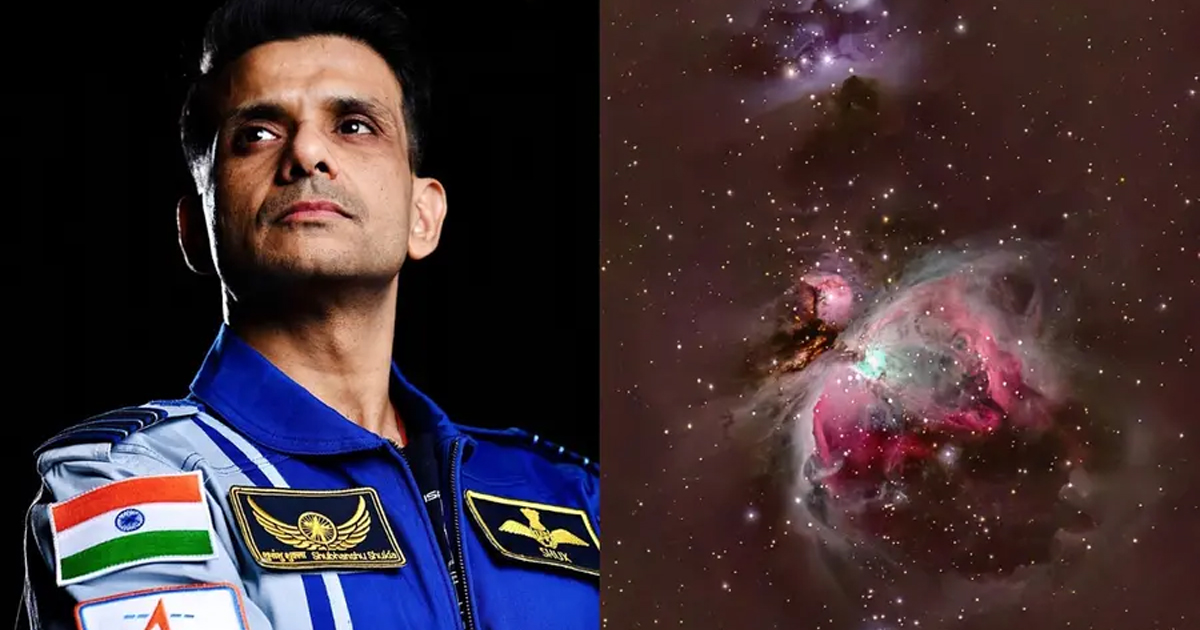
Indian spaceflight astronaut Shubhanshu Shukla, who returned from Earth last month after a successful stint on the Axiom-4 mission on the International Space Station (ISS), has posted breathtaking astrophotography shots of the Orion Nebula taken from the roof of his Bengaluru apartment. Shukla, or “Shux” as he is also known, was the first Indian to travel to the ISS — a tremendous milestone in India’s human spaceflight project under the Gaganyaan initiative.
In a sentimental social media update posted both on Instagram and X, Shukla explained the reason why the pictures, the official photographs taken aboard the ISS, have not been released because of an obligatory verification process where several international space agencies get involved.
“The photos taken on the station are some days behind being received, checked, and cleared due to the various space agencies involved. While I wait for these, I wanted to post an astrophotography story,” he added.
Shukla, who commanded the SpaceX Dragon vehicle ‘Grace’ on its way back from the ISS, posted a series of images of the Orion Nebula (M42), a favourite interstellar object cataloged by French astronomer Charles Messier.
“I started into astrophotography upon returning to India after my first leg of training at GCTC, Russia. The pictures in sequence are of the same interstellar object M42 (M stands for Messier – Name of the catalogue that maintains all night sky objects), also known as the Orion Nebula,” he wrote.
The photographs clicked on the station take some time to received, verified and cleared because of the multiple space agencies involved. While I wait for them I wanted to share an astrophotography story.
I started into astrophotography upon returning to India after my first leg… pic.twitter.com/SF6DMoiPHT
— Shubhanshu Shukla (@gagan_shux) July 24, 2025
He emphasized the gradual improvement in the image quality over time, showcasing his passion for astrophotography and self-learning.
“Over time, we improved, which is clear from the last picture. All the photographs were taken from the Bengaluru night sky. Slow or fast, if you move, progress is a certainty,” he added.
Shukla’s Return: Getting Used to Earth After Microgravity
Shukla recently appeared in a video showcasing the physical rehab process astronauts go through after long-duration spaceflights. The video captured him gradually regaining balance, walking with evident struggle, a peek into the biological adaptation after microgravity exposure.
While debriefing on his mission, Shukla clarified, “The body goes through several changes in space, ranging from fluid shifts and heart rate changes to muscle loss and balance problems, all as a means of adjusting to the weightless environment on the ISS.”
He added that when the astronauts come back to Earth, these adaptations reverse, necessitating a complicated recalibration of the neurological and physiological systems.
A New Chapter for India’s Gaganyaan Mission
Shukla’s flight into space has been a significant milestone in ISRO’s Gaganyaan mission, under which Indian astronauts are to be sent to low-Earth orbit on native capabilities. The first crewless test flight of Gaganyaan is projected by the end of 2025, while the first crewed mission is planned in 2027.
As India gets ready for this new era of human space exploration, Shubhanshu Shukla’s mission and people engagement still inspire a next generation of space scientists and enthusiasts.