
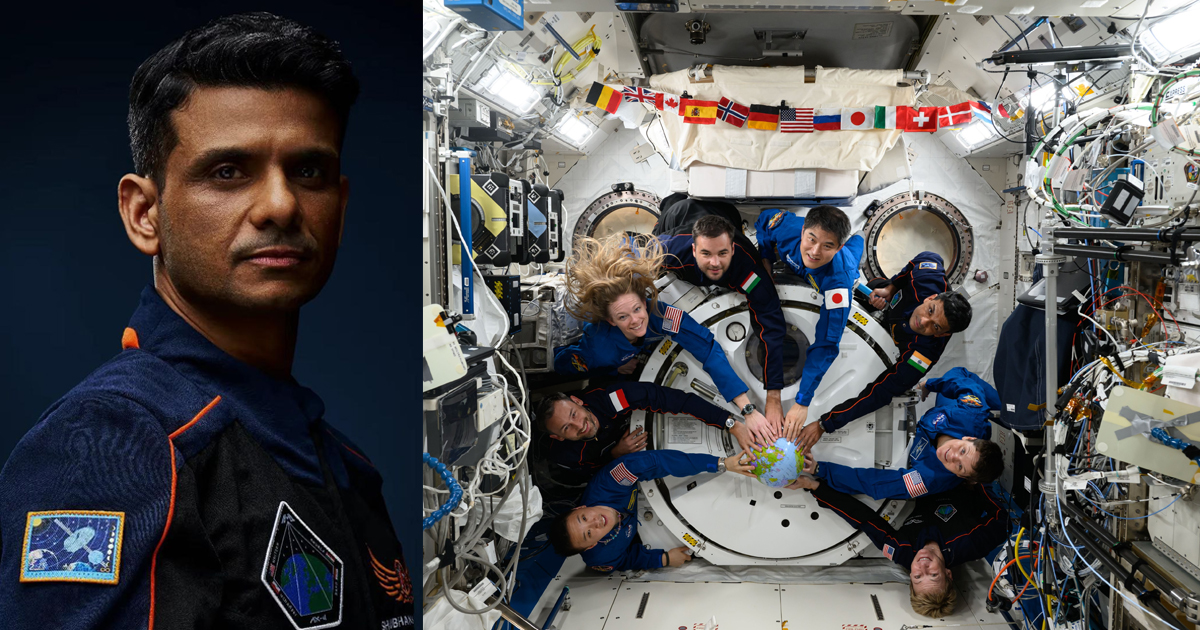
Indian Air Force pilot Group Captain Shubhanshu Shukla, who became the country’s first astronaut on the International Space Station (ISS), returned to Earth safely on Tuesday. SpaceX Crew Capsule Grace, in which he flew along with three astronauts from international space agencies, splashed down off the coast of San Diego, California, just after 3 PM IST.
Shukla is the second Indian, after Wing Commander Rakesh Sharma in 1984, to have ventured into space. He is, however, the first Indian to reside and work on the $150-billion ISS, a symbol of state-of-the-art international space cooperation.
Prime Minister Narendra Modi welcomed Shukla upon his return from space and wrote on X, “I welcome the nation along with Group Captain Shubhanshu Shukla as he lands on Earth after his record-breaking mission to Space. As India’s first space traveller to have set foot on the International Space Station, he has generated a billion dreams through his hard work, grit, and spirit of innovation. It is another milestone on our path to our own Human Space Flight Mission – Gaganyaan.”
The mission was part of Axiom Mission 4 (Ax-4), a commercial space mission organized by Axiom Space in collaboration with NASA and ISRO. India had allegedly paid about $70 million for Shukla’s seat on the mission. As Axiom Space puts it,
“About 433 hours, 18 days, and 288 Earth orbits and almost 12.2 million kilometres since docking with the International Space Station, the Ax-4 crew is now officially homeward bound.”
The journey back to Earth lasted about 22.5 hours. In addition to Shukla, the team consisted of American astronaut Commander Peggy Whitson, Polish Mission Specialist Slawosz Uznanski-Wisniewski, and Hungarian Mission Specialist Tibor Kapu.
A New Era in Global and Indian Space Exploration
The mission was a historic milestone not only for India but for Poland and Hungary, whose astronauts also resided and worked aboard the ISS for the first time in more than four decades. Axiom Space labeled the mission as a “historic milestone” that extended global involvement in space exploration.
For India, Shukla’s mission underlines the nation’s goals in space diplomacy and science. While on board the ISS, he performed seven India-centric microgravity experiments aimed at developing greater insights into long-duration spaceflight and planetary missions.
Shukla’s mission success puts India solidly in the league of countries operating active astronaut programs and proves it is ready for the coming Gaganyaan human spaceflight mission.
Next Steps: Recovery and Rehabilitation
Upon return from microgravity, Shukla will have medical rehabilitation for approximately one week to assist his body in readapting to Earth’s gravity. His mission, though, has already had a lasting legacy—inspiring a generation of future Indian scientists, engineers, and explorers.
This homecoming from space is not merely a splashdown—it’s the beginning of a new chapter in India’s space mission.