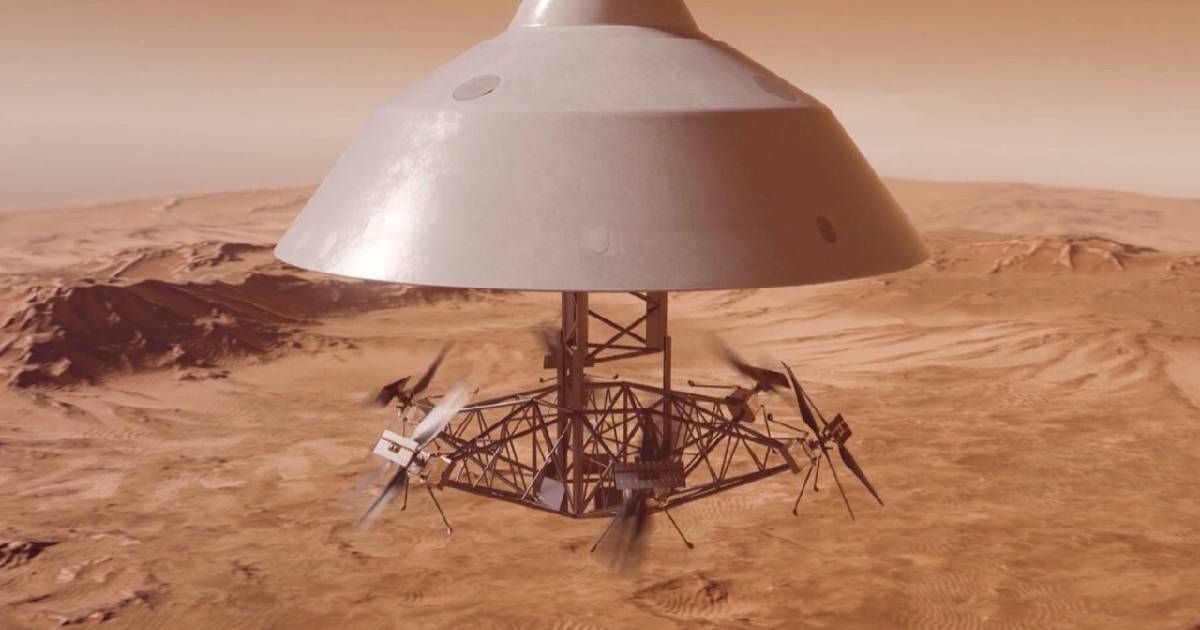
NASA is set to send a bold new Mars mission, Skyfall. The project consists of sending six sophisticated helicopters to aid in landing site reconnaissance, resource mapping, and future robot and human mission planning. Skyfall will be a new frontier in Martian exploration following the success of the Ingenuity helicopter. The aerial scouts will assist NASA in finding safe landing sites, detecting water ice, and leading America’s first astronauts on the Red Planet.
NASA’s Jet Propulsion Laboratory (JPL) developed Ingenuity as a technology demonstrator. Ingenuity was the first plane to make powered flight on another world. It was one success, and it altered how scientists approach exploring Mars.
Now, NASA is pushing the concept much more strongly. The new mission, Skyfall, will send out six helicopters rather than one. The aircraft will operate together. They will travel further, react quicker, and provide high-definition data in real time.
Mission Goals: Landing Zones and Resources
Skyfall helicopters will survey remote, isolated areas of Mars. These regions are considered too hazardous for rovers. The fleet will examine safe landing sites for landers and astronauts from an altitude. They will also scan for vital resources, including water ice.
The helicopters will provide mission teams with more insight by sending real-time imagery and data. This reduces the risks and makes appropriate planning and expeditious decision-making possible.
Improving Future Exploration
Helicopters will not substitute for rovers or orbiters. They will augment them. Rovers are slow and cover a small area. Helicopters can fly fast and cover larger expanses of ground. Orbiters, while helpful, do not have the resolution and responsiveness required for close-up surface activity.
Coupled with this tiered strategy, helicopters, rovers, and orbiters, scientists will have a complete understanding of Mars.
Preparing Mars for Human Footsteps
Skyfall is more than a routine robotics mission. It’s a component of NASA’s long-term strategy to send astronauts to Mars. The helicopters will test technologies that are vital for surface mobility and aerial logistics. They will assist in identifying locations suitable for habitats. They will assist in coming up with improved support systems for astronauts.
Despite being at the conceptual stage, Skyfall has promised to see humans on their way to walking on Mars.
Skyfall is a giant leap forward for planetary exploration. With six smart, flexible helicopters, NASA is poised to open doors. Success will make the fleet an earth-shaking force for exploring other worlds—and allow us to finally put foot on one.