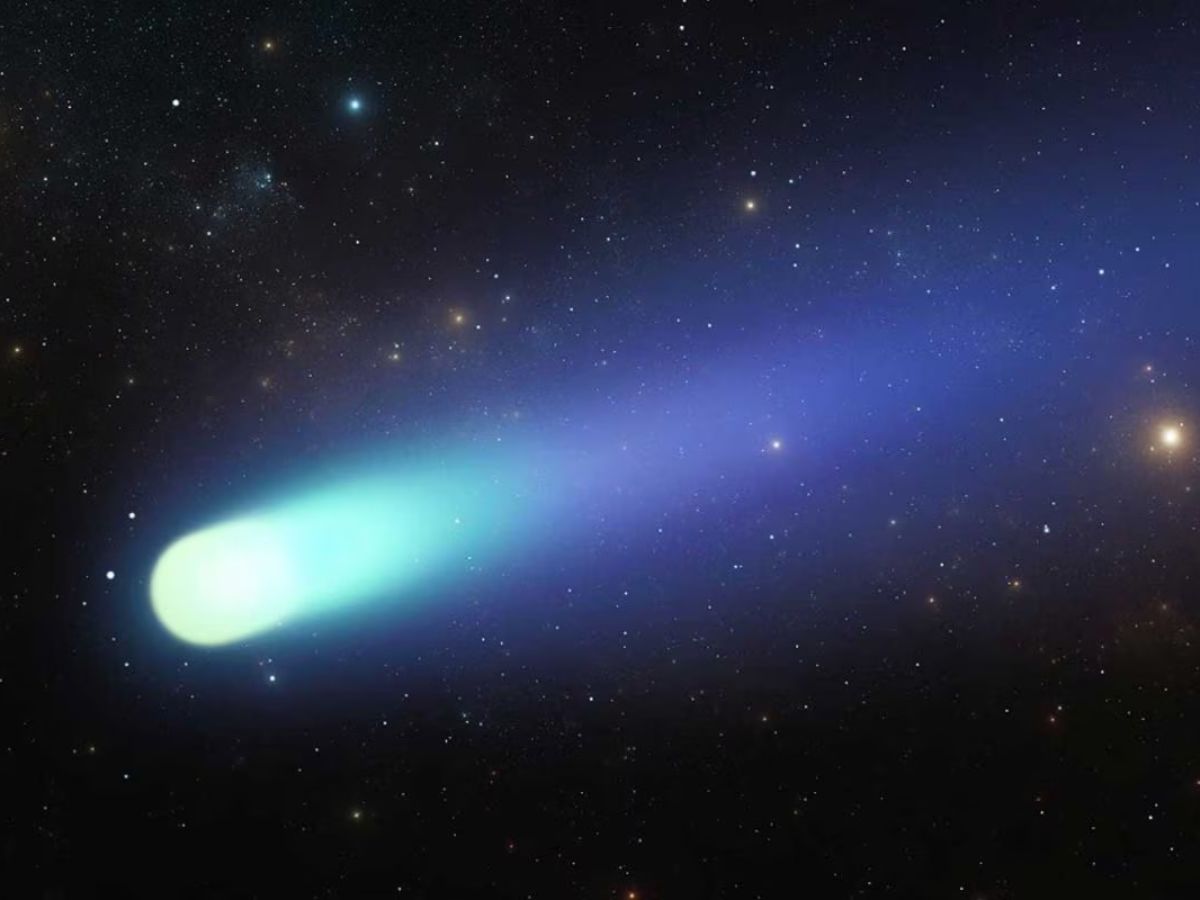
NASA has discovered an extraordinary, mysterious object: a comet named 3I/ATLAS racing towards our solar system at a record-breaking speed. It is observed to be the fastest interstellar object ever recorded.
It was first detected on July 1. It caught the attention of scientists due to its incredible speed of 130,000 miles per hour (approx: 209,000 km/hr). The speed overtakes previous interstellar visitors like ‘Oumuamua’ and ‘Borisov’.
NASA scientists believe that the high velocity could be due to something called the ‘gravitational slingshot effect’. It is caused by gravitational interactions with passing stars, planets, and nebulae. Due to such a high velocity, the comet will be visible for a short period of time. Scientists have a very limited time to gather valuable information from the comet.
ALSO READ: NASA Spots Giant Gas Planet Near Earth, Possible Life on Moons
Size and Structure Revealed
Vera C. Rubin Observatory reveals that the comet’s icy core could be 11.2 km wide. Although the Hubble Telescope observed it to be much smaller (around 5.6 km) in diameter, or as little as 320 meters across.
Despite the readings, it is still the largest interstellar object ever discovered. Discoveries tell that it is not a solid rock but a comet with an icy body, made up of dust and gases. It is surrounded by a glowing halo of evaporating material.
ALSO READ: Is NASA About to Deorbit Its Most Advanced CO₂ Satellite?
NASA also suggests that the comet is at least 8 billion years old, making it twice as old as our solar system. It means that 3I/ATLAS has been circling the Milky Way for eons.
Is it a Threat to Earth?
The comet, despite its high speed, poses no danger to Earth. It will make its closest approach to the Sun in October and will be positioned against the side of the Sun from Earth. This eliminates any possible threats it may cause to the Earth.