
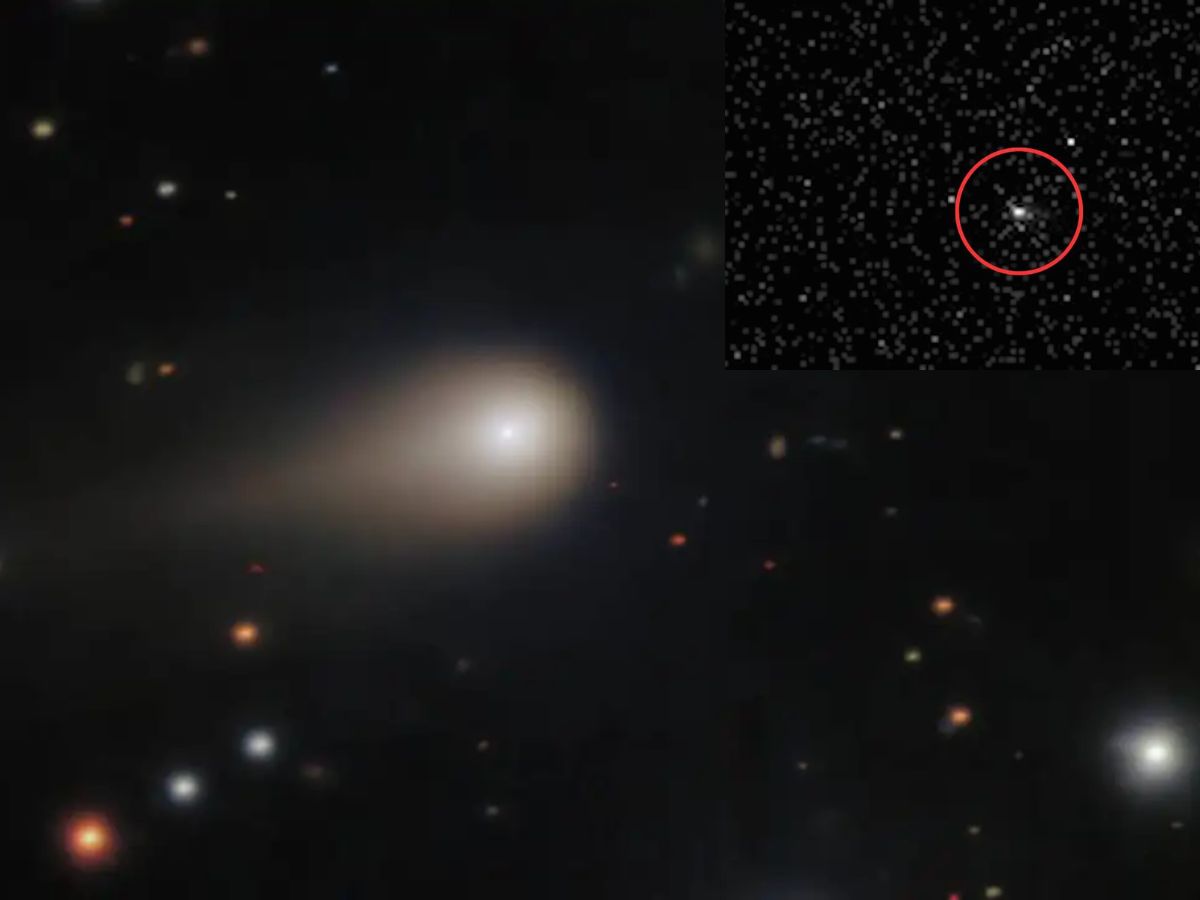
The interstellar visitor known as Comet 3I/ATLAS is back in view after its close encounter with the Sun, but it is not behaving like any typical comet. New images captured after its perihelion on October 29-30 reveal a bright, fuzzy ball of light with one glaring omission: a tail. This absence, now confirmed by multiple observatories and even orbiters at Mars, is deepening the scientific mystery surrounding this object from another star system and challenging preconceived notions of what a comet should be.
What Do the Latest Images from Earth Show?
Since emerging from the Sun’s glare, 3I/ATLAS has been imaged by several ground-based telescopes, including the Lowell Observatory in Arizona and the Virtual Telescope Project. These new post-perihelion photos all tell the same story. The comet appears as an intensely bright coma—a cloud of gas and dust—but completely lacks the iconic, streaming tail that characterizes most comets as they heat up near the Sun. This tailless nature has been a point of debate since its discovery in July, with only a brief, faint tail spotted in August before it vanished again.
How Did Mars Orbiters Contribute to the Puzzle?
The mystery was compounded by a unique opportunity: the comet’s close flyby of Mars in early October. Orbiters from around the world turned their cameras toward the visitor. The European Space Agency’s ExoMars Trace Gas Orbiter was the first to release an image, capturing what it described as a “slightly fuzzy white dot” with no visible tail. Hopes that a tail would develop as the comet heated further were dashed when China’s Tianwen-1 orbiter released its own image on November 6. The China National Space Administration’s photo also showed only a faint, fuzzy ball of light, explicitly describing a nucleus and a coma “several thousand kilometres” in diameter, with no mention of a tail.
Why is the Missing Tail Such a Big Deal for Scientists?
The most well-known aspect of a comet is its tail, which is created when wind and solar radiation force gas and dust away from the comet’s core. The consistent absence of a tail on 3I/ATLAS, even after its scorching close pass by the Sun, suggests there is something fundamentally different about its composition or behavior. Scientists are already intrigued because the comet has exhibited other strange activities, including unexpectedly brightening, undergoing sudden acceleration, and changing its trajectory. The lack of a tail is now another major piece of this puzzle, indicating that its ices may be vaporizing in an unusual way or that its dust particles are unlike those found in our solar system.
Also Read: ‘A Total Disgrace’: Trump Announces US Boycott of G-20 Summit in South Africa
What Happens Next with This Interstellar Mystery?
For researchers, the investigation is just beginning. The China National Space Administration stated that its researchers are conducting “further in-depth studies” based on the Tianwen-1 data. As 3I/ATLAS continues to move away from the Sun, astronomers worldwide will be closely monitoring it with powerful telescopes. Testing hypotheses about why this interstellar visitor is so unique will depend on each new image and piece of data, which could provide fresh information on how planetary systems evolve around other stars.