
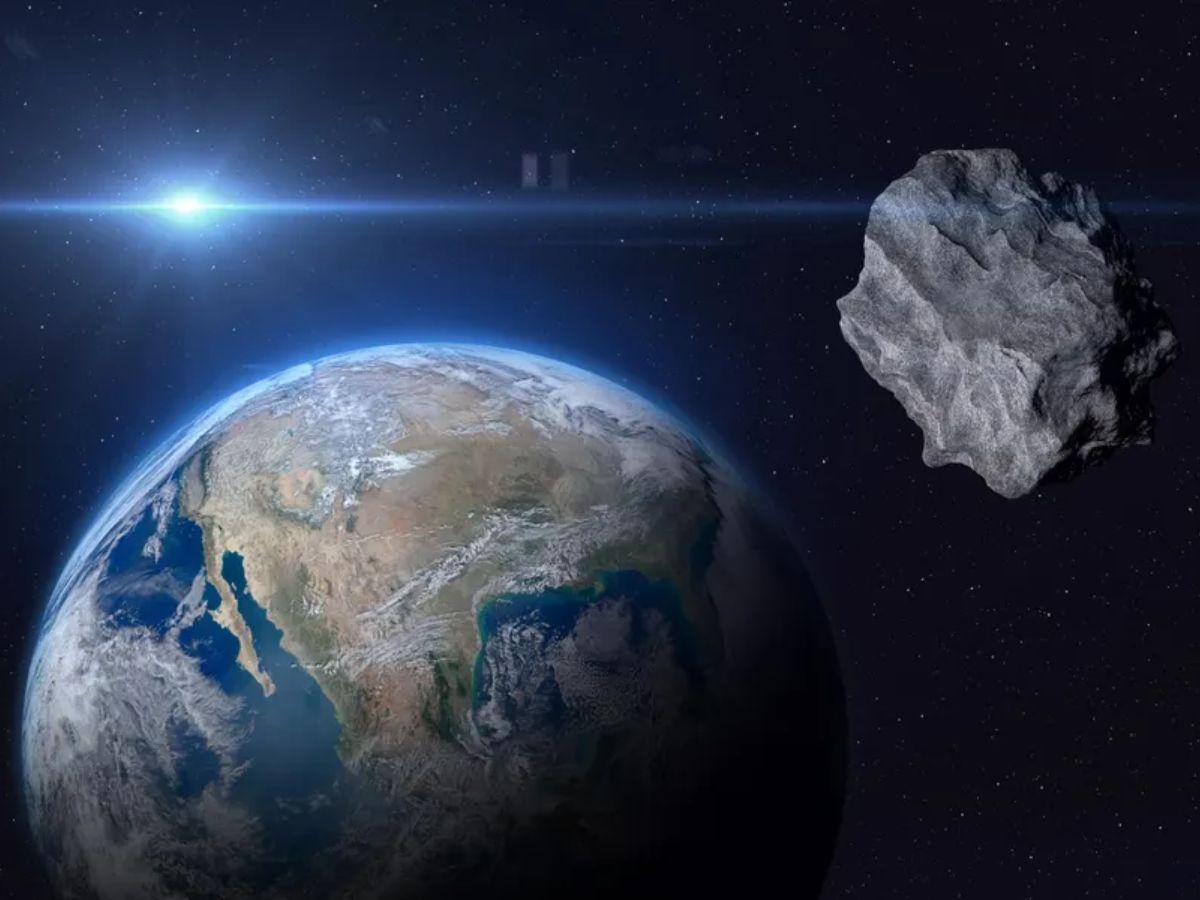
In a cosmic game of hide-and-seek, astronomers have discovered that Earth has had a secret travel companion for over six decades. Dubbed 2025 PN7, this newly identified quasi-moon has been orbiting alongside our planet, unseen until now. The discovery identifies a cosmic neighbor that has been and will continue to be a reliable component of our planet’s orbit around the Sun for many years to come.
What Exactly is a Quasi-Moon?
Publicized in the American Astronomical Society’s Research Notes, the discovery raises awareness of an intriguing object. But what is a quasi-moon?
A quasi-moon, as the name implies, is not a real satellite like the Moon. They are actually asteroids that lock into a gravitational dance with a planet. They follow the same orbital route as the planet around the Sun, traveling in a steady, tadpole- or horseshoe-shaped manner in relation to the planet. They do not literally orbit the Earth; rather, they are impacted by it but not gravitationally attached to it. Imagine them not as moons orbiting a planet but as cosmic travel companions racing the same racetrack.
How Was 2025 PN7 Discovered?
The Pan-STARRS observatory in Hawaii, a powerful telescope system designed to scan the skies for near-Earth objects, first spotted 2025 PN7 on August 2nd of this year.
Intrigued, astronomers then performed a digital archaeological dig through the telescope’s vast archive of past images. To their astonishment, they found pictures of the object dating all the way back to 2014. According to their calculations of its orbit, this space rock has been a consistent companion to Earth for more than 60 years and is expected to do so for another 60 years until eventually drifting away on its own course.
Also Read: Clear Your Calendar: The 10 Netflix Movies Everyone Will Be Talking About This Autumn Season
What Do We Know About This Celestial Companion?
Scientists have already gathered key details about our new neighbor:
Size: It is estimated to be about 62 feet wide—roughly the length of a bowling lane.
Distance: Its orbit maintains it at a significantly fluctuating distance from Earth, between 4.5 and 59.8 million kilometers.
Location: It was discovered in the constellation Piscis Austrinus (the Southern Fish).
Classification: It belongs to an elite group of near-Earth asteroids, providing a valuable subject for study.
Is This Earth’s Only Quasi-Moon?
No. Earth is known to have a entourage of approximately seven such quasi-moons. The most famous is Kamoʻoalewa (2016 HO3), an asteroid measuring between 131 and 328 feet across. It is so significant that China’s Tianwen-2 mission, launched in May of this year, is on its way to collect samples from it and return them to Earth by 2027. This mission aims to uncover clues about the origins of our solar system.
Also Read: Carrot vs. Sweet Potato: Nutritional Comparison to Find the Real Superfood
Are Quasi-Moons and Mini-Moons the Same Thing?
Although this is a frequent source of misunderstanding, the answer is unmistakably no.
Quasi-Moons: Like 2025 PN7, these are asteroids that co-orbit the Sun with Earth for decades or even centuries, maintaining a stable, distant relationship.
Mini-Moons: These are tiny, transient asteroids that orbit Earth for a brief time, anywhere from a few weeks to a few years, before escaping after momentarily becoming trapped in our gravity. The asteroid 2024 PT5 was a recent mini-moon, visiting from September 29 to November 25 last year.
The discovery of 2025 PN7 is a reminder that our cosmic neighborhood is still full of surprises, with ancient companions only now stepping into the light.