
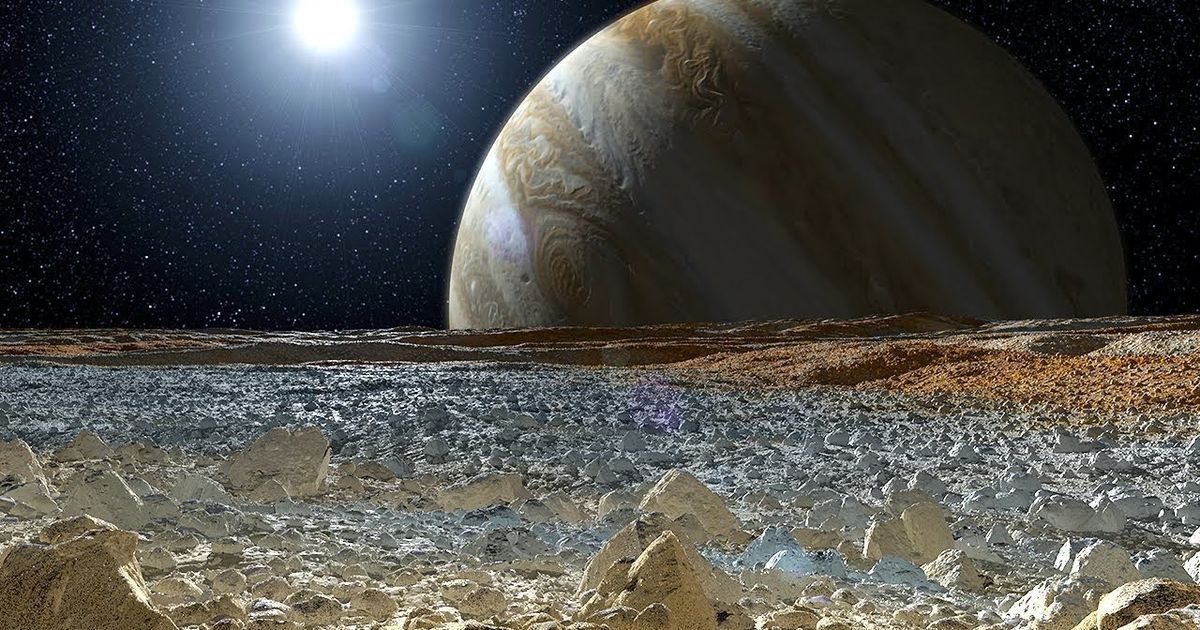
Scientists have long been interested in Europa, Jupiter’s moon, as a potential home for extraterrestrial life. Once believed to be a dormant icy sphere, Europa is now undergoing a sudden change in geology, potentially hiding a massive saltwater ocean beneath its surface. This comes as a revelation from the James Webb Space Telescope (JWST), whose high-resolution data is transforming our understanding of the moon.
Webb Telescope Spots Crystal Variations in Ice
In a recent study led by the Southwest Research Institute, researchers analyzed two regions in Europa’s southern hemisphere—Tar Regio and Powys Regio. They discovered that the surface ice in these regions crystallizes at varying rates, indicating ongoing geological processes, using JWST’s potent infrared detectors. These variations suggest a dynamic interaction between the surface and what lies beneath, a phenomenon scientists call “chaos terrains.”
Hydrogen Peroxide and CO₂ Indicate Recent Activity
In Europa’s surface layers, the telescope also found evidence of hydrogen peroxide and carbon dioxide, two substances that are extremely unstable in the radioactive environment of the moon. Their presence implies recent geological activity, possibly involving materials welling up from beneath the surface. “What we are seeing must be sourced from the interior,” said Ujjwal Raut, a program manager and co-author of the study, indicating a potential exchange between the surface and an internal ocean.
What Lies Beneath? A Saltwater Ocean 30 Km Deep
Scientists now believe Europa may house a subsurface ocean nearly 30 kilometers below its thick icy crust—one that could hold twice the amount of water as all of Earth’s oceans combined. Europa is one of the most intriguing options in the solar system for astrobiology research because of the possibility that microbial life could exist there in an environment that is warmed by tidal forces from Jupiter’s gravitational pull.
NASA’s Europa Clipper to Join the Hunt in 2030
In pursuit of definitive answers, NASA launched the Europa Clipper in October last year. The spacecraft will take a gravity assist from Mars before embarking on its 5.5-year journey to Europa. Once it arrives in the early 2030s, the Clipper will conduct dozens of flybys, using radar and spectrometry to probe the moon’s subsurface ocean, test for organic compounds, and assess its habitability potential.