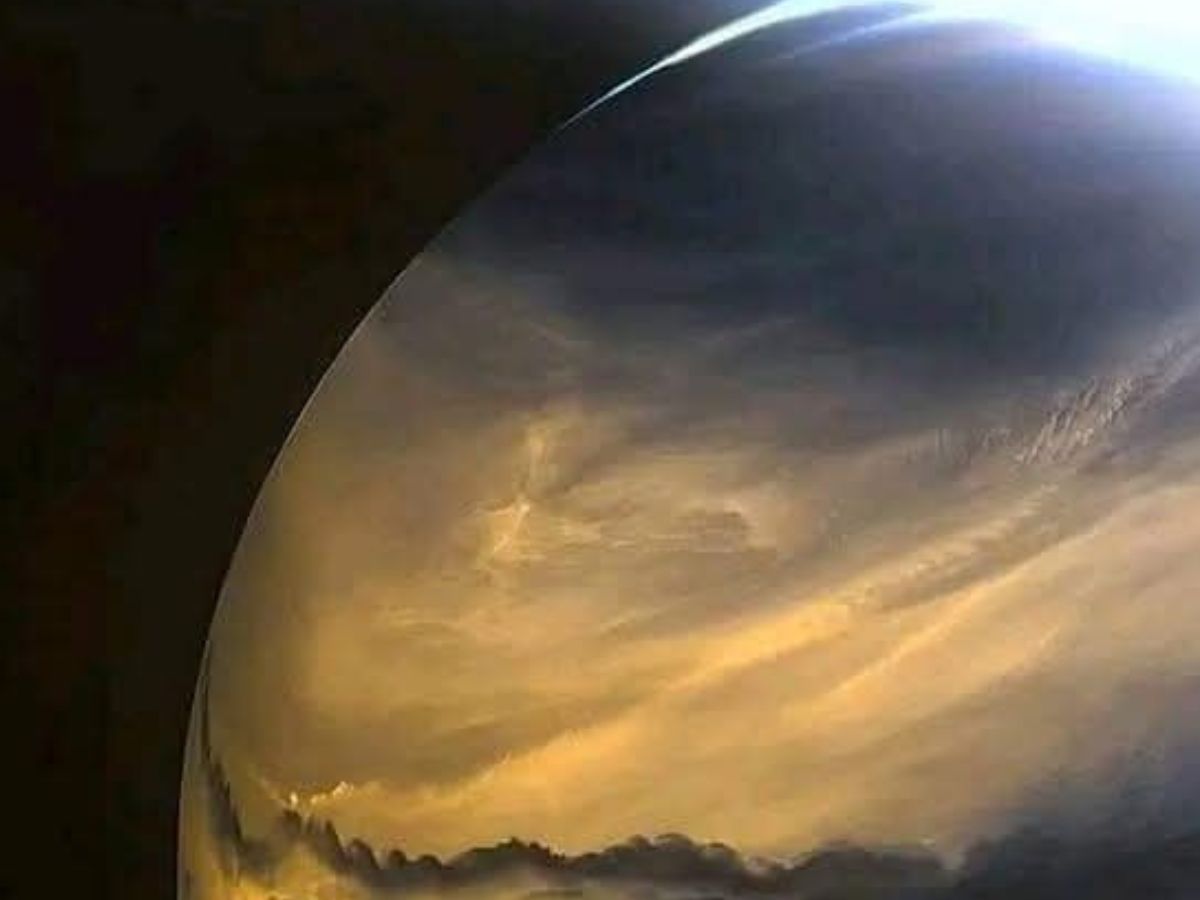
Japan Aerospace Exploration Agency (JAXA) released what scientists are describing as the ‘best photograph ever of Venus’ taken by its decade-long Akatsuki spacecraft, along with a wealth of new scientific discoveries that are transforming our knowledge of Earth’s mysterious twin planet.
Record-Breaking Image of Venus
This landmark image, publicly shared on August 3, reveals Venus’s swirling cloud tops with unprecedented sharpness, showcasing intricate atmospheric structures in remarkable detail. The photograph, taken by Akatsuki’s multi-wavelength cameras, highlights wave patterns, polar swirls, and the dynamic weather that define the planet’s dense, sulfurous atmosphere.
Akatsuki, which was deployed in 2010 and entered Venusian orbit in 2015, has used infrared, visible, and ultraviolet imaging to see through Venus’s dense cloud cover. With these instruments, scientists are not only able to image meteorological features but also to study temperature gradients and hunt for volcanic signatures and atmospheric lightning.
Clearest image ever taken of Venus by JAXA pic.twitter.com/4zO5DZghjY
— Black Hole (@konstructivizm) August 3, 2025
Recent Breakthroughs: Venus’s Jet Streams and Atmospheric Enigmas
JAXA’s researchers have unveiled several key discoveries from the Akatsuki mission:
- Jet-Setting Atmosphere: Akatsuki’s data revealed the existence of a fast-flowing equatorial jet stream, dubbed the “Venusian Equatorial Jet” in the lower and middle cloud layers, where winds can exceed 100m/sec. This discovery challenged previous assumptions, helping explain how Venus’s entire atmosphere rotates much faster than the planet itself, a phenomenon dubbed “super-rotation.”
- Bow-Shaped Gravity Waves: Only hours after its arrival at Venus, Akatsuki discovered a vast, motionless “bow-shaped wave” in the upper cloud decks, spanning more than 10,000km. Scientists now think that these long-lasting gravity waves are created by air moving over Venusian mountain ranges, which provides a clue to the planet’s stormy weather patterns.
- Streaky Clouds and Thermal Tides: Through continuous observation, Akatsuki has painted a detailed picture of winds, temperature fluctuations, and unusual “streaky” clouds seen at night, revealing connections between wave activity and jet streams much like those found on Earth.
- Akatsuki’s radio occultation experiments, which bounce radio waves off Venus’s dense atmosphere back to Earth, are providing three-dimensional insights into the planet’s chemical composition and vertical temperature structure.
Mission Legacy and Communication Breakdown
In late April 2024, JAXA lost contact with Akatsuki when the space mission went into a long-lasting attitude instability, which hindered its ability to point the spacecraft’s antennas toward Earth. The spacecraft remains unresponsive until August 2025 despite several attempts at recovery, but the mission has already far surpassed its scientific objectives.
Venus Exploration: What’s Next
JAXA and collaborating international agencies are reviewing new Venus mission proposals, buoyed by Akatsuki’s achievements and public interest sparked by the latest images. Meanwhile, the data and imagery collected over more than a decade ensure Akatsuki’s legacy as a pioneering effort in planetary atmospheric science, a mission that deepened humanity’s fascination with our turbulent, cloud-shrouded neighbour.