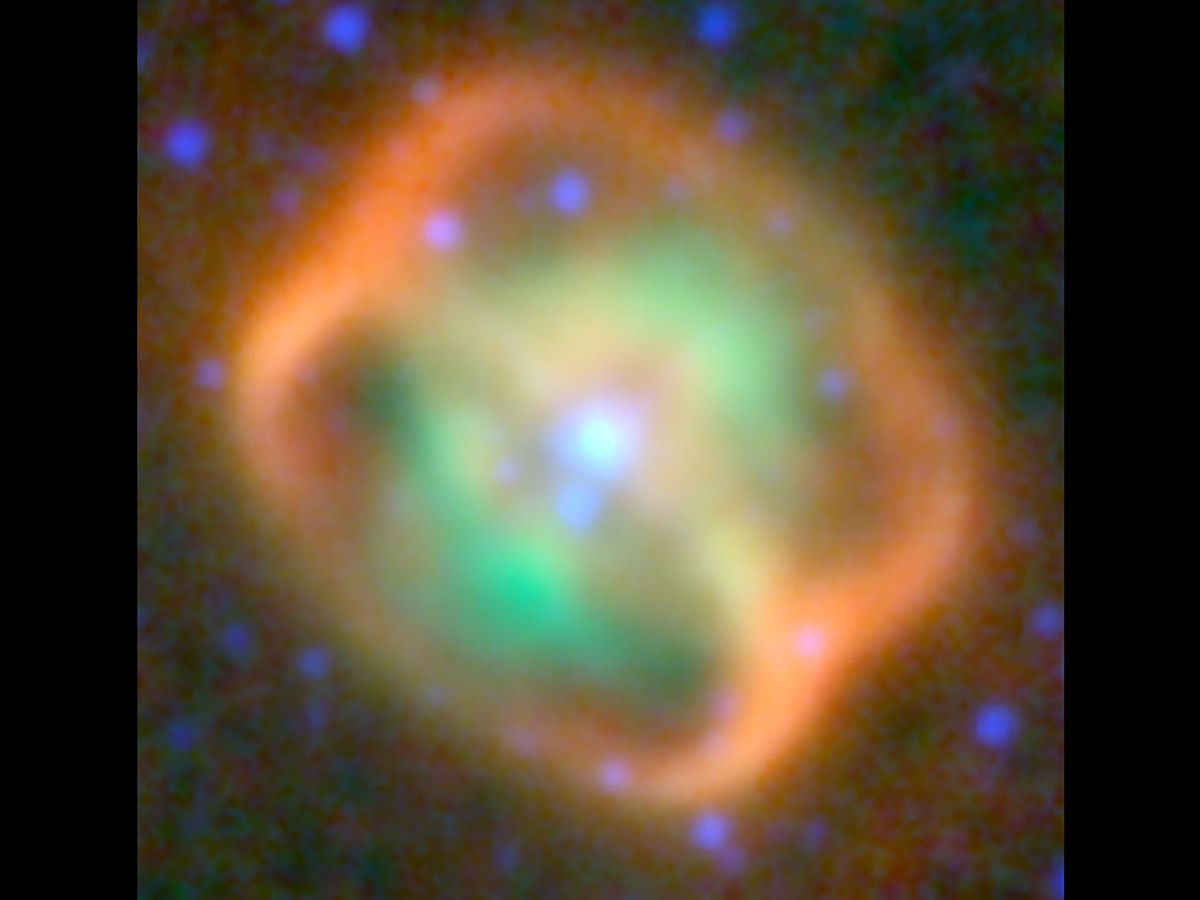
The James Webb Space Telescope (JWST) has revealed breathtaking new images of the planetary nebula NGC 1514. The nebula lies about 1,500 light-years away from Earth. JWST’s powerful mid-infrared camera showed ghostly rings of light around the dying star system, details that have never been seen before.
This discovery, published in The Astronomical Journal, gives scientists a chance to study the nebula’s complex 4,000-year history, and the findings raise new questions about how such mysterious rings form and change over time.
The History of NGC 1514
NGC 1514 was first spotted in 1790 by astronomer William Herschel, when he saw a hazy glow around a star, which confused experts at the time, and over the centuries, scientists used better telescopes to reveal more details.
Fascinating: Planetary Nebula NGC 1514: WISE vs Webb Images
Webb reveals unseen details, surpassing earlier WISE images with sharper resolution and broader infrared range.
Credit: NASA, ESA, CSA, STScI, NASA-JPL, Caltech, UCLA, Michael Ressler (NASA-JPL), Dave Jones (IAC) pic.twitter.com/NcCAvjWE2F
— World and Science (@WorldAndScience) June 1, 2025
In 2010, NASA’s WISE mission discovered two infrared rings in the nebula. But their shape and structure were unclear until JWST offered its detailed view, and using its Mid-Infrared Instrument (MIRI), JWST captured the rings in sharp detail, showing filaments, clumps, and turbulent features.
The Binary Star System at the Core
At the heart of NGC 1514 is a binary star system. One is a white dwarf, the dead core of a once larger star. The other is a giant companion star.
The white dwarf expelled its outer layers, creating the glowing nebula. Its giant companion orbits close by and interacts with it. This gravitational pull may have shaped the nebula’s strange hourglass-like structure.
JWST’s images show a three-dimensional envelope shaped like a pinched hourglass. The ghostly rings sit across the middle of this envelope. They are uneven and filled with unusual dust patterns, hinting at violent interactions between the two stars.
Unique Thermal Dust Emission
One of JWST’s most surprising findings is the nature of the rings. In many nebulae, rings glow with molecules like hydrogen or PAHs (polycyclic aromatic hydrocarbons). But in NGC 1514, more than 98% of the light comes from cool dust grains releasing thermal radiation.
This makes the rings rare and fragile. Scientists believe they may not last long, making them an important clue in studying dying stars.
Why JWST Matters
From being a fuzzy patch in William Herschel’s telescope to today’s detailed images, NGC 1514 has become a key subject in astronomy. The nebula challenges old theories about how stars die and how binary systems interact.
JWST’s clarity shows hidden structures, delicate dust, and complex dynamics like never before, and is helping astronomers better understand not only NGC 1514 but also the process of stellar death across the universe.