
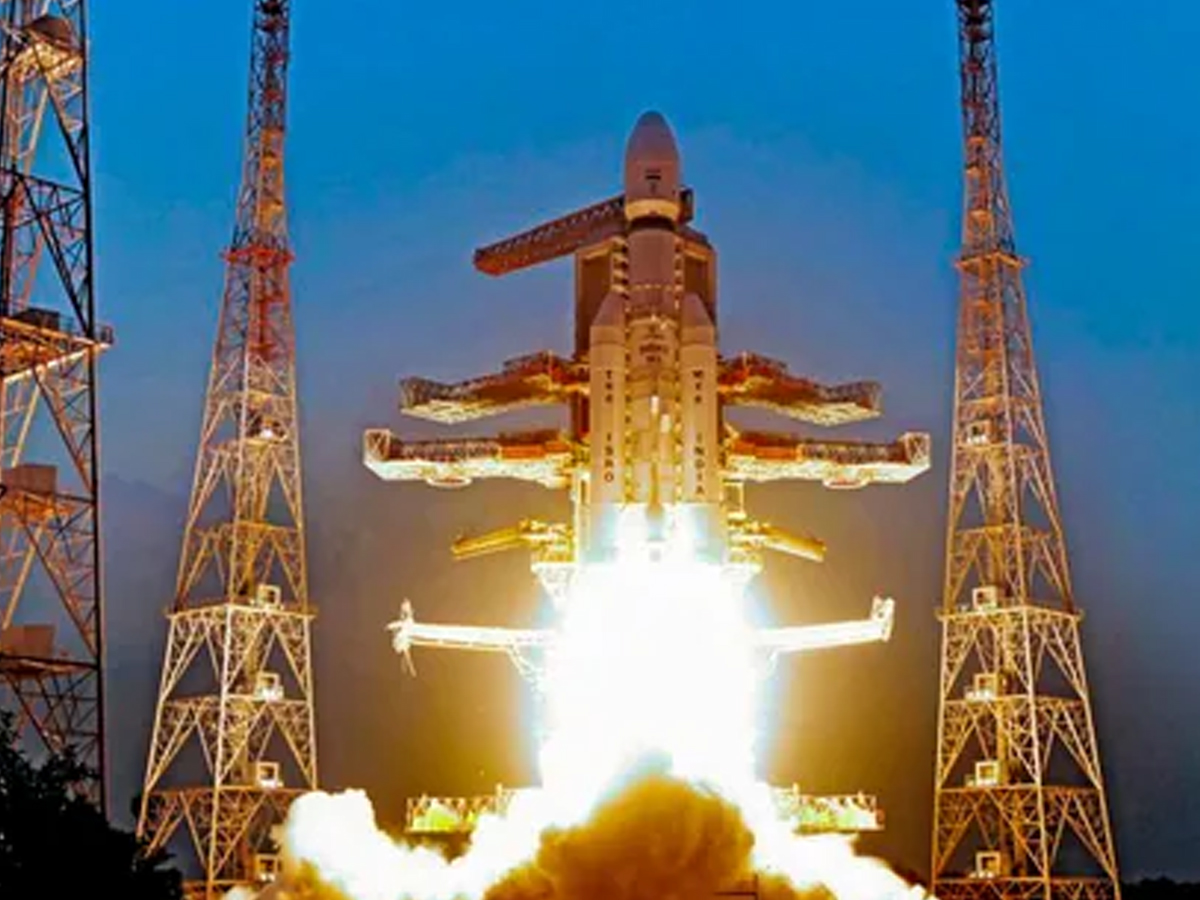
The Indian Space Research Organization (ISRO) has added another proud chapter to India’s space journey. On Sunday, ISRO successfully launched the country’s heaviest communication satellite, CMS-03, using the indigenous LVM3-M5 rocket, popularly called the ‘Bahubali’. The powerful rocket lifted off from the Satish Dhawan Space Center in Sriharikota, Andhra Pradesh, at 5:26 pm.
Within hours, the satellite was placed precisely into its designated orbit. The successful mission once again showcased India’s growing capability to build and launch heavy-lift rockets.
India’s Heaviest Communication Satellite
CMS-03 is the heaviest communication satellite ever launched from Indian soil, weighing about 4,400 kg. The satellite is designed to operate for at least 15 years and will provide multi-band communication services across the Indian landmass and nearby ocean regions.
ISRO officials said that the satellite was developed using completely indigenous technology, making it a major achievement under the government’s ‘Atmanirbhar Bharat’ initiative.
ISRO chief V. Narayanan called the mission a significant leap forward. He said, “CMS-03 includes a host of new technologies and is a shiny example of Atmanirbhar Bharat.”
Boost to India’s Communication and Security Network
The CMS-03 satellite will enhance India’s communication capacity across the Indian Ocean Region. According to the Indian Navy, it will provide powerful telecommunication coverage, helping improve space-based communication and maritime awareness.
Indian Navy officials told PTI that the satellite will provide advanced, secure communication channels vital to the Indian Ocean Region.
Lt Gen Anil K. Bhatt (retd), Director General of the Indian Space Association (ISpA), said, “The satellite will prove to be a game changer for India’s maritime and national security as it will provide advanced and secure communication channels that are important in the Indian Ocean Region.”
The satellite comes equipped with advanced encryption, wide frequency coverage, and high-capacity transponders. These technologies will support network-based naval operations and strengthen India’s situational awareness at sea.
The Power of ‘Bahubali’ Rocket
The LVM3, also known as the ‘Bahubali’ rocket, is India’s most powerful launch vehicle. It was built entirely with indigenous technology, including the C25 cryogenic upper stage. Since its first successful test flight, the LVM3 has been the backbone of ISRO’s heavy satellite missions.
ISRO noted that the rocket has maintained a consistent success record since its first development flight in December 2014, which carried out the LVM3 Crew Module Atmospheric Re-entry Experiment (CARE).
A Leap Toward Self-Reliant Space Technology
The success of the CMS-03 mission strengthens India’s position as a global space power. It demonstrates that India can design, build, and launch advanced satellites using its own technology. The launch also reinforces the vision of a self-reliant India in the field of space exploration and communication technology.
With CMS-03 now in orbit, ISRO has taken another bold step toward securing the nation’s digital and defense communication network for the future.