
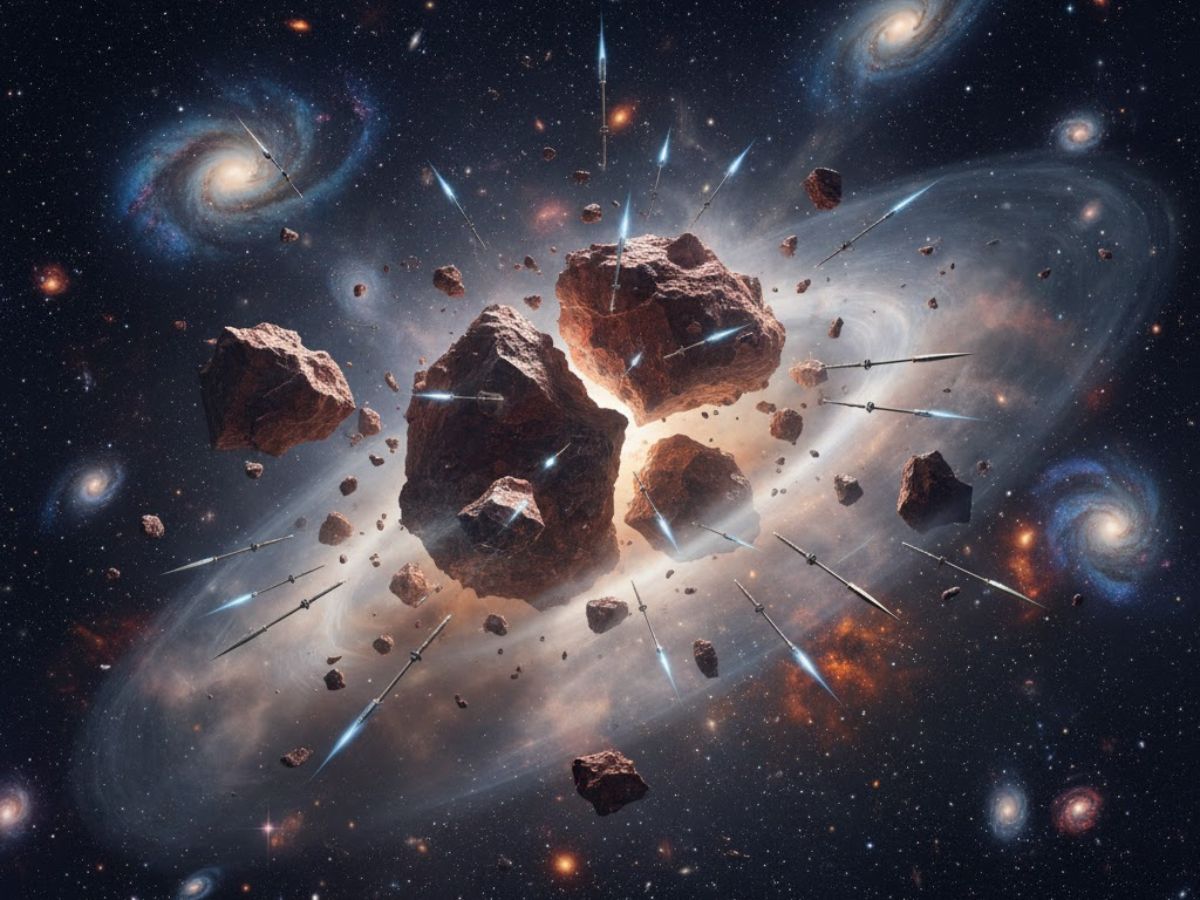
The interstellar object known as 3I/Atlas is approaching a critical point in its journey through our solar system. Scientists are observing it as it approaches perihelion, or its closest approach to the Sun, to determine whether it will exhibit typical cometary behavior or something much more unusual. According to a contentious notion put forth by Harvard astronomer Avi Loeb, 3I/Atlas may actually be a technical artifact from an extraterrestrial civilization rather than a comet.
What is the 3I/Atlas Interstellar Object?
3I/Atlas is an object detected on July 1st that is passing through our solar system from interstellar space. Its official classification is still under debate. Most scientists expect it to be a comet, a chunk of ice and rock. As such, it faces a significant test as it gets closer to the Sun’s intense heat and gravitational pull. The key date to watch is after October 29, when it emerges from the Sun’s glare, and its true nature may become clearer.
Why Do Comets Like 3I/Atlas Break Up?
Comets tend to disintegrate near the Sun through outgassing. The Sun’s warmth turns their frozen gases into vapor, which bursts out and can tear the comet apart. Rotational stress and the Sun’s gravitational tides are two further causes of comet breakup. The composition of the comet determines the probability of this occurring; comets with weaker compositions, such as 67P/Churyumov–Gerasimenko, are known to be more susceptible to disintegration.
Avi Loeb’s Theory on 3I/Atlas
Harvard scientist Avi Loeb has a different, more speculative explanation. He suggests that if 3I/Atlas does not break up naturally, it could be a sign of alien technology. In his blog, Loeb wrote, “If 3I/ATLAS is a comet of natural origin, it could disintegrate into fragments as it comes closer to the Sun.” He advises astronomers to watch “whether it breaks up into independent, smaller dots of light.” If it doesn’t break up, he theorizes the object could be an artificial “mothership.”
Could 3I/Atlas Launch Mini-Probes?
Avi Loeb’s most dramatic claim involves the object’s potential function. He earlier suggested that an alien mothership might send out small probes to explore our solar system. Now, he’s taken the idea further, saying these probes could be self-replicating — able to make copies of themselves and explore many planets and moons at once, using technology far more advanced than ours.
What Happens Next with 3I/Atlas?
The coming weeks are crucial for understanding 3I/Atlas. After its perihelion and once it moves away from the Sun’s glare after October 29, astronomers will get a clearer view. They will be looking for any unusual activity, such as a failure to disintegrate or the appearance of smaller, independent objects moving away from it. Loeb has even suggested it could use the Sun’s gravity to slingshot itself toward Earth, though he acknowledges this is a far-fetched idea.