
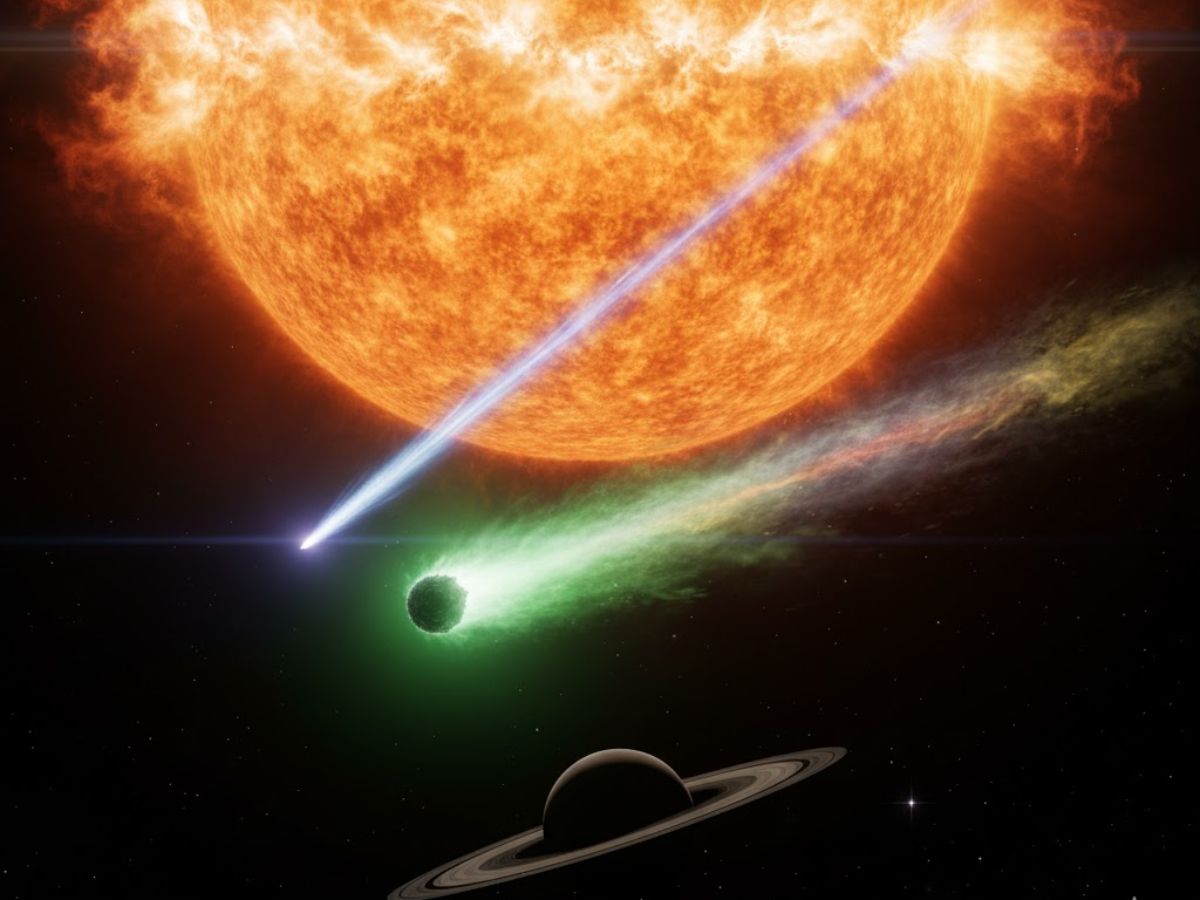
A rare sight in the solar system is occurring as interstellar comet 3I/ATLAS, a traveler from another star system, nears the Sun. At this point—called perihelion—the comet is most active, and scientists worldwide are joining efforts to observe it.
When is the Peak and How Can I Watch?
The comet is set to reach perihelion on Wednesday, October 29, at approximately 11:47 Universal Time (UT). NASA clarifies this closest approach will bring it to about 1.4 astronomical units from the Sun, which is just inside the orbit of Mars. For the general public, there is no direct “live stream” of the event in real-time. NASA, ESA, and other space agencies will publish updates, visuals, and data on their websites and social channels. Popular astronomy sites will continue reporting with real-time coverage and recent findings.
Why is This Comet So Special?
3I/ATLAS is only the third confirmed interstellar object ever detected, meaning it originated from deep space beyond our solar system. Its path is a one-way ticket; it is on a hyperbolic orbit that will not loop back around the Sun. Tracing its trajectory backward confirms it came from the direction of the constellation Sagittarius. It stands as an untouched relic from another star system, letting scientists study the composition of far-off regions in space.
Also Read: Microsoft Azure Outage: Full List of Services and Businesses Brought to a Halt
How Are Scientists Studying the Comet?
Since sending a spacecraft to the comet isn’t possible because of its extreme speed, scientists are relying on existing space telescopes for remote study. The Hubble Telescope has already captured a dust plume, while the James Webb Telescope detected gases like carbon dioxide and water in its coma. The European Space Agency (ESA) is also directing its Mars Express and the ExoMars Trace Gas Orbiter at the comet to gather additional data.
Which Spacecraft Will Have the Best View?
The most privileged view will belong to ESA’s Jupiter Icy Moons Explorer (Juice). Positioned perfectly in space, Juice will attempt to observe the comet in November 2025 when it is most active. The spacecraft will use its suite of cameras, spectrometers, and a particle sensor to conduct a detailed study. ESA is even considering coordinating with NASA’s Europa Clipper mission for joint observations. Data from Juice’s investigation is expected to be received on Earth by February 2026, which will then be analyzed and shared with the public.
Also Read: Fact Check: The Truth About TPUSA’s ‘All-American Halftime Show’ | Is It Canceled?
What Happens After the Peak?
After swinging around the Sun, the comet will begin its permanent journey back into interstellar space. Because it will be positioned on the far side of the Sun from Earth during its peak, it is not expected to become visible from Earth with the naked eye or small telescopes until sometime in November. For years to come, the observations made during this short visit will give scientists important information that will help them solve the puzzles surrounding the formation and evolution of planetary systems orbiting other stars.