
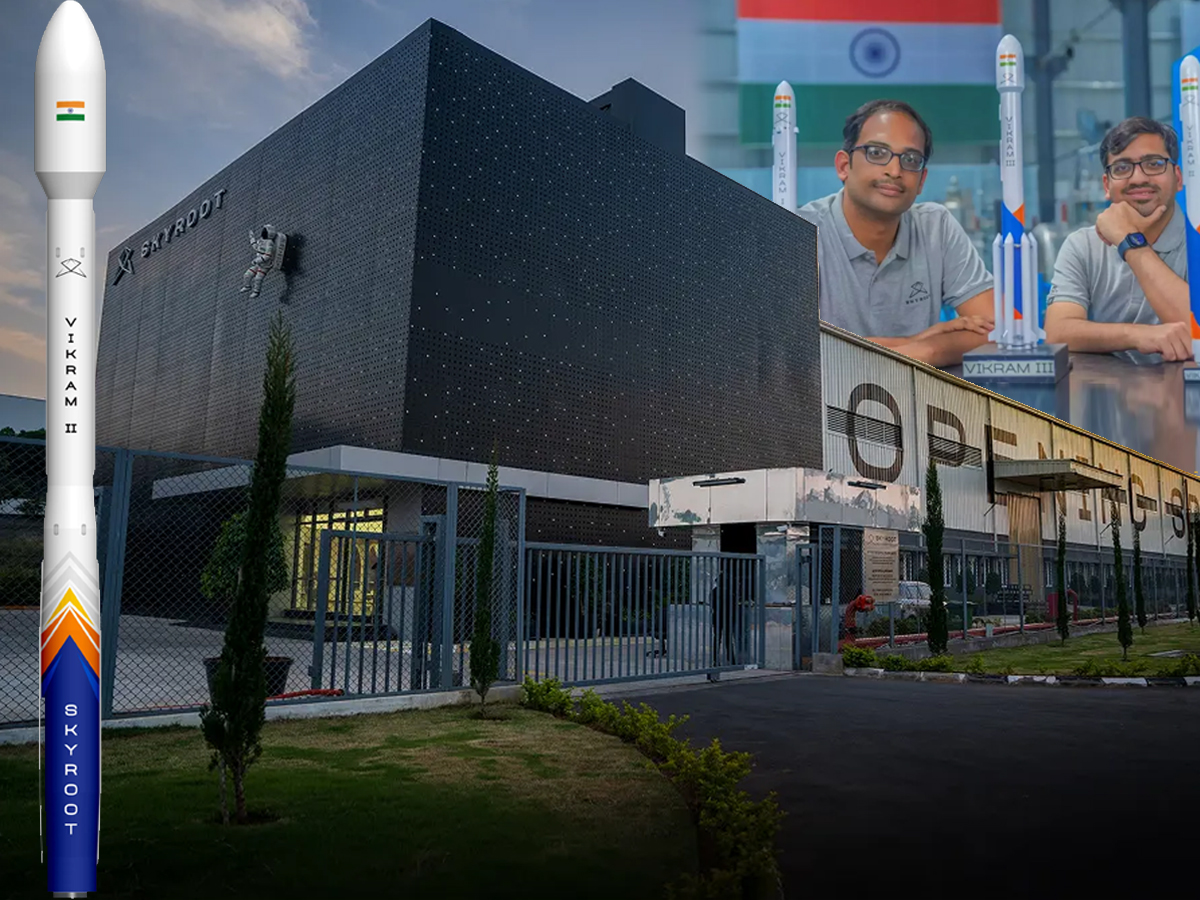
On 27 November 2025, Prime Minister Narendra Modi inaugurated Skyroot Aerospace’s new Infinity Campus via video conferencing and unveiled Vikram‑I, India’s first privately developed orbital rocket. Calling the occasion “a significant leap forward for India’s space sector,” he praised the energy, innovation, and ambition of young Indian scientists and entrepreneurs.
The event underscored how opening space to private players has unleashed “youth power,” entrepreneurship, and a surge of innovation, signaling a new era where private enterprise stands alongside public agencies in shaping India’s space future.
Until recently, India’s access to space was almost entirely controlled by the government, but in 2018, Skyroot Aerospace changed that narrative. It emerged as the first private aerospace company in India, founded by engineers who left government agencies to bring in entrepreneurial energy.
Skyroot aims to make space more accessible, especially for small‑satellite launches, and with this shift, India’s space sector is opening up to innovation and private ambition.
The Journey of Skyroot — From Idea to Launch
Humble Beginnings
Skyroot began with a small team working out of a modest facility in Hyderabad. The founders, former space‑agency scientists, wanted to build rockets from scratch, but with the agility and speed of a startup. They combined technical know‑how with a bold vision to challenge the old monopoly and open space to private enterprise.
Technical Milestones
Skyroot didn’t waste time and developed its own rocket engines, including advanced liquid‑fuel and cryogenic engines, which is a significant achievement for a private firm in India. The company’s engineering innovations include the use of composite structures, modern propulsion design, and rapid manufacturing methods, aiming for cost‑efficiency without compromising reliability.
First Success — Vikram-S Launch in 2022
In 2022, Skyroot launched Vikram-S, its first suborbital rocket. The launch marked a historic moment as it was the first privately built rocket from India to reach space. This success proved that private firms could indeed handle complex space‑tech tasks that once only state agencies undertook.
Towards the Orbital Mission — New Campus and Rocket Unveiled
In November 2025, the company took a giant leap forward. Formerly modest facilities gave way to a brand‑new “Infinity Campus”, a state‑of‑the‑art 200,000‑square‑foot facility designed for developing, assembling, integrating, and testing orbital‑class rockets. Alongside, Skyroot unveiled its first orbital‑class launch vehicle: Vikram-I.
Who is Pawan Kumar Chandana? Co-Founder of Skyroots
Pawan Kumar Chandana studied mechanical engineering (B.Tech + M.Tech) at a premier IIT, Kharagpur. After graduation, he worked at the ISRO, which is the government’s space agency, on major launch‑vehicle projects.
In 2018, he co‑founded Skyroot Aerospace and took charge as CEO & CTO. Under his leadership, Skyroot achieved private‑engine development, composite‑structure rockets, and successful early launches.
He combines deep technical expertise with entrepreneurial leadership, which helps steer Skyroot from a small startup to a national‑level space startup.
Who is Naga Bharath Daka? Co-Founder of Skyroots
Bharath studied engineering at IIT, Madras. He also worked at the Vikram Sarabhai Space Centre, focusing on avionics, guidance, and control systems, critical for any rocket’s success.
He left to co‑found Skyroot in 2018 and now serves as COO, overseeing technical subsystems, operations, and strategic planning. His expertise ensures that Skyroot’s rockets are not only powerful but precise, reliable, and safe.
What Skyroot’s Success Means for Private Space Ventures?
Skyroot’s journey shows how private initiative can transform sectors long dominated by state agencies. With its rockets, composite‑engine technology, and a dedicated campus, the company is positioning India on the global map of commercial space launchers.
The endorsement by the government, via the Prime Minister’s inauguration, signals that private aerospace is not merely tolerated but encouraged.
This matters for many reasons, as it opens opportunities for satellite startups, research institutions, and private firms in India to access space quickly and affordably. It can catalyze a broader ecosystem, from launch services to satellite design, data analytics, and more. At the same time, it gives Indian engineers and entrepreneurs a platform to innovate without leaving the country.