
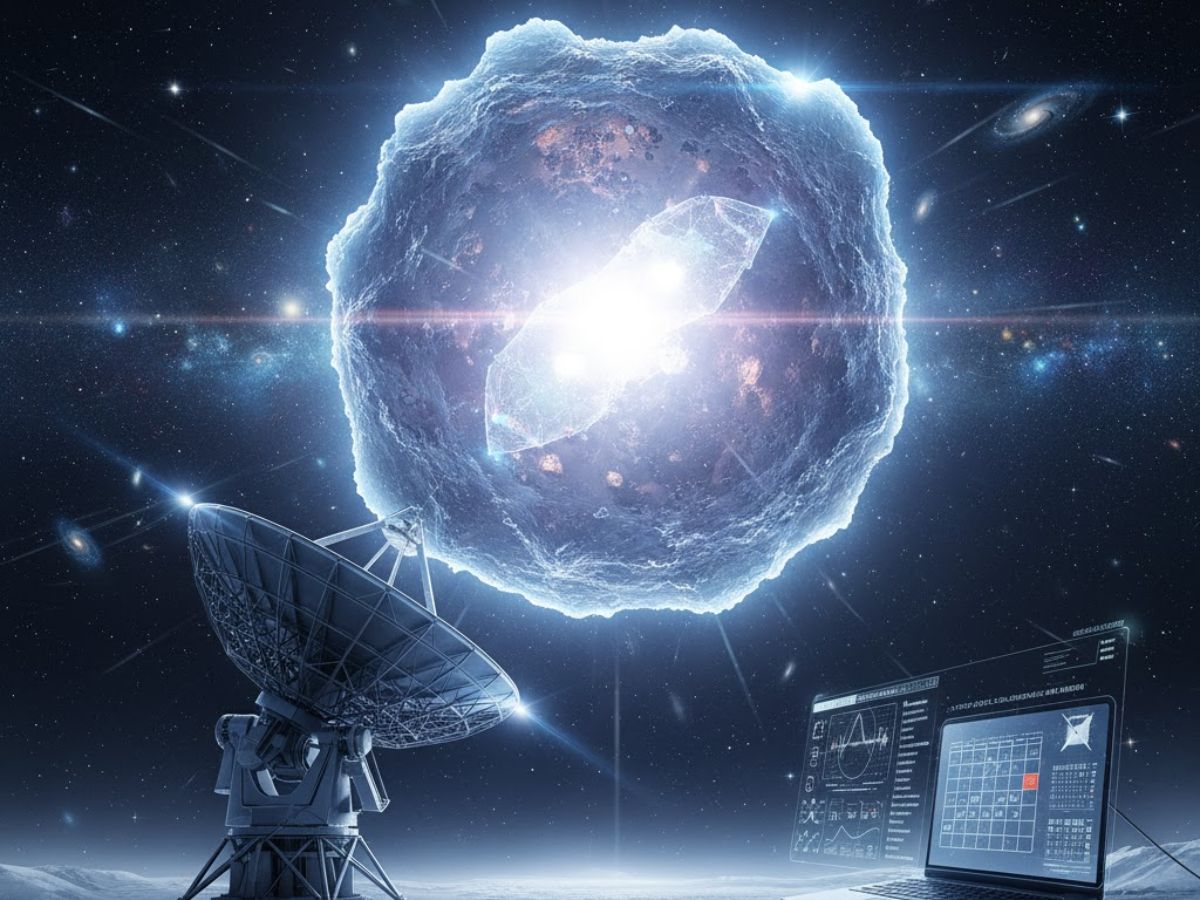
A mysterious interstellar object, 3I/Atlas, is moving closer to the Sun, and according to Harvard scientist Avi Loeb, what happens next could change everything we know about it. As it approaches its perihelion, or closest point to the Sun, it might disintegrate, or perhaps do something far stranger.
If 3I/Atlas is a natural comet, astronomers expect it to fragment under the Sun’s heat. But if it’s not natural, as Loeb provocatively suggests, the world may witness something entirely different — possibly a technological display from beyond Earth.
What happens when comets approach the Sun?
Comets undergo extreme heating and gravitational stress as they approach the Sun. Outgassing is the process that allows the frozen materials inside them to expand and evaporate, which can occasionally cause the comet to break apart.
Loeb explained in his blog:
“If 3I/Atlas is a comet of natural origin, it could disintegrate into fragments as it comes closer to the Sun. We should keep our eyes on this fuzzy ball of light and check whether it breaks up into independent, smaller dots of light.”
Comet breakups depend on their composition and material strength:
- Weak comets, like 67P/Churyumov–Gerasimenko, are formed from smaller clusters of rock and ice, making them prone to splitting.
- Some, such as 332P/Ikeya–Murakami, break apart due to rapid spinning.
- Smaller comets often fall apart because of thermal stress from extreme solar heating.
If 3I/Atlas follows the same natural process, its fragments will scatter harmlessly into space. But if not — scientists may have a different mystery on their hands.
Also Read: Who Is Sebastien Lecornu? Macron’s Trusted Ally Made PM of France Again
What makes 3I/Atlas so mysterious?
3I/Atlas is only the third known interstellar object to pass through our solar system — after ‘Oumuamua (1I/2017 U1) and 2I/Borisov. Both of those stirred global debate about their origins, with some scientists suggesting they were simply icy debris from other star systems, and others, including Loeb, proposing they might be technological in nature.
Discovered on July 1, 3I/Atlas has already shown some unusual characteristics in its trajectory and brightness, prompting Loeb to raise questions once again. The object’s true nature could become clear after October 29, when it emerges from behind the Sun’s glare.
Could it be a “mothership”?
Loeb has floated a bold theory: what if 3I/Atlas is not a comet, but a mothership, an alien spacecraft carrying mini-probes?
“A fleet of smaller objects could also appear as a result of a technological mothership which releases mini-probes to study multiple targets simultaneously,” he wrote. He further speculates these probes could even “self-replicate,” allowing them to multiply and explore different parts of the solar system, a concept that exists in advanced astroengineering theories but has never been observed.
While this idea may sound far-fetched, Loeb argues it shouldn’t be dismissed outright, citing unexplained anomalies in 3I/Atlas’s motion and composition. He has previously claimed that such objects might use the Sun’s gravitational force to propel themselves deeper into, or even toward, Earth’s vicinity.
Also Read: Fact Check: Princess Märtha Louise and Shaman Durek Verrett Respond to ‘Lavender Marriage’ Gossip
What’s next for 3I/Atlas?
Astronomers worldwide are watching closely. As it nears perihelion in late October, telescopes will track whether it breaks apart like a comet — or behaves in a way that challenges conventional explanations. The coming weeks could either confirm 3I/Atlas as a fragile visitor from another star system, or renew speculation that humanity may be witnessing something artificial crossing interstellar space.
Disclaimer: This article is based on scientific commentary and news agency astronomical data. Speculative statements attributed to Avi Loeb reflect his personal hypotheses, not confirmed evidence.