
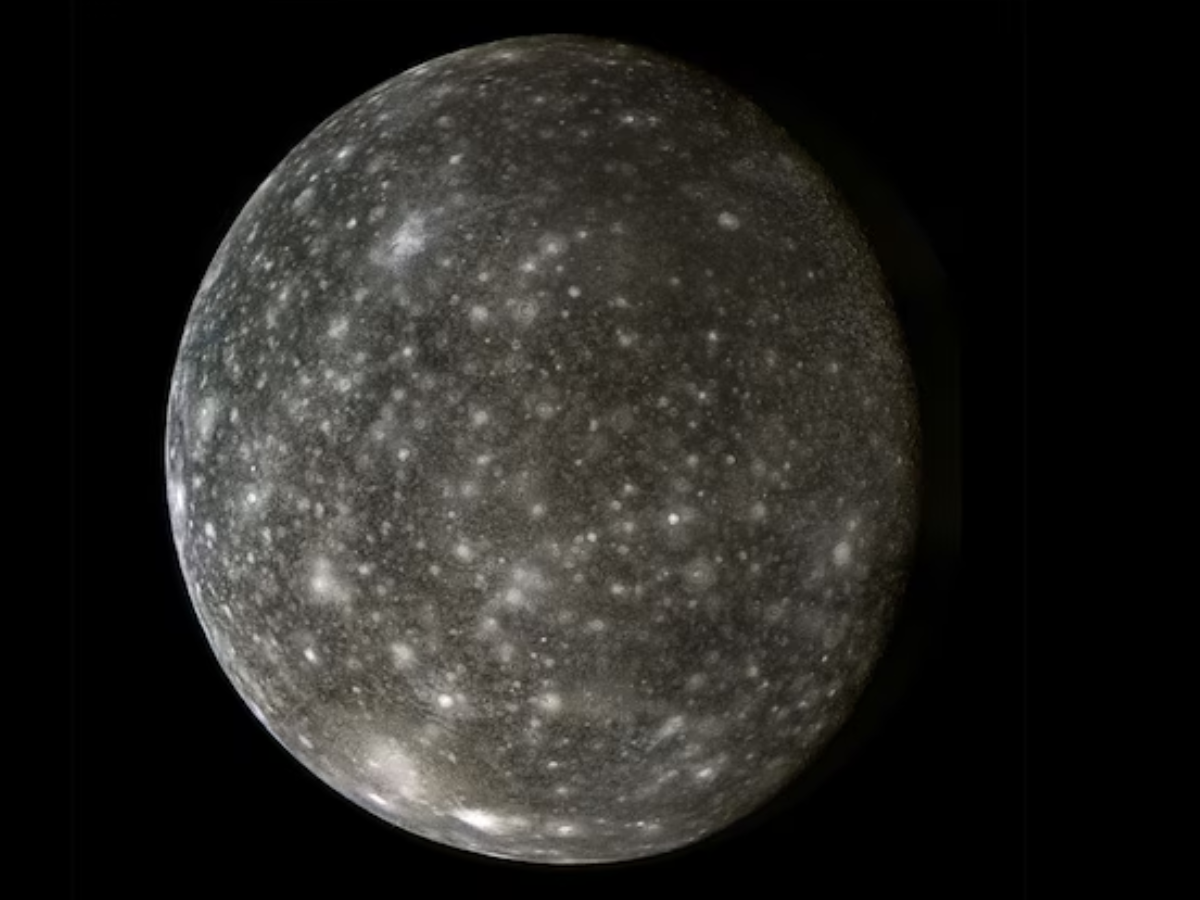
Callisto is larger than Mercury and lies very much in the shadows of its more illustrious siblings, Europa and Ganymede. But what distinguishes Callisto is that it has this scarred icy surface the most heavily cratered terrain in the Solar System. Each impact tells a story about billions of years of cosmic collisions. Voyager 2 first presented this battered world in 1979; now reprocessed pictures are giving finer views of its fractured crust. Bright ridges etched across the dark surface of Callisto hint at layers of ancient ice locked in place since the dawn of the Solar System.
Callisto Possibly Under an Ocean
Callisto’s rugged exterior, however, hides perhaps its grandest secret: a subsurface ocean. Scientists suspect that liquid water, probably warmed by some internal heat, could exist somewhere under ice kilometers thick. If this were true, Callisto would belong to the group of moons of Europa and Ganymede having their respective environmental characteristics capable of life support.
ALSO READ: Bermuda Triangle Mystery Cracked with Stunning New Theory: Scientists Drop Groundbreaking Claim
Unlike the active geology of Europa however, Callisto shows no geological activity and acts like a frozen time capsule that would preserve conditions from the most ancient days of planetary formation.
Why Callisto Is Important to Science
While it is larger than Earth’s Moon, Callisto is deficient in densification, a clue to its infusion with a great amount of ice. With this in mind, scientists are given a natural laboratory with which to study how water rich worlds evolve. Potentially concealed beneath ice, the hidden ocean adds interest to astrobiologists who continue their searches beyond the earth while impressive in itself.
ALSO READ: Petralona Skull Mystery Solved: 300,000-Year-Old Fossil Confirmed as Hominid After 60 Years
Callisto is considered to offer a higher record of history in the Solar System when it deals with craters. Its added stability renders it a possible outpost for human missions into Jupiter’s system. Safe landing ground than Europa’s treacherous surface.
Next Missions at the Doorstep
Callisto’s last detailed visit has been at the hands of NASA’s Galileo spacecraft in the 1990s. Two ambitious new missions that have taken up the exploration baton are ESA’s JUICE (Jupiter Icy Moons Explorer) and NASA’s Europa Clipper.
While the primary focus of both spacecraft is Europa, a great deal of important reconnaissance data will be collected concerning Callisto as the spacecraft fly through the Jovian system. Through composition, atmosphere, and magnetic field interaction study, scientists will establish whether indeed that ocean rests beneath the ice.
ALSO READ: Microsoft Launches 2 AI Models, MAI-Voice-1 & MAI-1 to Compete Directly With OpenAI