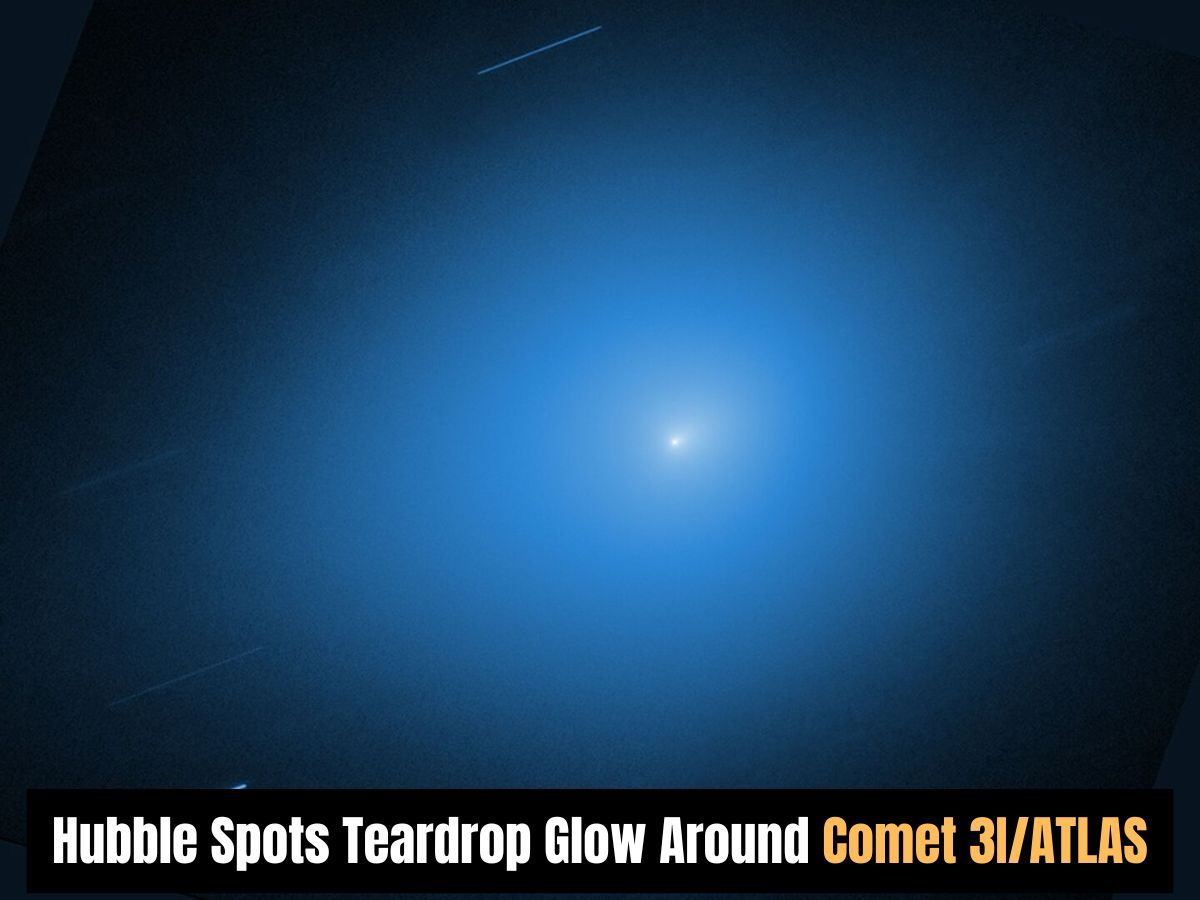
NASA’s Hubble Space Telescope has snapped a new image of comet 3I/ATLAS, the third known interstellar visitor to our solar system. Taken on November 30 from 286 million km away, it shows a bright, sun-facing halo around the nucleus about 40,000 km wide, extending up to 60,000 km.
What Does the Hubble Image Show?
The new data gives a clear view of a strange feature called an “anti-tail” – a spike of dust pointing toward the Sun, opposite the comet’s usual dust tail.Harvard astronomer Avi Loeb noted this feature was visible as early as July, just after the comet’s discovery.The latest measurement confirms the scale of this phenomenon:
- Glow Radius: About 40,000 kilometers.
- Anti-Tail Extension: Stretching out to roughly 60,000 kilometers.
Loeb theorizes this sunward teardrop shape is formed by a “large number of macroscopic non-volatile objects” released from the comet due to non-gravitational acceleration away from the Sun.
What Are the Leading Theories About This Comet?
3I/ATLAS has fascinated scientists since its discovery because its hyperbolic path shows it came from outside our solar system. Avi Loeb has suggested some unconventional ideas about it.
His theories include:
- Swarm of Objects: He suggests the comet may be releasing a swarm of small, non-volatile particles, which form the observed halo. He accurately predicted the 60,000-kilometer extension observed by Hubble.
- Potential “Mothership”: Loeb has previously speculated it could be more than a simple comet, even floating the possibility it could be an artificial object or a “mothership” releasing probes, though this remains a highly speculative minority view in the scientific community.
- Jupiter Encounter: He also predicted the comet might release tiny objects during its upcoming close flyby of Jupiter’s gravitational sphere of influence, which could be captured by the gas giant.
Alos Read: Indigo Crisis: Government Caps Airfares as IndiGo Cancellations Strand Passengers for Fifth Day
When Can We See It and How Old Is It?
The comet is on a historic journey through our solar system. Key facts about 3I/ATLAS include:
- Age: Estimated to be an ancient object, between 7 to 14 billion years old.
- Speed: It entered the solar system at a blistering speed of 60 km per second, which altered after its pass by Mars and its closest approach to the Sun (perihelion).
- Closest Approach to Earth: It is scheduled to reach its nearest point to our planet on December 19, 2025.
- Visibility: It is currently visible in the night sky for stargazers using binoculars or amateur telescopes.
Your Questions Answered: Interstellar Comet 3I/ATLAS FAQs
Q: What is the “interstellar comet”?
A: The comet is not from within our solar system. Its hyperbolic orbit indicates that it is only traveling on a passing trajectory and has not been captured by the Sun.
Q: What is the unusual “anti-tail” or glow?
A: It is a rare feature where dust and particles, pushed by solar radiation pressure, appear to point toward the Sun. In 3I/ATLAS, this forms a large, glowing teardrop-shaped halo, which scientists like Loeb theorize could be a swarm of released material.
Q: Could it really be an alien spacecraft?
A: Even though Avi Loeb has openly conjectured about this possibility, it is still an extreme minority theory with no proof. It is regarded by the mainstream scientific community as an intriguing but natural interplanetary object.
Q: How was it also observed by the Juice probe?
A: The European Space Agency’s Jupiter Icy Moons Explorer (Juice) spacecraft captured an image of the comet while en route to Jupiter. That data showed the comet was highly active after its close solar pass.
Q: Can I see comet 3I/ATLAS?
A: Indeed. It is starting to show up in the night sky as it gets closer to Earth. Observers with binoculars or a small telescope will have the best chance of seeing it on December 19, 2025, when it is closest.