
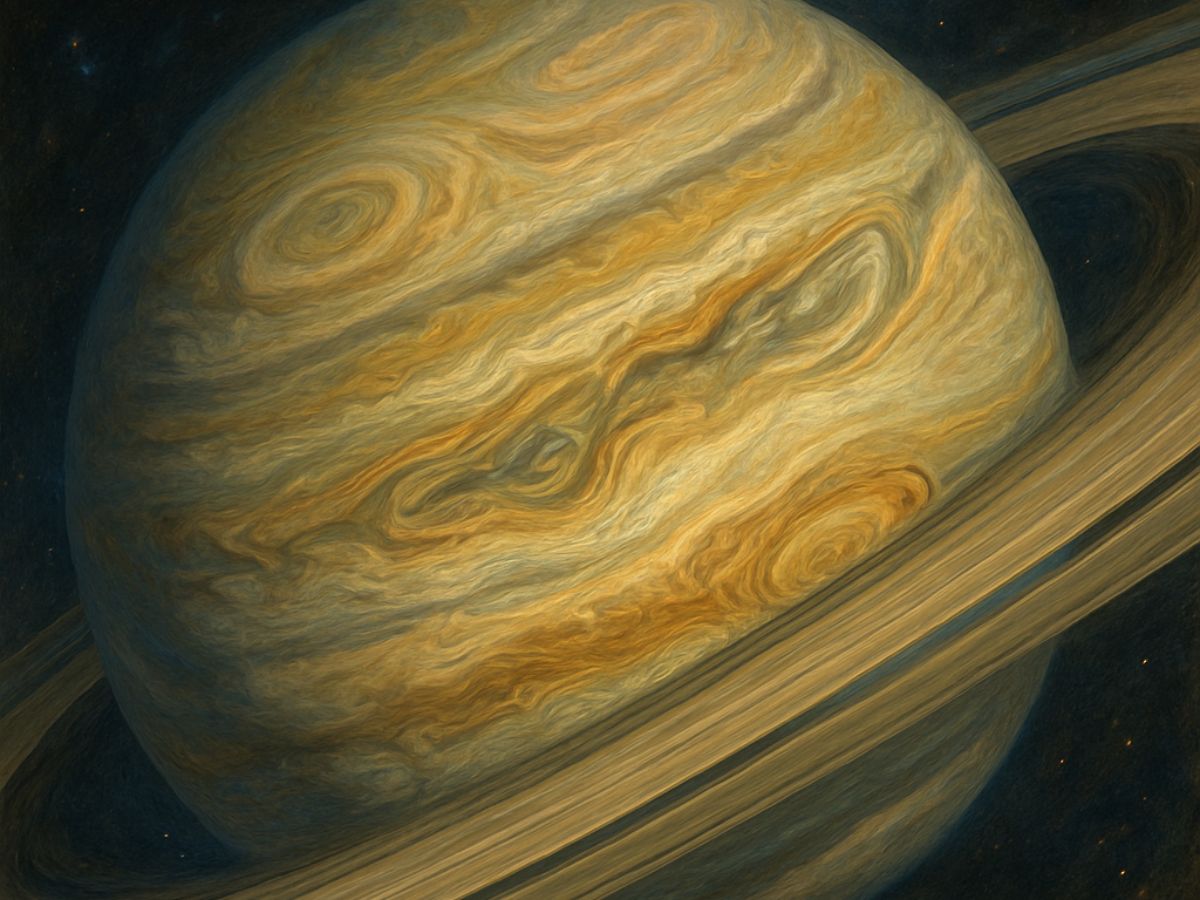
Scientists are perplexed by the strange and previously unknown formations that the James Webb Space Telescope (JWST) has revealed as it has peeled back the layers of Saturn’s atmosphere .The discovery, which may be linked to the planet’s iconic hexagonal storm, presents a全新的 (quán xīn – brand new) mystery about the atmospheric dynamics of gas giants.
The findings were unveiled by Professor Tom Stallard of Northumbria University at the EPSC-DPS2025 Joint Meeting in Helsinki. “This opportunity to use JWST was the first time we have ever been able to make such detailed near-infrared observations… The results came as a complete surprise,” he stated. The international team of 23 researchers observed Saturn for a continuous 10-hour stretch, leveraging JWST’s unprecedented sensitivity to see the faint emissions of Saturn’s upper atmosphere.
What Exactly Did Webb Discover?
The team focused on two distinct layers of Saturn’s atmosphere simultaneously:
- Over time, these “black pearls” appeared to float a little, yet they remained stable for hours. These “black beads” seemed to float slightly over time, but they stayed steady for hours.
- The Stratosphere (600 km up): In this lower layer, the data revealed a highly unusual, lopsided star-shaped structure with four arms extending from the north pole. Intriguingly, two arms of what should be a six-armed pattern were missing.
How Could These Features Be Connected?
The most tantalizing clue is the location of these bizarre structures. The four visible arms of the stratospheric “star” appear to emanate from positions directly above the points of Saturn’s famous hexagonal storm, which resides much deeper in the clouds.
Furthermore, the darkest beads in the upper ionosphere seem to align with the strongest arm in the stratosphere below. “Tantalizingly, the darkest beads in the ionosphere appear to line up with the strongest star-arm… but it’s not clear at this point whether they are actually linked or whether it’s just a coincidence,” Professor Stallard explained. This suggests a potential, yet unexplained, coupling between atmospheric layers separated by hundreds of kilometers.
Why Are These Discoveries So Significant?
Up until recently, studying Saturn’s upper atmosphere has been quite challenging because of its exceedingly weak emissions. JWST’s power has revolutionized this field. “JWST’s incredible sensitivity has revolutionized our ability to observe these atmospheric layers, revealing structures that are completely unlike anything we’ve seen before on any planet,” said Stallard.
The “dark beads” may result from complex interactions between Saturn’s magnetosphere and its rotating atmosphere, offering new insights into the energy that drives its aurora. Saturn’s extremely feeble emissions have made researching its upper atmosphere difficult until recently.
Also Read: After UK, Canada, Australia, Portugal Formally Recognises Palestine, Piling Pressure on Israel
What Happens Next?
The true nature of these features remains a mystery. The team hopes to secure more time on JWST for follow-up observations, especially as Saturn approaches its equinox—a seasonal change that occurs every 15 Earth years. This shift could dramatically alter the structures, providing crucial data to unravel their causes.
“Since neither atmospheric layer can be observed using ground-based telescopes, the need for JWST follow-up observations during this key time of seasonal change on Saturn is pressing,” Stallard added. The quest to understand these cosmic Rorschach tests has just begun.