
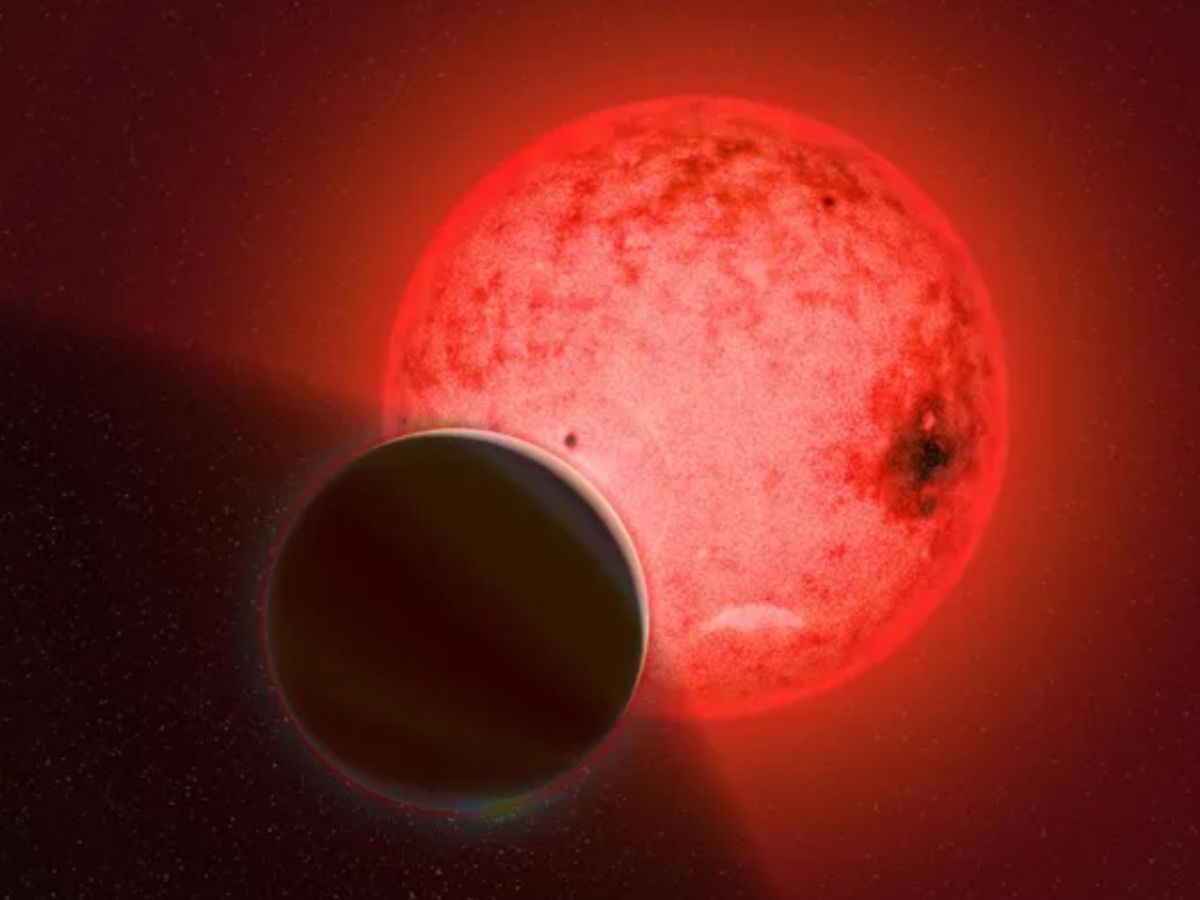
Astronomers have made a surprising discovery: a massive planet orbiting a star far smaller than the Sun. The finding has puzzled scientists, as such a huge planet should not be able to form around such a tiny star according to current theories of planet formation.
The star, named TOI-6894, is a red dwarf that has just 20% of the Sun’s mass. Red dwarfs are the most common type of star in our galaxy. However, it has long been believed that stars of this size don’t have enough material around them to form or hold on to giant planets.
Despite its tiny size, it hosts a gas giant planet with a mass comparable to or even larger than Jupiter. This combination challenges astronomers’ understanding of how planets form, particularly the belief that giant planets need a large, dense protoplanetary disk of material, which small stars typically lack.
Why This Is Surprising
Current models of planetary formation suggest that small stars cannot produce enough material to form massive planets. In other words, a star this small should not have the gravitational pull or the surrounding material to create a planet of this size. The discovery therefore raises questions about whether new mechanisms might allow giant planets to form in unlikely environments.
Implications for Astronomy
“This is a very unusual system,” said one of the lead astronomers involved in the research. “Finding a planet this big around a star this small challenges our existing theories and tells us that planet formation is more diverse than we thought.”
The discovery could help scientists refine models of planetary formation and better understand the variety of planetary systems in our galaxy. It also opens the possibility that other “forbidden” planetary systems may exist, waiting to be discovered.
Looking Ahead
Astronomers plan to study the star and its giant planet in greater detail using advanced telescopes. By analyzing its orbit, composition, and interactions with the star, they hope to uncover how such a planet could exist in a seemingly impossible situation. This unexpected find reminds us that the universe still holds many surprises, challenging what we think we know about the formation of stars and planets.
Also Read: From Accident to Hell: Which City Name Is the Strangest?