
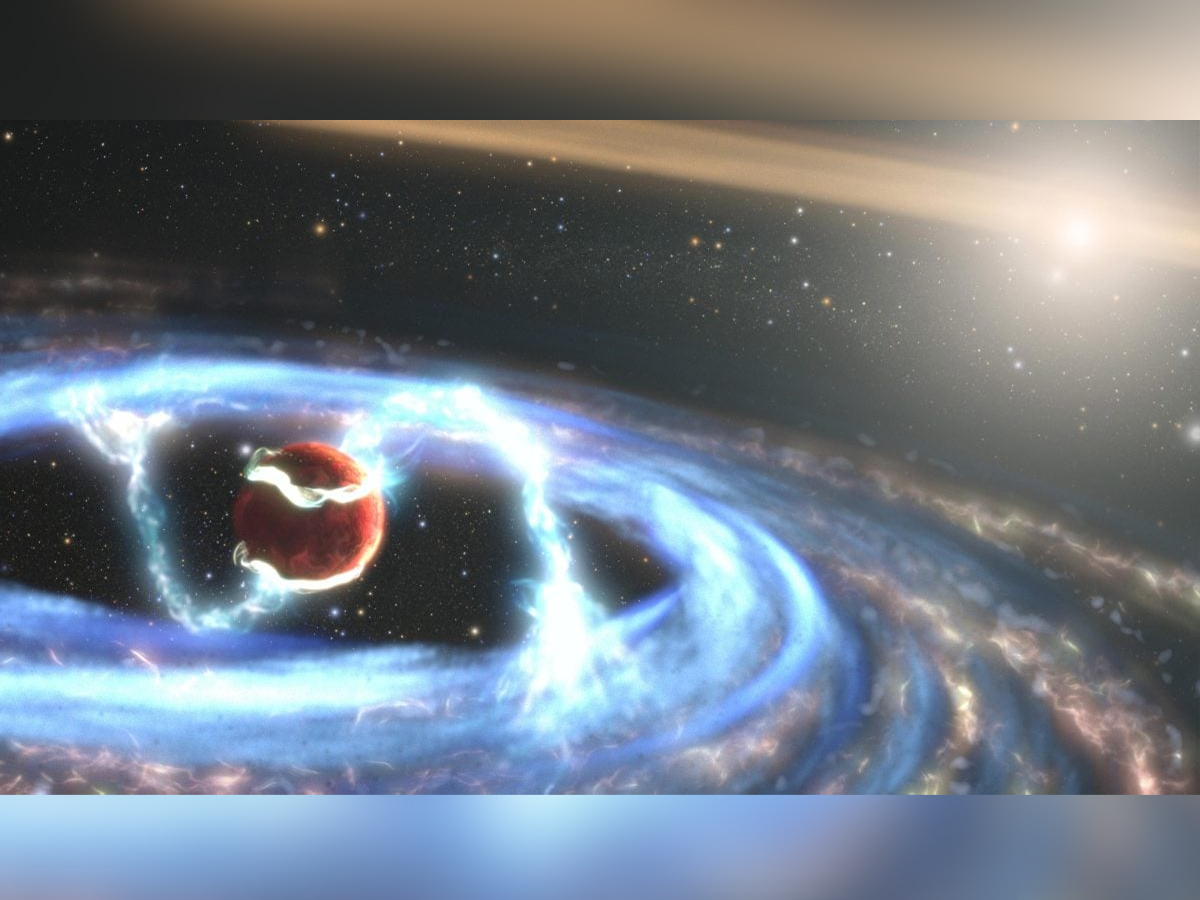
Astronomers have taken the first-ever direct photo of a baby planet forming around a young star. The planet was spotted inside a dusty ring, where it is still growing by pulling in gas from its surroundings.
Using advanced adaptive optics, the team captured glowing hydrogen gas streaming onto the infant world. This shows the planet is actively forming.
A Rare Discovery
The discovery was led by Laird Close, an astronomer at the University of Arizona, and Richelle van Capelleveen, a graduate student at Leiden Observatory in the Netherlands.
The team used some of the most advanced instruments in the world. These included the University of Arizona’s MagAO-X system at the Magellan Telescope in Chile, the Large Binocular Telescope in Arizona, and the European Southern Observatory’s Very Large Telescope in Chile.
Their findings were published in The Astrophysical Journal Letters.
Solving a Space Mystery
Astronomers have long studied dusty disks around young stars. Many of these disks have ring-like gaps, which scientists believed were caused by hidden planets clearing paths. But until now, no planet had been directly seen in these dark gaps.
“Dozens of theory papers have been written about these observed disk gaps being caused by protoplanets, but no one’s ever found a definitive one until today,” Close said.
He added, “Many have doubted that protoplanets can make these gaps, but now we know that in fact, they can.”
Detecting Planets With Hydrogen Light
The team searched for planets using a special type of light called hydrogen alpha, or H-alpha. This light is released when hydrogen gas falls onto a forming planet.
“As planets form and grow, they suck in hydrogen gas from their surroundings,” Close explained. “As that gas crashes down on them like a giant waterfall coming from outer space and hits the surface, it creates extremely hot plasma, which in turn, emits this particular H-alpha light signature.”
The MagAO-X system was designed to detect this light, making it possible to capture the baby planet in action.
This discovery is a breakthrough in understanding how planets form. It proves that young planets can carve out gaps in dusty disks, confirming years of theories.
For astronomers, this marks the beginning of a new era in studying planet formation directly.