
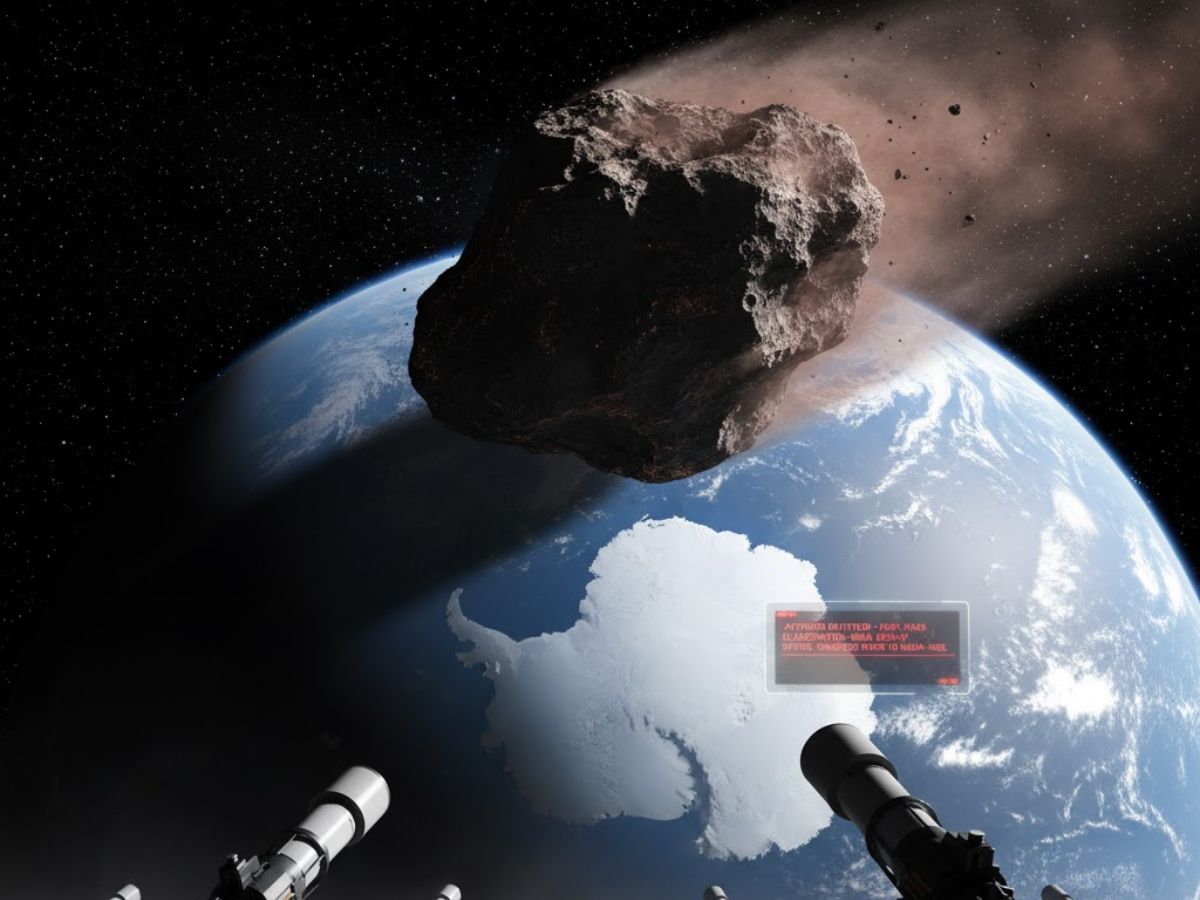
Earth experienced a celestial close call on October 1 as an asteroid whizzed past at an alarmingly close distance. When scientists disclosed that they had just discovered the space rock, known as Asteroid 2025 TF, a few hours after it had already approached our planet the closest, the situation became even more worrisome.
How close did the asteroid come to Earth?
Asteroid 2025 TF made its closest approach over Antarctica in the early hours of October 1. Only 482 kilometers separated it from the surface of the Earth. This near-miss is exceptional because it is even closer than the orbit of the International Space Station (ISS). For context, most objects tracked by astronomers pass at distances of millions of kilometres.
Also Read: Who is Jonathan Rinderknecht? Palisades Fire Suspect Charged in Deadly LA Blaze
Why is the delayed detection a concern?
The post-flyby detection was the event’s most concerning feature. The Catalina Sky Survey identified the asteroid only after it had already zoomed past Earth. This delay raises significant questions about our planetary defence capabilities and our ability to spot potential threats in time to take any action. The post-flyby detection was the event’s most concerning feature.
Was this asteroid a real threat to Earth?
According to space agencies, Asteroid 2025 TF was not a direct threat to life on Earth. The European Space Agency (ESA) confirmed that the 9.8-foot rock would have burned up in the atmosphere if it had entered, potentially creating a fireball and leaving only small meteorites on the ground. The real danger was to our infrastructure in space. Its path crossed the orbital lane of the ISS and satellites, meaning a direct hit on a spacecraft was a possible, though thankfully avoided, scenario.
How did scientists track it after the flyby?
Following its initial detection, ESA’s Planetary Defence Office sprang into action. They successfully observed the asteroid using the Las Cumbres Observatory in Australia. This tracking allowed them to precisely determine its size and confirm its closest approach time as 01:47:26 BST. The ESA praised the effort, calling the tracking of such a small, fast-moving object an “impressive feat” of astronomy.
Also Read: Trump Reveals Israel-Hamas’s First Phase of Signing Agreement, Says Hostages to be Released Soon
When will this asteroid return?
NASA, which recorded the event despite a government shutdown, has calculated the asteroid’s future trajectory. Data shows that Asteroid 2025 TF is scheduled to make another pass by Earth in 2087. On its next visit, it is predicted to be a much safer 5.97 million kilometres away at its closest point, posing no risk to the planet.
Disclaimer: This report is based on data and statements released by international space agencies.