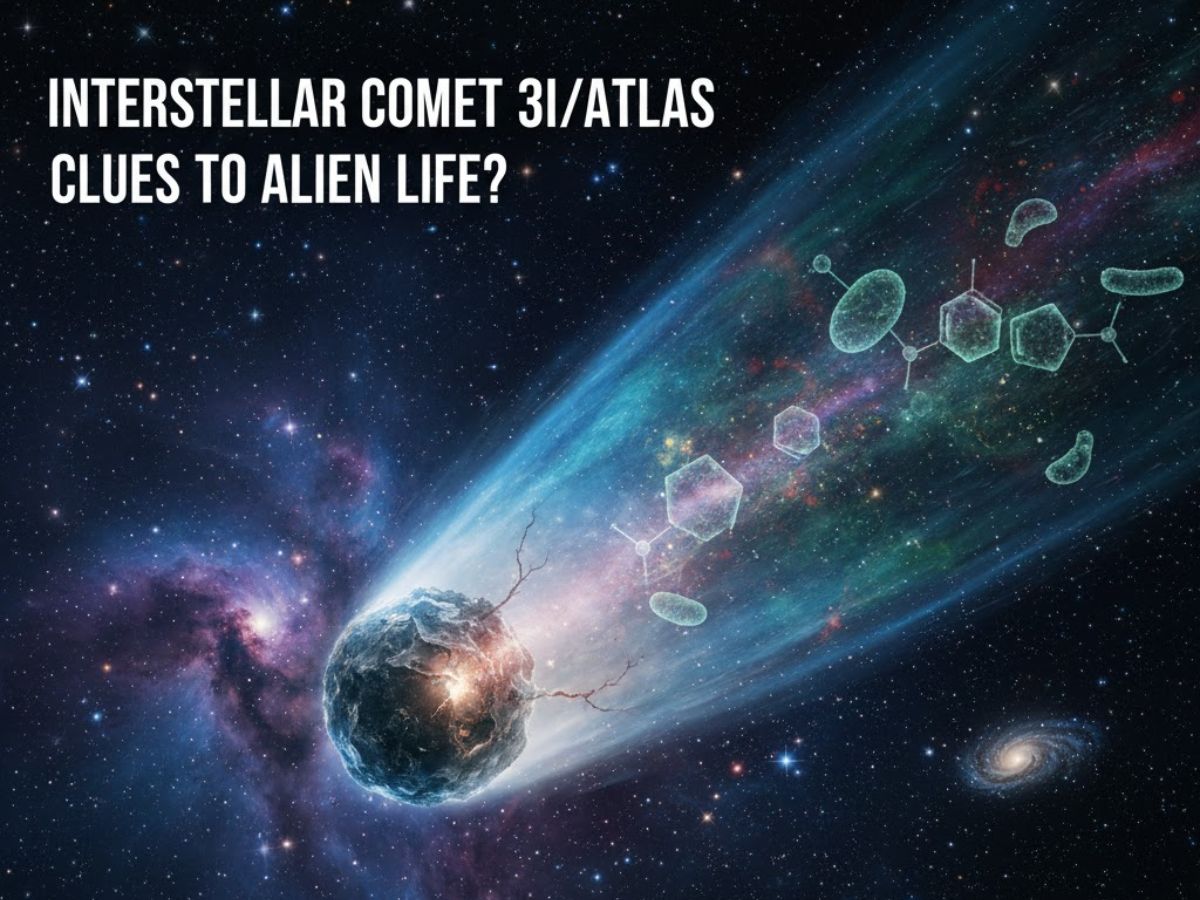
A strange signal from an interstellar visitor is challenging what astronomers know about the cosmos and could reveal crucial clues about the potential for alien life. Astronomers at Auburn University in Alabama pointed NASA’s Neil Gehrels Swift Observatory at the comet 3I/ATLAS and found something very unusual. They found the characteristic trace of hydroxyl (OH) gas, a chemical fingerprint of water, indicating that the basic components of life may not be exclusive to our solar system.
What Made This Comet Different?
The discovery was strange because of where it happened. Comets typically only release water when they are close enough to the Sun for their ice to turn into gas. However, 3I/ATLAS was seen shooting out jets of this water-based gas when it was nearly three times farther from the Sun than Earth. At this distance, most comets are silent and inactive. The alien comet was recorded losing a significant amount of water, about 40 kilograms every second, acting like a hose in the deep cold of space.
Also Read: ‘The Final Battle Begins’: Stranger Things 5 Trailer Drops, Teasing Epic Hawkins Showdown | Watch
How Was This Seen?
This strange activity would have been impossible for ground-based observatories to catch. The key was using a space-based telescope free from Earth’s atmosphere. The Neil Gehrels Swift Observatory was able to spot a faint ultraviolet glow from the comet, a telltale sign of the hydroxyl gas. This strong signal confirmed that something unknown and intriguing was occurring. Scientists theorize that the Sun’s heat may have been vaporizing tiny, icy grains released from the comet’s core, causing the unexpected early outgassing.
What Does This Mean for Life?
The study of comets and other star systems will be significantly impacted by this discovery. The criteria for studying comets in our own solar system are based on the water they release. Seeing 3I/ATLAS act similarly means scientists can apply the same rules, offering a rare chance to study the chemistry of a planetary system beyond our Sun. According to Professor Dennis Bodewits, detecting water from an interstellar comet is like “reading a note from another planetary system.” It powerfully suggests that the ingredients for life’s chemistry are common across the universe.
A Diverse Cosmic Neighborhood: How Does It Compare?
The variety of objects moving between stars is further highlighted by this discovery. Borisov and Oumuamua, the other two known interstellar visits, were very different. Borisov had a lot of carbon monoxide, whereas Oumuamua was arid and rocky. 3I/ATLAS, with its abundant and prematurely released water, is the third distinct type. As researchers note, “Each one is rewriting what we thought we knew about how planets and comets form around stars.”
Also Read: ISRO Set to Launch India’s Heaviest Satellite CMS-03: A Boost for Naval Communication
What Happens Next?
Currently, 3I/ATLAS is hiding in the Sun’s glare after reaching its closest point to the Sun, called perihelion, on October 29. Scientists are now waiting for it to reemerge from this conjunction in the coming days. This close encounter with the Sun would have changed the comet dramatically, and astronomers are eager to study it again to learn what new secrets this interstellar messenger has to share.