
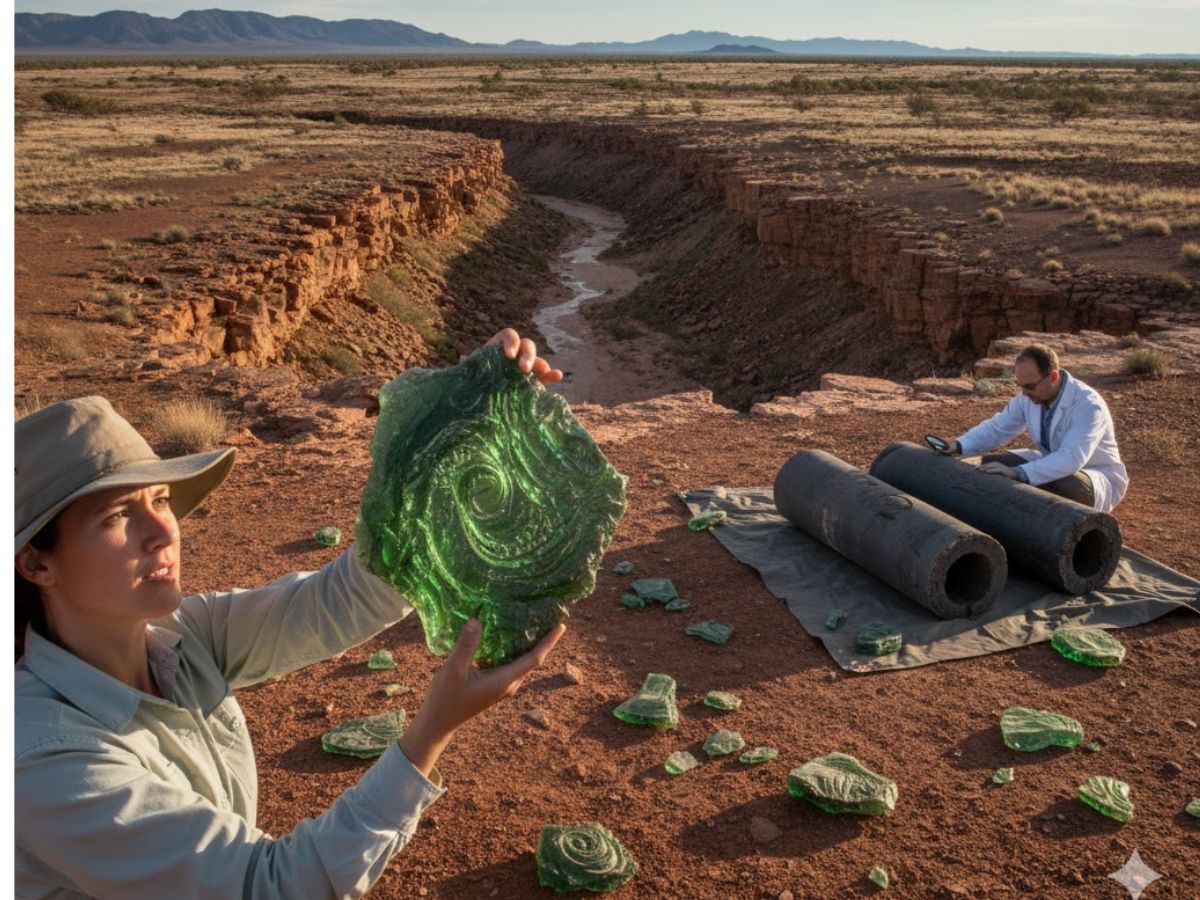
Mysterious glass blobs scattered across the Australian desert have been revealed as evidence of a massive asteroid impact that occurred 11 million years ago. The discovery, led by geoscientist Anna Musolino, confirms a long-forgotten cosmic collision, yet it deepens a major scientific mystery: where is the crater?
What Are These Mysterious Glass Blobs?
For centuries, peculiar pieces of natural glass known as ananguites or australites have been found in South Australia. Traditionally, most of this glass was thought to be tektites, formed from a giant meteorite impact in Southeast Asia around 788,000 years ago. However, a new study published in Earth & Planetary Science Letters has now identified that some of these glass pieces are far older and tell a different story. Geochronologist Fred Jourdan, a co-author of the study, calls them “tiny time capsules that hide a major event.”
How Did Scientists Uncover the Truth?
The breakthrough came from re-examining a curious finding from 1969. Back then, NASA scientists found that a small number of these glass beads had a different mineral composition. Musolino and her team decided to investigate this anomaly. They scanned collections at the South Australian Museum to find these “odd beads.” According to their investigation, the chosen samples differed from the typical australites in terms of density, bubble patterns, and trace element content. This demonstrated that they originated from a distinct, far older asteroid impact on a different region of the Earth’s crust.
What Makes This Discovery So Puzzling?
The key finding is the age. Argon dating on the samples revealed they are 11 million years old, far older than the known tektites. This confirms a previously unknown impact event. The major puzzle, however, is the complete absence of a crater. An impact powerful enough to scatter glass debris for thousands of kilometers would have left a massive crater. According to scientific theories, “severe weathering and the aridification of central Australia that occurred some 33 million years ago,” which erased all discernible evidence from the surface, is most likely what caused the crater to disappear.
Also Read: Who was Christopher Scholtes? Father Guilty in Daughter’s Hot Car Death, Passes Away