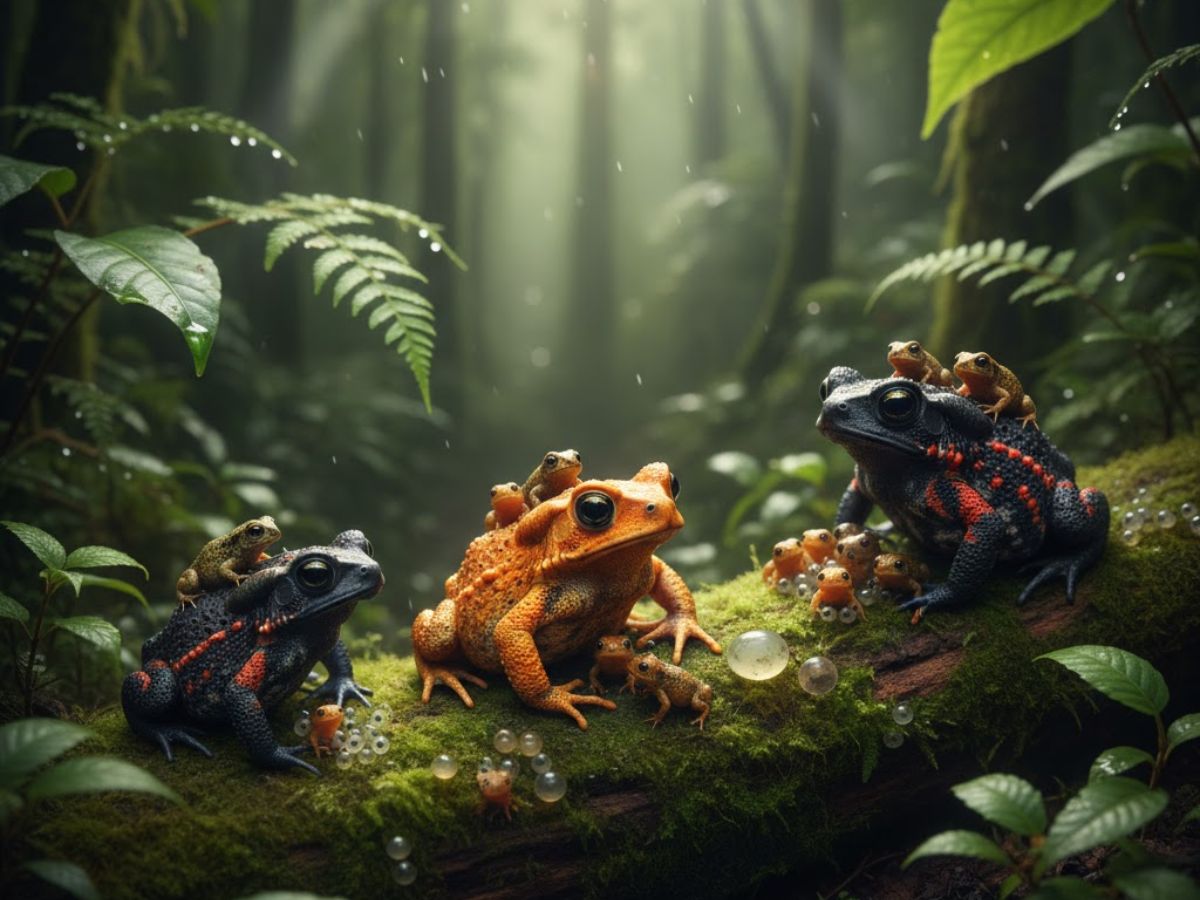
In a discovery that challenges a basic tenet of amphibian life, researchers have identified three new species of toads in Tanzania that give birth to live young. Unlike the vast majority of frogs and toads, which lay eggs that hatch into free-swimming tadpoles, these toads deliver fully formed baby toads, or “toadlets,” representing a rare and remarkable evolutionary adaptation.
What Makes These Toads So Unusual?
The reproductive strategy of these toads, belonging to the genus Nectophrynoides (commonly called African live-bearing toads or tree toads), is exceptionally rare. Out of more than 7,000 known frog and toad species globally, only 17 are known to give birth to live young. With this discovery, 13 of those 17 now belong to this single Tanzanian lineage, making the Eastern Arc Mountains a unique hotspot for this trait.
The three new species have been named:
- Nectophrynoides saliensis
- Nectophrynoides luhomeroensis
- Nectophrynoides uhehe
How Were These New Species Discovered?
The discovery involved identifying latent diversity within a group of toads that were previously believed to be well-known, rather than just discovering new toads in the forest. They were all categorized as Nectophrynoides viviparus, a single broad species, for many years.
Through a meticulous study involving:
- DNA Analysis: Comparing genetic material from hundreds of preserved specimens.
- Morphological Study: Noting subtle differences in head shape and gland placement.
By using bioacoustics to record and analyze their unique mating sounds in the wild, scientists were able to identify four distinct species, each with its own isolated population in the mountain forests, that were previously thought to be one species.
Also Read: Ukraine Disables Another Russian ‘Shadow Fleet’ Tanker with Sea Drone Attack
Why Is This Discovery Critical for Conservation?
By using bioacoustics to record and analyze their unique mating sounds in the wild, scientists were able to identify four distinct species, each with its own isolated population in the mountain forests, that were previously thought to be one species.
Habitat Loss:John Lyakurwa, a biologist at the University of Dar es Salaam, cautioned that “the woodlands where these toads live are disappearing swiftly,” pointing to human encroachment and climate change as the main risks.
Precedent of Extinction: A related species, Nectophrynoides asperginis, was declared extinct in the wild in 2009 due to habitat destruction from a dam and the spread of chytrid fungus, a deadly amphibian disease.
Increased Urgency: The finding emphasizes how critical it is to preserve the unique, delicate alpine habitats that each new species inhabits.
Your Questions Answered: Live-Bearing Toads FAQs
Q: How does “live birth” work in toads?
A: It is a form of ovoviviparity. The female retains the fertilized eggs inside her body. The embryos develop within the eggs, receiving nourishment from the yolk (not directly from the mother via a placenta, as in mammals). They hatch internally and are then born as miniature toads.
Q: What is the evolutionary advantage of skipping the tadpole stage?
A: This adaptation likely lets the toads live away from permanent water sources. Without needing ponds or streams for tadpoles, they can survive in upland forests where water is scarce or seasonal.
Q: Where exactly were they found?
A: All three new species, along with their relative N. viviparus, are found only in Tanzania’s Eastern Arc Mountains. This ancient range is a global biodiversity hotspot, home to many species unique to the area.
Q: What are the main threats to their survival?
A: The chytrid fungus, which has led to widespread amphibian losses worldwide, climate change, and the devastation of their damp forest habitats by logging and cultivation are the main threats.
Q: What happens next after this discovery?
A: Researchers will formally document the species in scientific journals. Conservationists will use the data to push for stronger mountain habitat preservation and update threat assessments like the IUCN Red List in order to prevent extinction.
Also Read: Goa Seeks Passport Revocation for Absconding Nightclub Owners in Deadly Fire Case