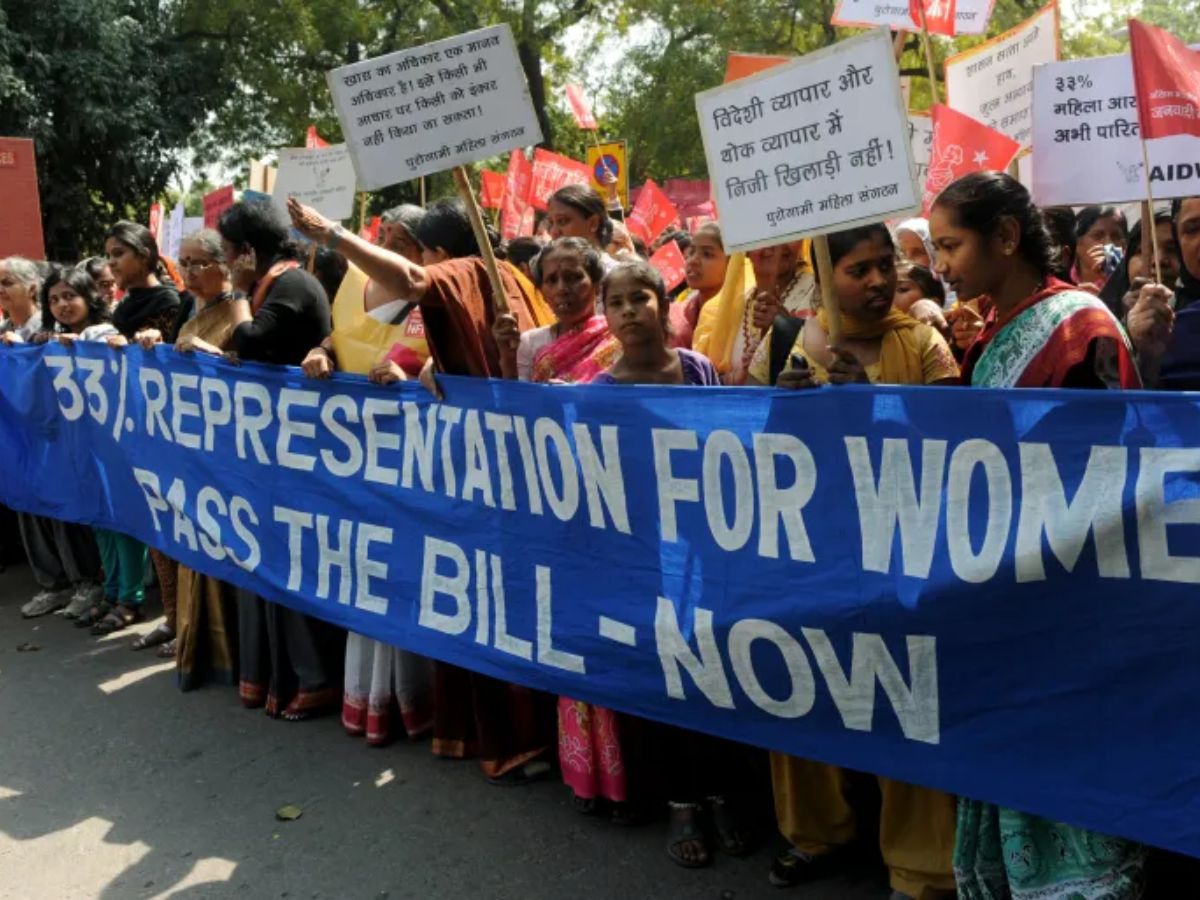
Politics around the women’s reservation bill, the Nari Shakti Vandan adhiniyam has hit a new low. Soon after the special session of Parliament both the Opposition and the BJP have hit the streets, blaming each other for denying women reservations. But more than that what was even more despicable is the way this government used the women’s bill as a prop to bring in delimitation through the back door. Samajwadi PArty Chief Akhilesh Yadav was right when he said that the government has made naari into a naara (using women as just a slogan). This session was not about women’s reservation. It was about delimitation.
Then why did the Modi Government incur the expense and trouble of calling a special session of parliament, right in the middle of two state assemblies ? The debate on delimitation could have happened during the Budget session itself or could have waited till the Monsoon session. Or anytime in May once the assembly polls were over. Is the Opposition right when it claims that this entire exercise was carried out, keeping the West Bengal polls in mind ? Could the Modi Government be so partisan that it would upset an entire nation just so it can get the BJP elected to power in West Bengal. Because, let us face it, the BJP has little or no chances of wresting power in Tamil Nadu, a state where both the national parties have been reduced to a side show. If anything, the Delimitation debate may work against the BJP’s ally the ADMK for the southern states are viewing the move to increase seats as a vote to make the North and central India more powerful than the South.
Hence, I come back to the Opposition’s very pertinent question : can the BJP find no other way to defeat Mamata Bannerjee than to carry out this entire charade, club the Women’s Bill with Delimitation, knowing fully well that the Opposition will not support the latter and therefore will have to vote against the former as well ? The catch here is that the Opposition did not fold and play into the Government’s game. Not only did it stay united but it also stayed articulate and on message. The INDIA bloc has argued that the two are not one, that while it voted against Delimitation, it is all for implementing the WOmen’s Bill which has already been passed in 2023. What is stopping the government from implementing that bill?
Before I end, I would like to add a much more important – and purely personal point of view. Is the public at large, and more specifically, in West Bengal, going to vote on gender lines? Do we vote for a woman leader – be it Mamata Bannerjee, Mayawati, Jayalalitha, Rekha Gupta – and of course Indira Gandhi, because we want to see a woman leader. Or are there other considerations at play? For instance, Mamata has won successive elections because of her connect with the people. She has won because of her hold on the system, her organisation, her welfare schemes and her politics. Not because she is a woman. In fact her being a woman would be the one of the last considerations a vote has in mind when casting her or hit vote. What the voter would like to know is what benefits Mamata is offering her – and these parameters are the same that one would apply to a man seeking a woman’s vote. Why was the former Madhya Pradesh CM called Mama (mother’s brother) by the voters of his state? It is because of the welfare schemes such as Laadli Behna that he had announced specially for women. Similarly Devendra Fadnavis managed to woo the women’s vote with his Lakdi Behna scheme. It is not the gender but the credibility of the leader that the voter votes on.
Similarly, Mayawati’s appeal is not her gender but that she is a Dalit leader; likewise Jayalalitha’s vote bank was a cult around her personality and again, not the gender card. (MGR had a similar cult following.) The Delhi Chief Minister was not the campaign face of the BJP, she was brought in later (in fact here one could argue she was brought in so that the BJP would not face criticism that prior to the Delhi election, it did not have a single woman CM), but since then Rekha’s politics have transcended the gender card. She is not being judged on governance and performance metrics, as would any other CM who is not a woman.
As for our first (and only) woman Prime Minister Indira Gandhi it was the dynasty card and not her gender that got her a foot in the door. And after that, it was her personality and individual politics that earned her a place in our politics, not her gender.
So, it can be argued that as far as the voter is concerned, a woman candidate is judged on the same metrics as the male. To say that the women voters will be unhappy if the bill is not passed is wrong. It is the women wannabe politicians who will be unhappy when the bill is not passed; as far as the voter, any leader who looks after the needs of the women voter, be it through welfare schemes or job opportunities, will get the vote.