The recent uproar around gig workers has exposed uncomfortable questions about inequality and class divide in India’s convenience economy. While AAP leader Raghav Chadha has sought to insert himself into the debate, the sharper focus has come from the public exchange with Zomato founder Deepinder Goyal, which revealed a deeper moral dilemma. At its core, the issue reflects a guilt-free urban elite culture that demands speed and convenience, while remaining detached from the precarity faced by those who keep the system running.
Deepinder Goyal highlighted how, for most of history, inequality survived not just because of income gaps, but because of distance. The labour of the poor was kept out of sight of the rich. Factory workers toiled behind walls, farmers worked in distant fields, and domestic labour remained confined to backrooms and service entrances. Consumption was detached from production. The privileged enjoyed comfort without confrontation, benefit without burden, and crucibles, without guilt.
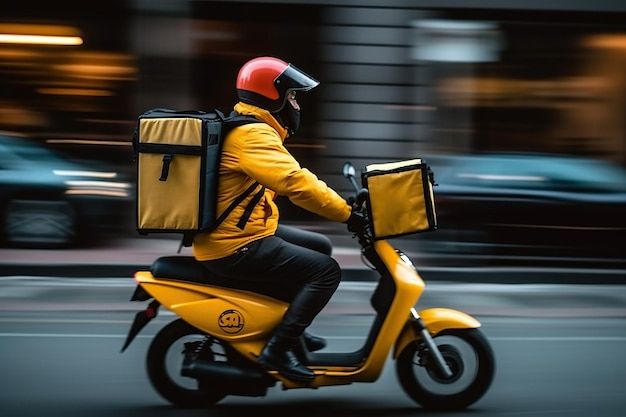
India’s gig economy has disrupted this centuries-old arrangement. For the first time, at an unprecedented scale, the working class and the consuming class now meet face to face, transaction after transaction. The delivery partner at the doorstep with a ₹1000 food order. The rider navigates rain and traffic to bring groceries at midnight. The worker on a borrowed bike, logged into an app for eight or ten hours, sustaining a livelihood that is modest but real.
Well beyond a mere economic shift, it is a sociological rupture. From Invisible Labour to Everyday Encounter. Classical sociology helps explain why the gig economy feels so emotionally charged. Georg Simmel argued that modern economies depend on social distance to function smoothly. Distance allows transactions without moral overload. The pre-digital economy perfected this separation. Labour was intermediated, hidden, and abstracted.
The gig economy collapses that buffer. As Erving Goffman’s work on face-to-face interaction suggests, once human presence enters an exchange, roles are no longer abstract. Inequality stops being statistical and becomes personal. You see the fatigue. You hear the politeness. You sense the asymmetry. That is why discomfort, not just debate, defines public reactions to gig work.
INDIA’S GIG REALITY: SCALE AND SUBSTANCE
This discomfort is unfolding against a massive structural transformation. According to NITI Aayog’s 2022 report, India had around 7.7 million gig and platform workers in 2020-21, projected to grow to 23.5 million by 2029-30. Far from being marginal, gig work is becoming one of the largest absorbers of India’s urban and semi-urban labour force.
Crucially, most gig workers are internal migrants, drawn from rural and small-town India into cities where traditional formal jobs remain scarce. For many, platform work pays better than older informal alternatives such as daily wage construction, street vending, or unregistered factory work. Studies consistently show that platform earnings, while volatile, often exceed pre-gig incomes, especially when measured against flexibility and entry barriers.
This does not mean gig work is ideal. It means it is preferable to what existed before.
THE REAL SOURCE OF THE ANXIETY: MORAL GUILT
The intensity of the debate around gig work is often misread as a clash over economics or labour law. In reality, it is driven by something subtler: guilt among the consuming classes.
An 800 delivery might equal a worker’s day’s earnings after fuel costs, app commissions, and bike rent. That arithmetic was always true in some form, but it was never visible. Today it rings the doorbell. Sociologist Rachel Sherman, writing on service labour, observed that elites often oscillate between benevolence and avoidance when confronted with inequality they directly benefit from. In India’s gig economy, this plays out in awkward tipping, forced politeness, or moral overcompensation on social media.
Others retreat into justification: “They choose this work.” Some swing to moral absolutism: “This is exploitation, full stop.” Both responses stem from the same source—the collapse of invisibility.
THE UNSPOKEN DEMAND BEHIND MANY “SOLUTIONS”
Here lies the uncomfortable truth rarely acknowledged in public discourse. Many aggressive calls to ban, freeze, or over-regulate the gig economy are not fundamentally about worker dignity. They are about restoring moral comfort for consumers. They seek to remove the face from the transaction.
But as James C. Scott’s work on informality warns, destroying imperfect systems does not automatically produce better ones. In India, banning or regulating gig platforms into economic unviability does not convert gig workers into secure, salaried employees. Those jobs do not materialise overnight. Instead, work retreats into deeper informality—cash payments, zero accountability, no digital trace, and no public debate at all.
The consequences are predictable. Platforms shrink. Prices rise. Demand falls. Workers lose income first. And then something else happens. The affluent regain convenience without confrontation. The guilt dissolves. Inequality returns to abstraction.
MARKETS, AGENCY, AND EVOLUTION, NOT ERASURE
A right-leaning sociological perspective does not deny inequality. It rejects the idea that dismantling markets is the solution. Gig workers are not passive victims. They exercise agency—choosing hours, platforms, routes, and intensity in ways unavailable in traditional informal work. Their bargaining power grows as platforms compete and as demand expands. Earnings, incentives, and protections have already evolved since the early years of ‘platformisation,’ and they will continue to do so precisely because the work is visible and contested.
As Joseph Schumpeter noted, progress in capitalist systems is evolutionary, not moralistic. The gig economy is a transitional form, not an endpoint.
THE DOORBELL IS NOT THE PROBLEM
The gig economy did not create inequality in India. It exposed it to people who previously had the privilege of not seeing it. Every delivery is a reminder that prosperity rests on labour. The discomfort this generates is not a policy failure. It is a moral reckoning. The choice before us is simple.
We can use this visibility to improve conditions incrementally, strengthen safeguards, and respect work without destroying livelihoods. Or we can regulate and ban our way back into ignorance where inequality survives comfortably, unseen and unquestioned. Visibility is the price of progress. The doorbell is not the problem. What matters is what we do after opening the door.
Kritant Mishra is a Public Policy Consultant and head of an NGO. His areas of interest are Socio-Anthropology, Health Policy, Education, and Socio-Economy.