
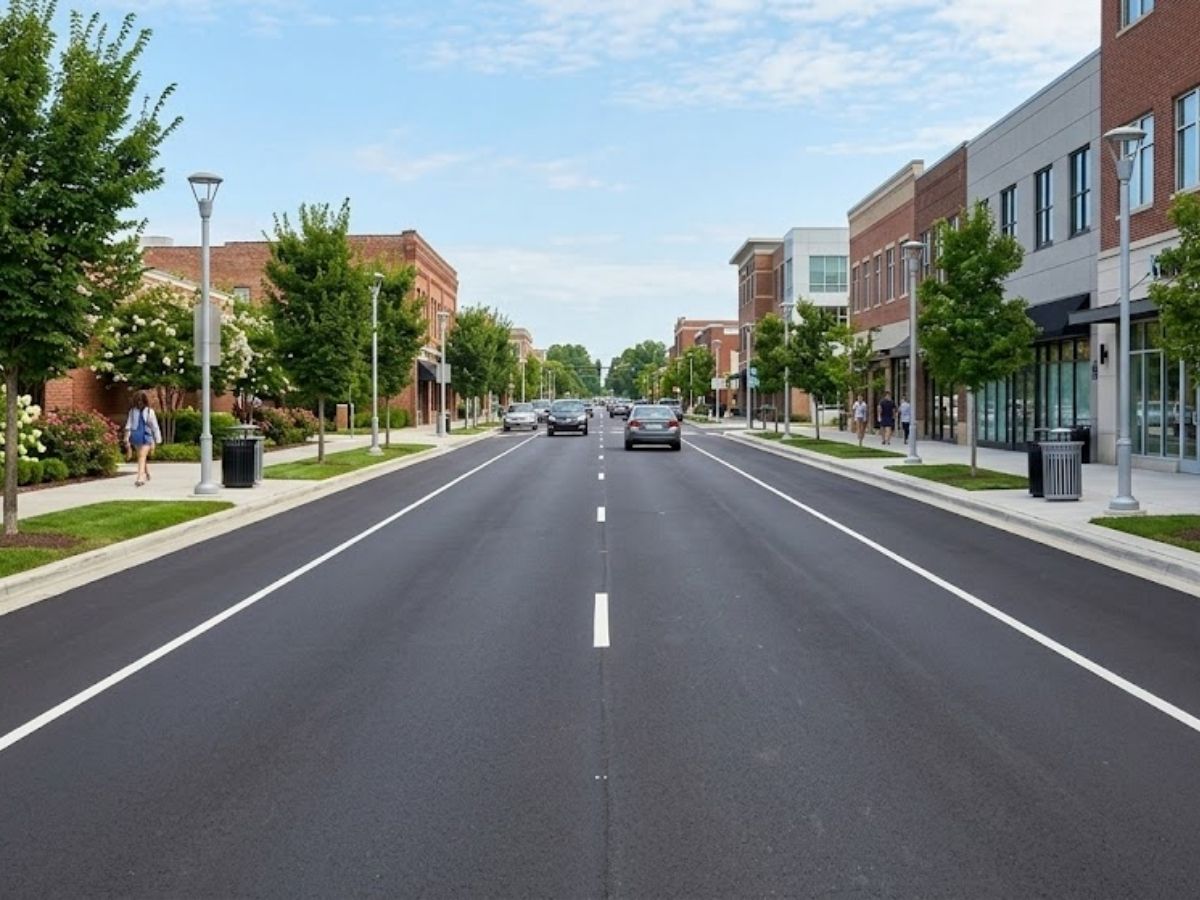
The group of residents said the ‘melody’ road is “causing significant distress and serves no public necessity.
Introduction
A newly opened stretch of Mumbai’s Coastal Road is catching attention for more than just easing traffic. Drivers cruising along a section of the road are being treated to a musical surprise the surface plays the tune of ‘Jai Ho’ as vehicles pass over it in a steady speed. Mumbai installation uses specially engineered rumble strips. These are grooves cut into the asphalt at a calculated depths and distances to create sound through tyre friction. Officials say the project was executed using Hungarian technology and technical expertise. Hungary has long experimented with melody roads that combine traffic management with creative design. The chosen tune, Jai Ho from Slumdog Millionaire, is audible even with windows closed when drivers maintain the intended speed range.
The science behind how the roads make music
At first glance, the musical road appears as a series of shallow ridges carved into the asphalt. But each groove is carefully placed using acoustic calculations. When tyres roll over these ridges, they vibrate rapidly, like running a stick along the gaps of a metal fence. The spacing between grooves determines how often the tyre is jolted. Faster impacts create higher-frequency vibrations, while wider spacing produces lower tones. Engineers design these intervals so that when a car moves at a specific speed, the vibrations combine into recognisable musical notes.
Inside the vehicle, the car’s body acts as a resonating chamber, amplifying these patterns into sound waves that drivers perceive as a melody. If a driver goes too slowly, the notes stretch and sound off-beat; too fast, and the tune becomes rushed and distorted. The concept builds on traditional rumble strips used worldwide to alert drivers who drift from lanes, but here, the same safety principle is turned into an acoustic instrument.
Musical roads around the world
While Mumbai’s installation is India’s first, the idea has decades-old roots. The earliest known musical road, called the ‘Asphaltophone’, appeared in Denmark in 1995, created by artists Steen Krarup Jensen and Jakob Freud-Magnus, using raised road markers to produce tones. The modern concept gained popularity in Japan in 2007, when an engineer, Shizuo Shinoda discovered that grooves cut into asphalt could generate musical sounds when vehicles passed over them at specific speeds.
From there, melody roads spread globally, appearing in countries like Hungary, South Korea, and the United Arab Emirates. In Japan, several well-known ‘Melody Roads’ run through scenic areas such as Gunma and Hokkaido, where drivers hear local folk tunes while travelling at steady speeds.
Hungary’s Route 67 near Mernye famously plays rock hit number A 67-es útby the band Republic, turning a highway stretch into a musical tribute. South Korea’s Anyang ‘singing road’ plays nursery tunes to keep motorists alert, while the UAE’s Sheikh Khalifa Street in Fujairah features a 750-metre musical stretch that plays Beethoven’s Ode to Joy.
Across Europe and beyond, installations range from small experimental roads to tourist attractions designed to encourage safe driving. Each country adapts the technology differently; some use it to maintain speed discipline on long highways, while others create interactive public art experiences that transform routine commutes into something unexpectedly playful
The Right to Sleep as a Fundamental Right
Article 21 of the Constitution guarantees the right to life and personal liberty. Over decades, judicial interpretation has expanded “life” beyond mere animal existence to include dignity, health, and quality of living. The Supreme Court of India has repeatedly affirmed that sleep is intrinsic to this guarantee. In earlier observations, including those articulated by Justice Dipak Misra, the Court recognised sleep as a biological necessity essential to human functioning and dignity. Sleep deprivation, the Court observed, directly impairs the right to live with health and well-being. This jurisprudence places sleep squarely within constitutional protection.
Thus, the issue is not whether residents are inconvenienced. The question is whether repetitive, engineered sound even if culturally symbolic intrudes upon a legally protected sphere of life.
Noise Regulation and Statutory Limits
Beyond constitutional doctrine, statutory law governs environmental sound. The Noise Pollution (Regulation and Control) Rules, 2000 prescribe permissible decibel limits, particularly during nighttime hours (10 p.m. to 6 a.m.), with stricter standards in residential zones.
These regulations reflect scientific consensus: chronic nocturnal noise is associated with hypertension, cardiovascular strain, cognitive fatigue and psychological stress. In a dense metropolis like Mumbai, where baseline ambient noise levels already strain permissible thresholds, any additional source of patterned sound warrants regulatory scrutiny.
The crucial legal question becomes empirical (1) Does the musical road exceed permissible decibel levels at nearby residential points? (2) Was a noise impact assessment conducted prior to installation? (3) Has compliance with nighttime limits been independently verified? If the answer to these questions is unclear, governance enters constitutionally vulnerable territory.
Public Interest vs. Proportionality
The supporters of the installation argue that it serves a legitimate public purpose, namely, road safety. Since, India continues to face alarming traffic fatality rates, if acoustic grooves encourage motorists to maintain optimal speed, the intervention arguably advances a compelling state interest.
However, constitutional law demands proportionality and it cannot end by solely identifying a legitimate objective. The State may pursue legitimate aims, but its methods must not disproportionately burden fundamental rights. The doctrine of proportionality, as embedded in Indian constitutional jurisprudence requires that:
(1) The measure must pursue a legitimate objective.
(2) It be suitable to achieve that objective.
(3) It must be necessary, i.e., no less restrictive alternative exists
(4) The impact on rights must not be excessive in comparison to the benefit sought to be achieved.
When the above principles are applied to the present context, the inquiry becomes more nuanced. Even if the objective of speed regulation is a legitimate objective, is continuous musical output during late hours necessary to achieve the said aim? Could the grooves be engineered to function silently beyond certain times? Could alternative traffic calming measures achieve similar safety outcomes without acoustic consequences?
If less intrusive alternatives exist, the present design may fail constitutional scrutiny under the proportionality standard.
Environmental Jurisprudence and Noise as a Pollutant
Indian environmental law recognises noise as a pollutant. The Noise Pollution (Regulation and Control) Rules, 2000 which was framed under the Environment (Protection) Act, 1986 —prescribe specific decibel ceilings for industrial, commercial, residential, and silence zones, with stricter limits during nighttime (10 p.m. to 6 a.m.).
The Supreme Court in Church of God (Full Gospel) in India v. K.K.R. Majestic Colony Welfare Association has repeatedly treated noise pollution as a violation of fundamental rights when it exceeds permissible limits. Religious freedom, commercial activity, and festive expression have all been subjected to noise regulation. Which is settled that no activity, however culturally valued, enjoys immunity from environmental standards.
Thus, a question that arises is : (1) Has the musical road’s acoustic output been measured at nearby residential receptors? (2) Does it remain within prescribed decibel limits at night? (3) Were environmental impact considerations formally recorded before implementation? Absent transparent compliance data, the project may face challenges grounded in environmental law, not merely constitutional rhetoric.
A Broader Urban Question
Mumbai is often romanticised as “the city that never sleeps.” Yet constitutionalism rejects romanticism as a basis for policy. The vitality of a city cannot justify erosion of basic human needs. The right to life under Article 21 protects the conditions that make urban living sustainable including rest.
If Mumbai’s singing road becomes the test case, it will not merely be about melody or patriotism. It will be about the balance between collective infrastructure goals and individual constitutional guarantees. In that balance, the law is clear: public interest measures must respect fundamental rights. A city may celebrate innovation — but it must also protect sleep.
Jagriti Dosi is a Practising advocate at the High court of Delhi
Kamlesh Singh is a author of Sabarimala Verdict: A Tussle between Constitution & Religion.