
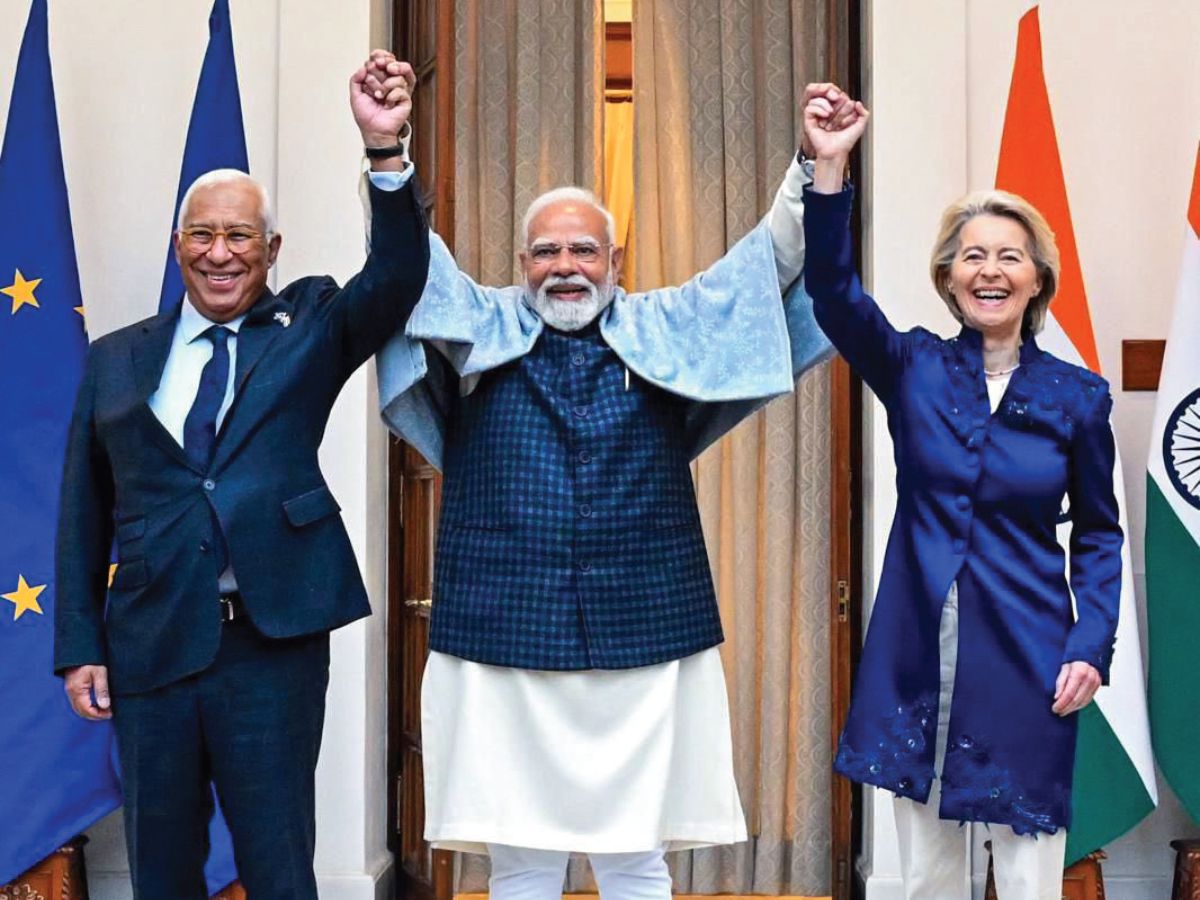
India today finds itself at an unusual and potentially transformative juncture in the global economic order. On one side lies the long-negotiated India–EU agreement — often described as the mother of all deals — impenetrable with market access, regulatory standards, and long-term discipline. On the other is the rapidly deepening India–US economic engagement — increasingly resembling the father of all deals — driven by technology, capital, and strategic convergence. Considered separately, each is consequential. Taken together, they could quietly but decisively reshape India’s growth trajectory.
The deal with the European Union is, at its core, about acceptance into the most rules-intensive market in the world. The attraction is not merely access to nearly 450 million consumers. What truly matters is alignment with European standards — on product quality, labour norms, environmental safeguards, data protection, and now carbon emissions. In effect, trade with Europe is inseparable from regulatory convergence.
For Indian firms, particularly in manufacturing, this represents both an opportunity and a stress test. Firms that meet European standards acquire a form of global certification, easing access to other developed markets. Over time, this can lift India’s export basket away from low-margin, price-driven goods towards higher-value, contract-based manufacturing. The macroeconomic payoff is gradual but deep: higher productivity, greater formalisation, and improved institutional quality.
But these gains are not costless. Compliance burdens fall disproportionately on MSMEs, adjustment costs are front-loaded, and domestic policy flexibility narrows. In the short run, some firms will exit rather than upgrade. The India–EU deal, therefore, is not about speed or headlines. It is about embedding Indian industry within a stable, predictable, and rules-based global trading system — a slow but durable source of growth.
The emerging economic compact with the United States operates through a very different channel. Here, tariffs are almost incidental. The real action lies in technology, services, and capital. Semiconductors, defence manufacturing, artificial intelligence, space technologies, digital public infrastructure, and advanced services dominate the agenda. The US brings frontier innovation, deep capital markets, and a risk-taking private sector — ingredients that can raise India’s total factor productivity far more rapidly than traditional trade liberalisation.
The growth impulse from this relationship is sharper and more visible. Technology diffusion boosts high-skill employment, strengthens India’s position in global value chains, and accelerates the shift towards advanced manufacturing and knowledge-intensive services. At the same time, deeper integration with the US economy increases exposure to dollar-linked financial cycles, shifts in tech regulation, and geopolitical recalibrations. The US deal accelerates growth — but it also transmits volatility.
Seen together, these two engagements are not alternatives; they are complements. The EU anchors India in a rules-based order; the US plugs India into the cutting edge of global innovation. One rewards patience and compliance; the other rewards agility and scale. Very few large economies today have credible access to both.
This dual engagement has an important macroeconomic consequence: risk diversification. In a world where globalisation is fragmenting — trade blocs are hardening, technology is increasingly weaponised, and climate policies are morphing into trade barriers — India reduces its dependence on any single market or growth model. The EU provides stability and predictability; the US provides speed and dynamism. Together, they help India hedge against shocks emanating from either system.
There is also a deeper strategic shift underway. India is moving away from a growth model anchored primarily in domestic demand and services exports. In its place is a hybrid model: export-disciplined manufacturing, technology-led services, and strategic participation in global supply chains. If managed well, this shift can sustain growth rates of 7 per cent or more without the macroeconomic fragilities that have historically accompanied India’s investment cycles.
Yet the benefits will not be automatic. Trade agreements amplify domestic strengths; they do not create them. Without parallel reforms in skills, logistics, contract enforcement, and MSME financing, the gains from both deals will remain uneven. High-skill sectors will surge ahead, while labour-intensive manufacturing may struggle to absorb India’s expanding workforce at scale. There is also the risk of regulatory overload — EU-style compliance layered atop US-style IP and data regimes could squeeze smaller firms unless domestic support systems improve.
Policy autonomy is another concern. Deeper integration inevitably brings greater scrutiny — over subsidies, public procurement, industrial policy, and data governance. The challenge for India will be to trade credibility for growth without surrendering the flexibility needed for late-stage development. This will require careful sequencing: opening markets where domestic capabilities are ready, while retaining transitional support where they are not.
The political economy dimension should not be underestimated either. Adjustment costs will be concentrated, while benefits accrue over time and across sectors. Managing this transition will demand credible safety nets, active skilling policies, and a clear communication strategy that frames trade not as a threat, but as a pathway to upgrading.
Still, the larger picture is unmistakable. By simultaneously engaging deeply with the EU and the US, India is positioning itself as a swing economy in a polarised world — large enough to matter, flexible enough to adapt, and non-aligned enough to engage across blocs. This is not just trade policy; it is growth strategy. In that sense, the metaphor holds. Europe teaches discipline; America brings dynamism. India’s task is not to choose between them, but to mature fast enough to benefit from both — turning scale into competitiveness, and opportunity into sustained prosperity.
The writer is Senior Fellow at NCAER, New Delhi. The views expressed are personal.