
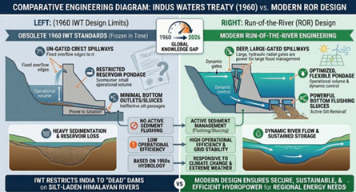
The Indus Water Treaty (IWT) is viewed as one of the cornerstones of water diplomacy between transboundary countries, as the agreement functioned flawlessly for more than six decades without interruptions or defects. In different periods of time, the agreement managed to maintain the joint management of transboundary water sources isolated from any political and military rivalry that existed between the two states. However, there came a time when this arrangement under the Indus Water Treaty become impossible. After the terrorist incident at Pahalgam in April 2025 which led to the deaths of twentysix people, India decided to put the Indus Water Treaty in ‘Abeyance’ or ‘temporary suspension’ citing Pakistan’s support to state-sponsored terrorism, signaling that lower-riparian water security can no longer be insulated from Pakistan’s conduct regarding cross-border terrorism. Furthermore, India argues the that the treaty permitted India to utilise the Western Rivers, only for specified engineering was agreed upon in 1960, with changes in time, India aims to bring changes in design of its dams with modern run-of the-river engineering which requires high sediment loads of Himalayan rivers. The Salal Hydro Project on the River Chenab is the focal point of this change. India is employing the Salal project’s facilities to obtain water resources that are protected under the Indus Waters Treaty because they had previous restrictions from the treaty’s implementation. New Delhi is changing regional hydro political dynamics through its technical and strict treaty interpretation, which provide different meanings to storage capacity limits and run-of-the-river projects guidelines.
The riparian asymmetry: The Legal and technical trap
The main problem with the Indus Water Treaty lies in its distribution system, which identifies three Western rivers for allocating water rights between Pakistan and India. The bulk of the waters was awarded to Pakistan, whereas India’s water rights remained restricted and narrowly defined as run-of the-river. The geographical and legislative constraints of the Chenab Basin have made it necessary for India to contend with difficulties in both engineering and ecology, as illustrated by the Salal Hydroelectric Project. This 690 MW power station, whose construction began in two phases in the late 1980s and 1990s, was built to generate the necessary peak-load electricity for the Northern Grid. Pakistan used the treaty’s technical annexes to oppose the Indian drafts. Operational difficulties have emerged in the area because the Himalayan rivers flow through the early stages of river formation, with steep slopes, resulting in high silt loads. It has been found that the Chenab River system discharges about 32 million cubic meters of silt into the sea annually. The construction of a storage reservoir became a major sedimentation site due to the lack of flushing facilities, leading to excessive deposits beyond the site. The results of the latest bathymetric survey and report indicate that the site’s storage capacity has been drastically reduced, from 284 million cubic meters to only 14 million cubic meters. In the case of Salal, one can see how stable legal arrangements can run into difficulties when they try to address rivers that undergo natural environmental changes. As sediment fills the reservoir, the ability to regulate water flows to generate electricity becomes less effective, turning valuable assets into a technical and environmental burden. This problem not only requires new approaches from the engineering side but may also require reconsideration of the treaty provisions on the information regarding sediment exchange. Further deterioration of the dam is inevitable as long as it operates, and electricity cuts are expected during critical periods.
interests in the region and economic growth. Through Pakistan’s utilisation of the Indus Waters Treaty (IWT) dispute settlement system, the country leveraged the mechanisms of neutral experts and the court of arbitration to build diplomatic pressure on India while retaining its stance. Pakistan brought up the issue of Kashmir to the world’s attention, all the while blocking India from its infrastructure project development. The existing inequality proves that the Treaty is no longer a balanced mechanism for international cooperation, but rather a contested arena, the struggle for domination in which will determine each state’s geopolitical interests. The shortcomings of their systems are very close to the moment when control over key energy sources in India should be transferred to other states due to the need to perform a treaty that has become detrimental to India’s national security. The case of the Salal illustrates that once environmental management becomes a tool of zero-sum geopolitics, states lose their energy security and their capacity to manage natural resources amid climate change and political uncertainty.
The shift In strategy and reclaiming autonomy
has the right to act in efficient ways to create greater control of the region from the hydro-political aspect, which is achieved by the development of the resources. The process of desilting will work together with the ongoing renovations taking place in other upstream Chenab Basin hydroelectric plants in order to obtain the greatest amount of energy from all regional facilities. The creation of energy within the region is an important towards the development of western rivers. The Ministry of Power is now planning to adopt several modifications for hydroelectric plants in Jammu and Kashmir, rather than relying on the old pattern. Sediment management was carefully carried out at the Salal hydroelectric project by the Ministry of Power and NHPC from late 2025 to early 2026, including dredging and flushing. These technical adjustments are carried out to reduce the impacts of sedimentation resulting from young, profiled Himalayan rivers in previous years.
rivers. Firstly, this move by the Indian government is of great historical significance for the country. There are two main benefits for India arising from this arrangement: First, it allows the country to undertake activities outside its territory but ensures the effective utilisation of its run-of-the-river hydropower projects. By pledging to utilise all its power projects through the most efficient ness and sediment control through actual performance measurements rather than relying on predetermined treaty annexes. India will defend its major infrastructure changes as climate-related measures by asserting that current environmental requirements, which did not exist at the time of the 1960 treaty, must be followed to protect the safety of the Himalayan dam. The emerging hydro-political paradigm integrating development and strategy in the Indus Basin is illustrated in . India must undertake a dual approach to this project. First, there should be a connection between the performance capability of the Chenab and Jhelum hydel power plants and the existing security issues in the region. By claiming that energy security is an inviolable security issue, New Delhi creates a cost-benefit framework applicable to all basin countries. International inspections of how
Geopolitical complexities and strategic Implications
However, the matter of the Salal Dam cannot be seen as a purely civil engineering issue, as it is a case of an unfair strategic game that jeopardises India’s security It is also made more complex by the prevalent double standards regarding infrastructure. While on the one side there is a firm stance taken by Islamabad regarding India’s compliance with the restrictions placed by the IWT based on mid-twentieth-century technologies regarding the western rivers, on the other side Pakistan has been enthusiastically pursuing the development of new and large-scale infrastructure using the latest desilting technologies and automated gates, which have often been denied to India’s engineers according to the terms of the treaty. This aspect becomes particularly challenging due to third-party countries’ involvement in the matter, particularly China through the China-Pakistan Economic Corridor (CPEC). This is because the transformation of the upper Indus water system in terms of hydrology, storage capacity, etc., using foreign technological know-how and funds creates a major strategic liability for the country. This is because the country’s capacity to manage its sediment load annually is limited. The geopolitical map of the Chenab Basin, as shown in highlights the Salal, Baglihar, and Ratle projects alongside proposed diversions like the Marhu Tunnel to demonstrate the spatial scope of India’s factor in the development of socio-economic conditions in the Union Territory of Jammu and Kashmir. The present suspension of the Indus Waters Treaty (IWT) has led to a drastic change in India’s infrastructure strategy for the western rivers. It appears that India has now decided to take up large-scale modernization of its hydroelectric facilities in the Union Terrritory of Jammu and Kashmir. The Ministry of Power, along with NHPC, performed sediment control works at Salal by dredging and flushing, thereby recovering its storage capacity in late 2025 to early 2026. The purpose of these engineering works is to rehabilitate the reservoir to normal operating conditions and address sediment accumulation from the Himalayan rivers. The new strategy for implementation is the last step in the cycle of actions undertaken in India, starting with legally imposed restrictions that made the country unable to employ its river-based resources. India The future of the Indus basin lies in New Delhi’s consistent commitment to translating diplomatic gestures into tangible hydrological outcomes. The implementation of the project to construct the infrastructure of the western rivers is necessary to establish it as a standard project through the utilisation of engineering methods that effectively manage sedimentation. India utilises engineering methods alongside its legal authorities to secure transboundary water sources.


Conclusion
In response to the suspension of the Indus Water Treaty, the Indian government has altered its attitude and economic methods possible, India achieves a hydro-political balance in the region. Through the desilting scheme, coupled with changes to projects in the upper regions of the Chenab basin, the country achieves the region’s maximum hydropower output. The continuous availability of power in Jammu and Kashmir influences the region’s socio-economic development, as energy is produced in-house to meet local demand. India needs to establish a forward-looking, rulebased hydrological policy framework to help the country sustain its operational improvements. The foundation of this diplomatic shift is the establishment of adaptive management protocols that will guide assessments of technical effective India maintains its sediment control techniques provide an opportunity to discuss the international standards applicable to current hydropower plants. The argument that Pakistan steals water is no longer scientifically convincing and should be disproved using technical and ecological studies. For the Indus Basin to see improvements, New Delhi will have to turn its diplomacy into a water policy. India can defend its transboundary water supply using advanced technology and legal frameworks that serve its growth and defence purposes. South Asian hydropolitics is destined to undergo a significant change at this stage.
(The author is President, India Water Foundation. His views are personal.)