
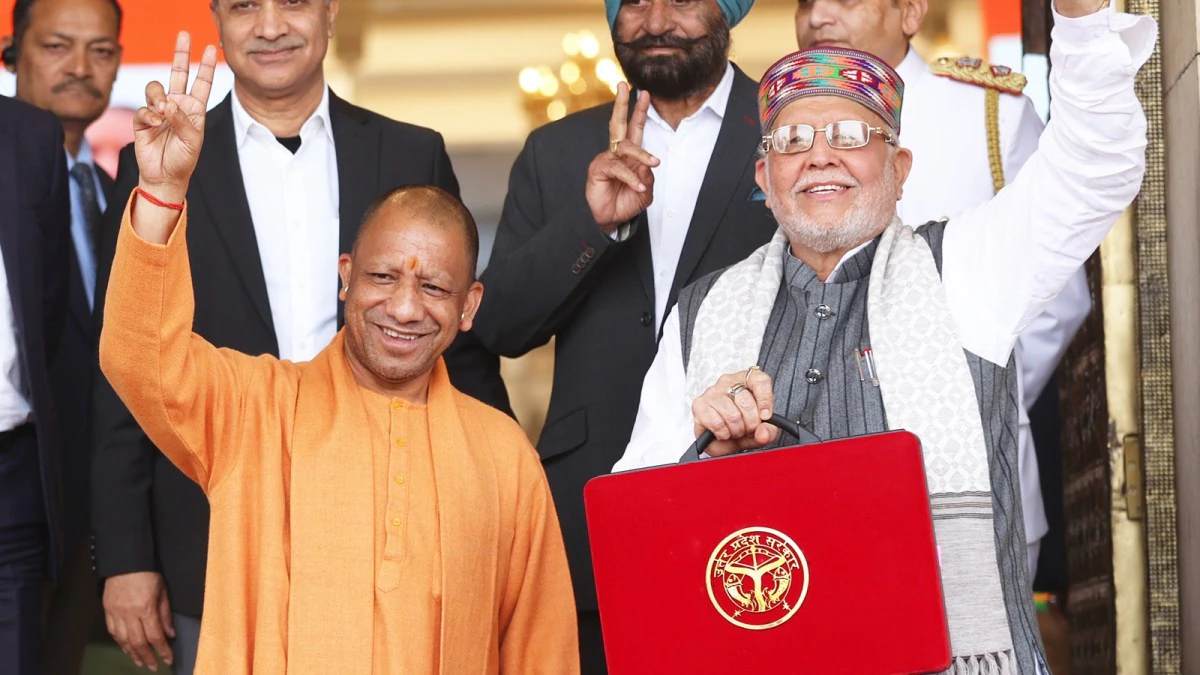
The presentation of Uttar Pradesh’s Economic Survey 2025-26 in the state assembly marks not just another budgetary ritual but a testament to a profound economic turnaround. Under Chief Minister Yogi Adityanath, India’s most populous state, home to over 25 crore people, has shed its image as a developmental backwater, emerging as a powerhouse of growth, investment and innovation. This isn’t mere rhetoric; the numbers tell a story of deliberate policy, relentless execution, and a vision aligned with Prime Minister Narendra Modi’s “Viksit Bharat.” Where previous regimes mired the state in corruption, lawlessness and stagnation, CM Yogi’s governance has unleashed potential long suppressed by political opportunism.
Consider the sheer scale of economic expansion. In 2016-17, Uttar Pradesh’s Gross State Domestic Product (GSDP) stood at ₹13.70 lakh crore, a figure that reflected decades of neglect under Samajwadi Party and Bahujan Samaj Party rule, when the state was synonymous with goonda raj and investor flight. Fast forward to 2024-25, and the GSDP has more than doubled to ₹25.25 lakh crore, with projections for 2025-26 pegging it at ₹31 lakh crore. This isn’t accidental growth; it’s the result of transparent policies, time-bound incentives and what Yogi calls the “Triple S” guarantee—Safety, Stability and Speed. Once, investors shunned UP; today, the state has garnered industrial investment proposals exceeding ₹40 lakh crore. This influx has propelled UP’s contribution to India’s national economy from 8.6% in 2016-17 to 9.1% in 2024-25, underscoring its pivot from peripheral player to national driver.
Per capita income paints an even more compelling picture of reversal. At Independence, UP’s per capita income matched the national average, but by 2014-15, it had plummeted to just 50.2% under successive non-BJP governments that prioritised vote banks over development. Yogi’s administration has arrested this decline, pushing the ratio to 53.5% by 2024-25. In absolute terms, per capita net state value added rose from ₹48,512 in 2016-17 to ₹1,09,844 in 2024-25, with 2025-26 estimates at ₹1,20,000. This historic shift, doubling in eight years, reflects not just economic buoyancy but a commitment to inclusive growth, lifting millions from poverty’s grip. Contrast this with the opposition’s hollow critiques; their regimes left UP’s poor mired in dependency, while Yogi’s focus on infrastructure and skilling has created real pathways to prosperity.
Logistics, often the unsung hero of economic narratives, exemplifies this transformation. For three consecutive years, UP has clinched the “Achiever” grade in the national LEADS Logistics Index 2024, a feat that converts the state’s vast 2,40,928 square kilometers from a logistical nightmare into a competitive edge. Under Yogi’s push for highway development tracks now traverse seamlessly, reducing transit times and costs. This isn’t abstract; it’s the backbone enabling interstate trade and global integration. The ambitious Lucknow State Capital Region (SCR), spanning 27,826 square kilometers (encompassing eight districts), mirrors NCR and MMR models but on a grander scale. By fostering integrated economic corridors, industrial zones and housing clusters, the SCR bets on agglomeration economies, decentralising growth from hubs like Noida and Kanpur to create multiple poles of opportunity. If realised, this could redefine UP’s urban landscape, turning demographic density into economic dynamite.
Agriculture, traditionally UP’s lifeline but long plagued by inefficiency, has been reimagined as a strategic asset. The state’s dominance is staggering: 732.4 lakh metric tonnes of wheat, 245.9 lakh metric tonnes of potatoes, 2,451.5 lakh metric tonnes of sugarcane and leadership in milk (358.5 lakh metric tonnes). This output isn’t just volume; it’s the bedrock of India’s food security. Yogi’s integration of digital tools like DBT-linked incentives, e-carbon credits and e-procurement has modernised the sector, shifting it from subsistence to a digitised powerhouse. Irrigation facilities for 26.17 lakh hectares and 37.21 crore saplings planted under afforestation drives show a nuanced grasp of sustainability, linking natural resources to long-term productivity.
Financial inclusion and employment metrics further illuminate the depth of change. Through initiatives like TIN-AP, 21,891 enterprises have registered, with micro-credit disbursals of ₹3.79 crore formalising the informal. The Ujjwala Yojana has reached 1.85 crore households with LPG connections, while 10.22 crore Kisan Credit Cards empower farmers. Employment under MGNREGA stands at 53.40 lakh persons (36.37 lakh rural, 17.03 lakh urban), complemented by 2.74 lakh skilled through various programs from 2017-18 to 2026. These aren’t welfare handouts; they’re engines of consumption and capacity-building, expanding economic participation where exclusion once reigned.
Digital governance seals this narrative. As the first state to saturate GeM procurement and roll out e-prosecution, UP has slashed corruption and transaction costs, fostering a business-friendly ecosystem. This cultural shift toward transparency aligns with Modi’s digital India vision, making UP attractive for FDI and domestic investment alike.
The February 11, 2026, presentation of the ₹9.13 lakh crore Budget for 2026-27—a record outlay up 12.2%—cements this trajectory. CM Yogi Adityanath termed it a “decennial testament” to a decade of progress, outlining a roadmap for self-reliant and developed Uttar Pradesh en route to a $1 trillion economy and Viksit Bharat@2047. With capital expenditure at 19.5%, and strong allocations to education (12.4%), health (6%), and agriculture (9%), it intensifies focus on youth skilling, women’s dignity, farmer welfare, poverty alleviation, and reducing regional disparities in backward areas like Purvanchal and Bundelkhand.
Critics, often from the opposition benches, dismiss this as hype, but the data begs to differ. Where SP and BSP fostered chaos, Yogi has instilled order; where Congress-era neglect lingered, BJP governance delivers. This metamorphosis positions UP not just as India’s growth engine but a model for states grappling with scale. In a multipolar world, UP’s rise under Yogi exemplifies “Sabka Saath, Sabka Vikas”—a blueprint for inclusive, resilient progress. The opposition’s carping aside, the numbers don’t lie: Uttar Pradesh is no longer a laggard; it’s leading the charge.
Shehzad Poonawalla is National Spokesperson, Bharatiya Janata Party (BJP).