
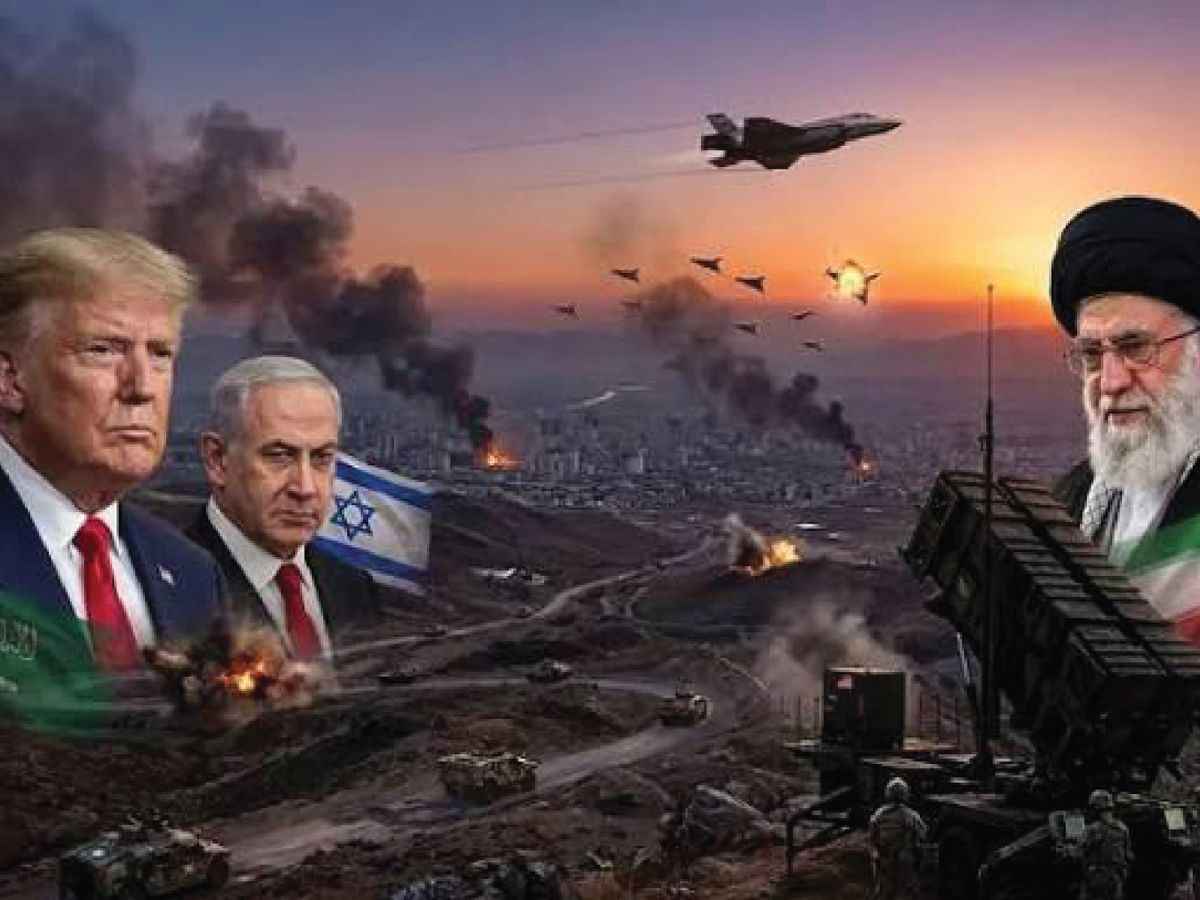
The ongoing conflict in West Asia between the US-Israel and Iran is not just a geopolitical, economic or armed conflict; it is also a civilization conflict. That is why, the theocratic Iran might fall, but civilization Iran cannot be destroyed. Its seeds were shown in the from the beginning of the Abrahamic religions (Judaism, Christianity, Islam) who trace their roots to the patriarch Abraham (circa 2000-1700 BCE), who entered a covenant with one God to establish a monotheistic tradition. However, they are in civilization clash since beginning.
In the early 1990s, as the Cold War ended and ideological rivalries receded, American political scientist Samuel P. Huntington offered a provocative thesis about the future of global conflict. In his seminal work The Clash of Civilizations and the Remaking of World Order, Huntington argued that the primary source of conflict in the post Cold War era would not be ideological or economic, but cultural and civilizational. According to him, ‘In this new world, the most pervasive, important, and dangerous conflicts will not be between social classes, rich and poor, or other economically defined groups, but between peoples belonging to different cultural entities.’ His prediction that, the world would increasingly witness tensions along the fault lines of major civilizations like Western (Christian), Sinic (Chinese), Islamic, Judaism and others. Among these, he identified the relationship between the Western Christian world and the Islamic world as one of the most volatile fault lines. Today, amid rising tensions involving the United States, Israel, and Iran, Huntington’s thesis appears to echo once again in international discourse.
Recent geopolitical developments have intensified this perception. The prolonged conflict in Gaza following the Hamas attack on Israel in October 2023 has triggered a wider regional crisis, drawing in multiple actors across West Asia. The United States, Israel’s closest ally, has continued to provide military and diplomatic support to Tel Aviv, while Iran, long considered Israel’s principal regional adversary, has supported groups such as Hezbollah and other non-state actors opposing Israeli influence. Escalations in the Red Sea involving Houthi forces and Western naval responses have further complicated the regional picture. International media outlets from The New York Times to The Guardian have repeatedly highlighted how the crisis risks expanding into a broader regional confrontation involving ideological, religious, and strategic dimensions.
From a Huntingtonian perspective, these tensions can be interpreted as part of a broader civilizational friction between the Western world, historically shaped by Christian traditions and liberal democratic values, and the Islamic world, which carries its own distinct religious and cultural identity. Huntington argued that centuries of historical interactions from the Crusades to colonial interventions have left deep scars that continue to influence contemporary geopolitics. In this context, conflicts involving Western powers and Muslim-majority societies are often framed not merely as political disputes but as civilizational struggles.
The U.S. Israel–Iran triangle illustrates how geopolitical rivalries can acquire civilizational overtones. Israel, closely aligned with the United States and Western allies, is often perceived in parts of the Muslim world as an extension of Western influence in the region. Iran, on the other hand, positions itself as a champion of resistance against Western hegemony and Israeli power, invoking both religious symbolism and anti-imperialist rhetoric. This narrative, frequently echoed in political speeches and media commentary, reinforces the perception of a deeper cultural divide.
However, the reality of international politics remains far more complex than Huntington’s framework might suggest. Many scholars argue that reducing contemporary conflicts to civilizational clashes risks oversimplifying intricate political, economic, and strategic factors. The Israel–Iran rivalry, for instance, is shaped as much by security concerns, regional power competition, and historical grievances as by religious identity. Similarly, Western alliances with several Muslim-majority nations such as Saudi Arabia, the United Arab Emirates, and Jordan demonstrate that geopolitical interests often override civilizational boundaries.
Moreover, divisions within the Islamic world itself challenge the notion of a unified civilizational bloc confronting the West. Sectarian rivalries between Sunni and Shia groups, political tensions among Middle Eastern states, and differing national interests reveal a complex mosaic rather than a monolithic Islamic civilization. The Syrian civil war, the Saudi–Iran rivalry, and political upheavals during the Arab Spring illustrate how internal dynamics frequently drive conflicts within the region. Yet Huntington’s thesis retains relevance not because it perfectly explains global politics, but because perceptions of civilizational conflict can shape political behavior. When leaders, media narratives, and public discourse frame disputes in cultural or religious terms, they reinforce identities that deepen polarization. The risk lies in transforming political conflicts into existential struggles between cultures, making compromise increasingly difficult.
The present international climate demonstrates how rapidly such narratives can spread. Social media platforms amplify images of violence and suffering, often stripped of context, fueling outrage across continents. Demonstrations in European and American cities over the Gaza war, as well as growing Islamophobia in parts of the West, highlight how distant conflicts can intensify identity politics worldwide. In such an environment, Huntington’s warning about cultural fault lines appears less like a prediction and more like a cautionary signal.
At the same time, the globalized world is far more interconnected than Huntington envisioned. Economic interdependence, migration, and digital communication have created overlapping identities and shared interests across civilizations. Millions of Muslims live in Western countries, contributing to their economies and cultural life, while Western institutions engage extensively with Muslim-majority nations in trade, education, and diplomacy. These interactions complicate the narrative of inevitable civilizational confrontation.
Indeed, history offers numerous examples of cooperation and intellectual exchange between Islamic and Western civilizations. During the medieval period, Islamic scholars preserved and advanced classical Greek philosophy, mathematics, and medicine, later transmitting this knowledge to Europe and helping ignite the Renaissance. Trade routes linking Asia, Africa, and Europe fostered centuries of cultural interaction, demonstrating that civilizations have long influenced and enriched one another.
India’s civilizational ethos offers an important perspective in this debate. For thousands of years, the Indian subcontinent has served as a confluence of cultures, religions, and philosophical traditions. Hinduism, Buddhism, Jainism, Sikhism, Zorosthrianism, Judaism, Islam, Christianity and several other faiths have coexisted within the same social landscape, producing a rich tapestry of pluralism. The principle of “Vasudhaiva Kutumbakam” , the idea that the world is one family embodies a worldview that emphasizes dialogue, mutual respect, and coexistence. In a time when civilizational narratives threaten to deepen global divisions, Bharatiya values rooted in inclusivity, tolerance, and cultural synthesis can provide a framework for reconciliation. By promoting interfaith dialogue –ekam sad viprah bahuda vadanti (truth is one but the wise men spoke of it differently), multilateral cooperation, and respect for diversity munde munde matir bhinna kunde kunde navam payah, jatau jatau navacaro nava vani mukhe mukhe. (From shaved head to shaved head, the understanding is different; from pot to pot, the milk is new; from class to class, the conduct is new; and from mouth to mouth, the speech is new.) Diversity is an inherent part of human society and the natural environment. We do well to be accepting of it and adjust ourselves as appropriate., India’s civilizational philosophy offers a reminder that civilizations need not clash; they can collaborate.
Ultimately, the tensions among the United States, Israel, and Iran reflect a complex interplay of geopolitics, religion, identity, and power. While Huntington’s theory helps illuminate certain patterns of cultural tension, it should not become a deterministic lens through which the world views itself. The challenge for the international community lies in ensuring that civilizational identities become bridges rather than barriers. If history has witnessed clashes between civilizations, it has also shown that dialogue, exchange, and coexistence remain equally powerful forces shaping the destiny of humanity.
Dr. Ravi Rameshchandra, Associate Professor, School of International Studies, JNU, Delhi