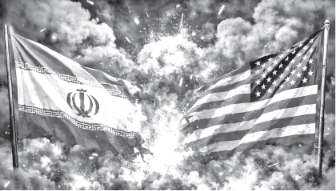
Pakistan’s Balochistan province is being plunged into turmoil by the US–Israel war on Iran. The region’s strategic significance and natural resource endowment has long enticed foreign involvement. Yet the Iran war is worsening Balochistan’s existing drivers of instability, insurgency, jihadist expansion, cross-border conflict and political marginalisation, threatening the very investments that the United States, China and Pakistan are each counting on. Balochistan, already plagued by insurgency, deprivation and border violence, is ill-equipped to cope with a war on its doorstep.
The fallout from the US–Israel war on Iran is now colliding with one of the world’s most volatile environments — Balochistan, Pakistan’s southwestern province bordering both Afghanistan and Iran. While Balochistan’s instability is not new, the Iran conflict has changed its trajectory. The Iran conflict threatens to draw insurgency, jihadist expansion and state rivalry together into a single, compounding crisis in the province.
Impact of the Conflict on US Interests
The consequences for this volatile region bear directly on US interests, especially strategic competition with China. Since 2015, China has made Balochistan a focal point of its Belt and Road Initiative through a multibillion-dollar infrastructure and energy development plan, centred on the deep-sea port at Gwadar. The province contains massive untapped mineral deposits, including the Reko Diq deposit, one of the world’s largest underdeveloped copper–gold reserves. The United States has demonstrated interest in securing access to these resources, approving US$ 1.3 billion in financing for Reko Diq — placing Balochistan in the middle of great power jockeying over critical mineral supply chains.
Yet the province is also a site of frequent and deadly political violence perpetrated by separatist and jihadist groups. These groups commonly target China–Pakistan Economic Corridor infrastructure, Pakistani security forces and Chinese nationals. The ongoing Iran conflict risks accelerating a deterioration of security conditions in Balochistan — threatening the economic investments that Washington, Beijing and Islamabad are each counting on.
Balochistan is already one of the world’s most unstable border regions. Home to numerous militant and insurgent groups, a sprawling illicit economy and a growing narcotics trade, the province is now absorbing the knock-on effects of a war on its doorstep. These pressures sit atop longstanding drivers of Baloch unrest — political marginalisation, enforced disappearances and economic strain, deepened by the collapse of cross-border fuel and trade flows since the outbreak of the US–Israel war on Iran. Islamabad’s crackdown on peaceful Baloch protests, including the detention of activist Mahrang Baloch, has further narrowed nonviolent political space.
The conflict’s spillover effects have direct beneficiaries in Balochistan. One group standing to gain is the Islamic State — Khorasan Province (ISKP). ISKP has steadily expanded its presence in Balochistan, with its well-documented anti-Shia ambitions central to its broader ideological agenda. The turmoil in Iran creates new opportunities for ISKP, allowing it to recruit more freely, expand its operational footprint in Balochistan and intensify its activities.
The US–Iran Conflict and Regional Implications
Any escalation involving Iran increases security risks along the Pakistan–Iran border. Refugee movements, arms trafficking, and militant infiltration could rise during periods of instability. Pakistani security agencies may be compelled to divert resources toward border management, potentially weakening counterinsurgency efforts within Balochistan itself.
Balochistan is also home to a growing separatist insurgency, led by the Balochistan Liberation Army (BLA), which routinely targets Pakistani security forces and Chinese infrastructure. The BLA has escalated its violent activities in recent years, most notoriously hijacking the Jaffar Express passenger train in March 2025.
Echoing earlier threats by Baloch militants in late 2025, in April 2026, the BLA-allied Balochistan Liberation Front announced it would target all foreign companies operating in the province, regardless of country of origin. Weeks later, gunmen killed nine people at a copper-gold site in Chagai, while a broader wave of arson — including an incident where more than 30 cargo containers were torched in Nushki on 26 May 2025 — continues to disrupt the province’s mineral economy.
The US–Iran conflict directly affects trade routes, energy markets, and investment flows. Balochistan’s economy, already underdeveloped, could suffer from disruptions in regional commerce. Increased military tensions in the Arabian Sea or the Strait of Hormuz could impact Gwadar Port’s development and discourage foreign investment.
Balochistan’s illicit economy further sustains these militant networks. The province remains a corridor for smuggling operations, including narcotics and Iranian oil, generating revenue for criminal and militant networks. An unstable Iran creates further space for these networks to flourish.
The Tehreek-e-Taliban Pakistan has also been expanding its footprint into Balochistan, making the province a convergence point for militant threats and an arena for direct military conflict between Pakistan and Afghanistan. In February 2026, Pakistan’s Minister of Defence Khawaja Asif declared ‘open war’ on neighbouring Afghanistan. Accusing the Taliban of harbouring anti-Pakistan militants, Islamabad’s Operation Ghazab Lil Haq crossed a line with the Taliban by striking Taliban military installations, not just militant camps. The Taliban have claimed retaliatory strikes in Balochistan. But so far, the confrontation has resembled episodic cross-border escalation more than sustained war.
The Afghanistan–Pakistan confrontation is just the latest example of how militant groups operating across borders can generate interstate conflict in the region. In January 2024, Iran and Pakistan exchanged crossborder air and missile strikes, each targeting militants that they accused the other of harbouring. In April 2025, Pakistan and India were on the brink of war after a terrorist attack in Kashmir.
The conflict in Iran adds a dangerous new dimension to these clashes. Ethnic Baloch communities reside on both sides of the Pakistan–Iran border, with armed separatist groups, including the BLA, maintaining a presence in Iran’s Sistan and Baluchestan province. Border security gaps associated with a destabilised Iran give such groups greater freedom to move, recruit and coordinate cross-border activities.
The combination of weakening border management, heightening interstate tensions, intensifying crime–terror nexus and fueling violence makes Balochistan even more inhospitable, especially as a backdrop for great power competition over critical resources.
As the United States steps into great power competition over Balochistan’s critical mineral reserves, it must grapple with the consequences of the Iran conflict unfolding at the province’s doorstep. The same geography that offers the potential of critical mineral wealth also serves as an expanding base for militants, civil unrest and the spillover of the Afghanistan–Pakistan confrontation — all now compounded by a destabilised Iran.
Gwadar, China, and the Strategic Equation
The significance of Balochistan extends beyond the US–Iran rivalry. China’s substantial investments in Gwadar Port and CPEC have transformed the province into a critical component of Beijing’s regional strategy.
A prolonged US–Iran confrontation could indirectly affect Chinese interests in Balochistan. Disruptions in maritime trade routes, security threats to infrastructure projects, and increased regional militarization would pose challenges to China’s economic ambitions in the Arabian Sea region.
Consequently, Balochistan has become a point where the interests of multiple global powers intersect. The province now represents not merely a domestic security concern for Pakistan but also an arena of broader geopolitical competition involving the United States, Iran, China, and regional actors.
Future Prospects
Balochistan occupies a unique and critical position in the geopolitics of the US–Iran conflict. Its location along the Pakistan–Iran border, proximity to the Strait of Hormuz, ongoing insurgency, and strategic assets such as Gwadar Port make it a region of immense importance. As tensions between Washington and Tehran continue to influence regional dynamics, Balochistan remains vulnerable to the spillover effects of conflict, including security threats, economic disruptions, and geopolitical competition.
Pakistan’s efforts to maintain neutrality and facilitate dialogue have highlighted the province’s strategic value in regional diplomacy. However, lasting stability in Balochistan will depend not only on external geopolitical developments but also on addressing the internal political, economic, and social challenges that have fueled unrest for decades.
In the evolving landscape of South Asian and Middle Eastern geopolitics, Balochistan stands as both a strategic opportunity and a potential flashpoint—one whose future will significantly shape the security architecture of the wider region.
Dr.S.Krishnan is an Academician and Experienced Journalist based in Jaipur.
Dr. Kamini Choudhary is an Assistant Professor in School of Law, HRIT University, Ghaziabad.