
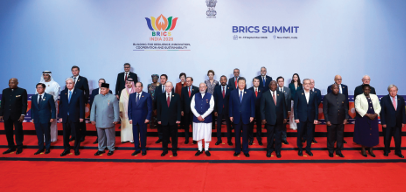
While leaders negotiated in New Delhi, the country introduced itself through a dinner menu, a journalist’s gift bag and a temple backdrop.
Diplomacy has its formal language: statements, negotiations, handshakes and carefully composed photographs. But a country can also speak through what it serves its guests, what it places in their hands, and what it chooses to show behind them. At the 18th BRICS Leaders’ Summit in New Delhi, India’s presentation of itself extended beyond the conference hall. A milletled gala dinner, a media kit featuring regional products and crafts, and a backdrop drawn from India’s civilisational heritage offered a different kind of introduction to the country. Call it the other summit: less about the negotiating table, more about the experience of being welcomed to Bharat.
A menu with a message
The gala dinner hosted by Prime Minister Narendra Modi at Bharat Mandapam on September 12 began with a simple but telling choice: millets were not an afterthought. They were a theme. The menu’s note on Shree Anna described millets as nutrient-rich grains that require fewer resources and can support agricultural sustainability and climate resilience. It also recalled the United Nations’ designation of 2023 as the International Year of Millets.
The idea was carried through the meal. Pearl millet appeared in the pulao, sorghum in the Indian bread, and barnyard millet in a dessert. The menu made a case for these grains not through a speech, but through a meal that visiting leaders could experience for themselves.
The starters offered a playful meeting of tradition and presentation. Khandvi MilleFeuille reworked the Gujarati gram-flour preparation, tempered with mustard, coconut and curry leaves, and served with Kesar mango, micro-greens and yoghurt dressing. Khumb Galouti brought pan-grilled mushroom kebabs with mint pearls, served on sheermal.
The main course travelled across ingredients and regional influences: Paneer Lababdar; Gucchi Marmik, featuring Himalayan morel mushrooms and asparagus with saffron, raisins and mamra almonds; Carrot Bean Poriyal, finished with freshly grated coconut; and Thakkali Belle Saaru, a light lentil broth with tomatoes and curry leaves.
Then came the millet centrepiece: Millet Pulao, combining basmati rice and pearl millet with spices and seasonal aromatics. Beetroot raita and assorted Indian breads accompanied the meal.
Dessert turned towards indulgence. Old Delhi Fruit Cream with Jalebi paired seasonal fruit and lightly whipped cream with a crisp sweet fritter. Shahtoot Phirni, a slow-cooked milk-and-rice pudding topped with mulberries and gold leaf, offered another distinctly Indian finish. Pomegranate juice and coconut water completed the drinks selection.
A menu cannot explain the full complexity of a country. But it can make its diversity tangible. This one moved from Gujarati khandvi to South Indian poriyal, from Himalayan morels to Old Delhi fruit cream—and placed millets, with their contemporary relevance, at the centre of the story.
The media kit: A small parcel of India
The introduction to Bharat did not end at the dinner table. The summit’s media kit, as described in the material shared about it, brought together regional foods, craft and practical accessories for journalists covering the event. There was sattu and makhana from Bihar, and specialty 100 per cent Arabica Koraput coffee from Prime Minister Narendra Modi, along with Chinese President Xi Jinping, Russian President Vladimir Putin and other world leaders, poses for the family photo on day 2 of the BRICS Summit 2026 at Bharat Mandapam, in New Delhi on Sunday. ANI rise in demand for premium hotel rooms. or a piece of Gujarati textile can become a quiet ambassador long after the event is over.
the tribal hills of Odisha. A Gujarati block-printed or Bandhani textile added a touch of craft and colour. The kit also included a branded tote bag with a built-in charging port, a coffee mug, a flask and official stationery.
It was an interesting combination. The food and textile items carried the imprint of particular places and traditions; the charging port and other useful objects belonged to the everyday life of a journalist on assignment. That contrast is what made the kit more than a collection of souvenirs. It brought together regional heritage and contemporary utility—an idea of India that is rooted without being frozen in the past.
A gift bag may seem a modest thing beside a summit attended by heads of government. Yet journalists are often the people who carry small impressions of a host country into stories, conversations and memories. A cup of Koraput coffee
A temple in the frame
The visual setting for the leaders’ welcome offered another layer to India’s presentation. The Ramanathaswamy Temple of Rameswaram, Tamil Nadu, was used as a backdrop at Bharat Mandapam, bringing an image of India’s civilisational heritage into a contemporary diplomatic encounter. The temple’s distinctive architecture and long history gave the welcome a cultural dimension beyond the formalities of protocol.
The image of Prime Minister Modi welcoming Chinese President Xi Jinping against an ornate setting brought together two different registers: the immediacy of a meeting between world leaders and the deeper historical memory of the country hosting them.
Such symbolism should not be asked to do the work of diplomacy. A backdrop cannot settle a dispute, and a photograph cannot stand in for an agreement. But images matter. They tell visitors—and the world watching them—what a country chooses to place at the centre of its self-presentation.
Here, the message was not only that India is a modern diplomatic host. It was also that the modern state stands within a much older civilisational story.
Hospitality is also an exercise in organisation
Behind the visible details lay the less visible work of hosting: accommodation, transport, interpretation, food service, scheduling and coordination. Delhi’s hotels prepared for visiting leaders and delegations, while the city managed the demands of a major international gathering. Reports described special hospitality arrangements and a sharp rise in demand for premium hotel rooms.
The public sees the arrival, the handshake and the photograph. The host city sees the many moving parts that have to work together to make those moments possible.
There is a human dimension here, too. A summit is not experienced only by presidents and prime ministers. It is also experienced by the journalist looking for a quiet place to file a report, the chef preparing a meal for unfamiliar guests, the hotel staff managing an unusually busy evening, and the local resident navigating temporary traffic diversions.
The summit briefly changes the rhythm of a city. Its success depends not only on what happens in the meeting rooms, but on how well the surrounding world accommodates the gathering.
The soft power of being remembered
India’s BRICS chairship has been framed around “Building for Resilience, Innovation, Cooperation and Sustainability”, with a “Humanity First” approach. The dinner’s focus on millets connected a traditional food to questions of nutrition and sustainability; the media kit connected regional products and crafts to a global audience; and the temple backdrop placed a contemporary event within a civilisational frame.
Together, these details formed a portrait of Bharat that was not delivered as a single speech. It was served, carried, photographed and experienced.
That is the quiet power of hospitality. It does not replace hard negotiations or guarantee agreement. It can, however, create a more human setting in which countries meet—and leave visitors with something more enduring than a schedule of meetings.
At a summit, the official record will preserve the statements and decisions. The smaller memories may travel further: the taste of millet pulao, the sweetness of shahtoot phirni, the aroma of Koraput coffee, the texture of a Gujarati textile, or the image of a temple’s architecture behind a leader’s welcome.
For a few days, New Delhi hosted the world. And through food, craft and heritage, India offered it a taste of Bharat.
Dr. Siddhartha Dave, PhD, is an alumnus of the United Nations University in Tokyo and a former Lok Sabha Research Fellow. He writes on foreign affairs and national security.