
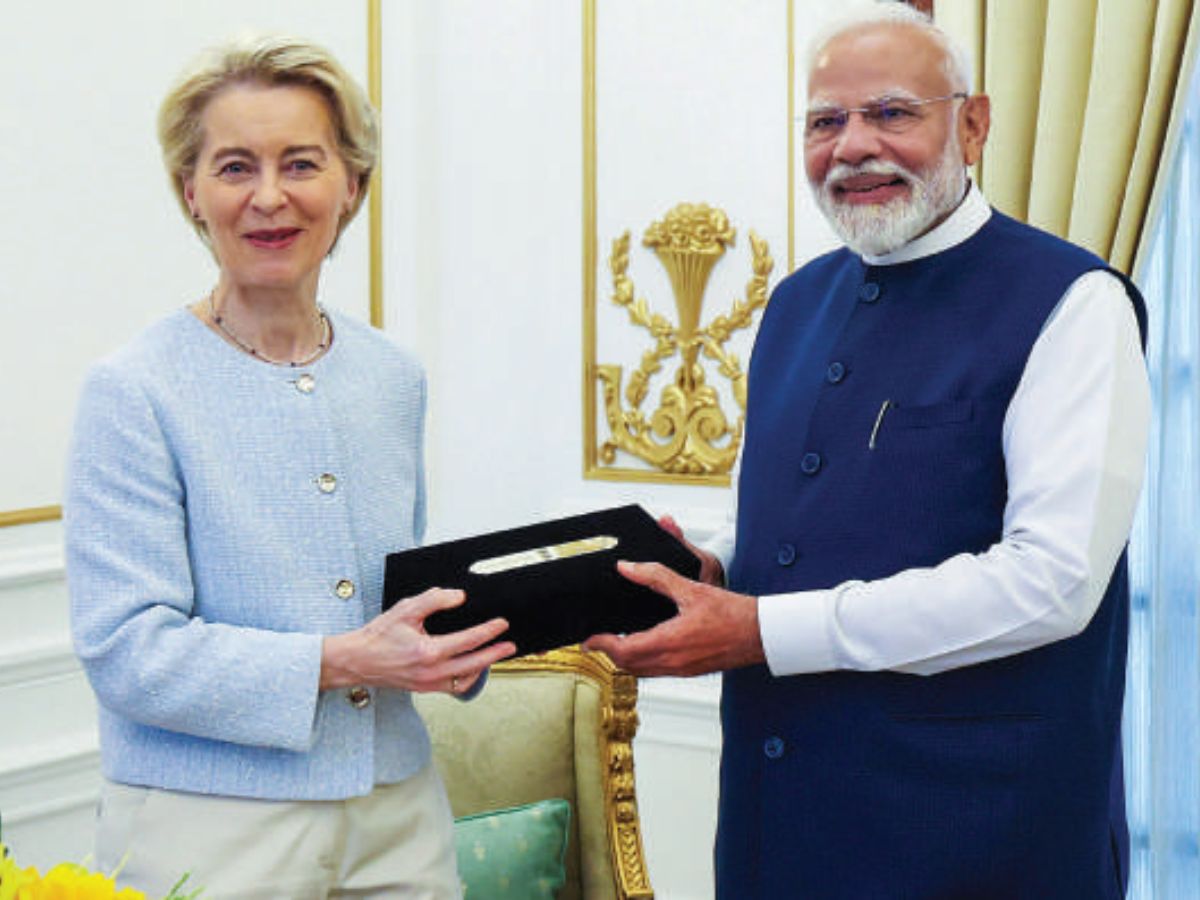
The India-EU relationship reached a historic milestone with the formal announcement of the conclusion of negotiations on a landmark Free Trade Agreement (FTA) during the India-EU Summit in New Delhi. This development, coinciding with the culmination of India’s 77th Republic Day celebrations—where European Commission President Ursula von der Leyen and European Council President António Costa attended as chief guests—underscores the deepening strategic partnership between the world’s largest democracy and the world’s largest single market.
In his remarks in recent days, Prime Minister Narendra Modi emphasized the privilege of hosting the EU leaders and highlighted how their presence underscores the growing strength of the India-EU partnership. He stressed India’s commitment to shared values, adding momentum to deepening engagement across diverse sectors. PM Modi described the FTA as a balanced, forward-looking pact that will significantly propel trade, investment, and economic integration. He linked it to broader opportunities for India’s youth through trade and mobility agreements, noting that such deals create new possibilities amid rising global trust in India. This aligns with Modi government’s vision of a self-reliant yet globally integrated economy, positioning the deal as a response to protectionist pressures, weaponisation of tariffs being done by some and a step toward shared prosperity.
The FTA—often hailed as the “mother of all deals” by Commerce and Industry Minister Piyush Goyal and echoed by Ursula von der Leyen—focuses on goods, services, and trade rules, with separate tracks for investment protection and geographical indications. Negotiations, relaunched in 2022 after years of stagnation since 2007, have culminated in a balanced pact. Key elements include reducing or eliminating tariffs on over 90% of traded goods, providing duty-free or preferential access for Indian labor-intensive exports like textiles, garments, chemicals, gems and jewellery, leather, footwear, pharmaceuticals, and electrical machinery. For the EU, this means phased tariff reductions on items such as automobiles (110% duties to around 40% for brands like BMW, Renault and Volkswagen), wines, spirits, and other goods. Sensitive sectors like Indian agriculture and dairy remain protected, reflecting India’s priorities. Services liberalization covers telecommunications, transport, accounting, and auditing, while addressing non-tariff barriers and regulatory cooperation.
This deal is poised to be a game-changer and win-win for both sides. For India, it restores competitiveness lost after the EU withdrew Generalized System of Preferences (GSP) benefits in recent years on many products, offsetting global protectionist pressures, including higher tariffs elsewhere. It will boost exports, attract investment, integrate India deeper into European supply chains, and support manufacturing under Make In India. For the EU, it opens a market of 1.4 billion consumers, diversifies trade away from over-reliance on other partners amid geopolitical uncertainties, and strengthens resilience in green technologies, digital transformation, and critical supply chains.
In terms of scale, the agreement creates a free trade area covering nearly 2 billion people—India’s 1.4 billion plus the EU’s 450 million—and a combined economy approaching a quarter of global GDP. Bilateral trade already stands at around €124-136 billion in goods (with India enjoying a surplus) and the FTA is expected to significantly expand this, enhancing economic integration.
Benefits are mutual and substantial. India gains enhanced market access for its competitive sectors, technology transfers, job creation in export-oriented industries (potentially over a million jobs), and buffers against global trade disruptions. The EU secures greater opportunities for its firms in India’s growing market, particularly in high-value goods and services, while advancing strategic goals like the Trade and Technology Council, Global Gateway and India-Middle East-Europe Corridor (IMEC).
Beyond economics, the FTA represents a strategic realignment rooted in a shared vision of democracy, a rules-based international order and the rule of law. Amid disruptions caused by protectionism, India and the EU are building greater autonomy and reliability. Both sides emphasize commitment to democratic values, multilateralism and tackling global challenges collaboratively. Initiatives like joint naval participation in the Republic Day parade (EU operations Atalanta and Aspides marching for the first time) highlight deepening security and defense cooperation. The summit builds on institutional alignments, including climate action, technology and global stability, positioning the partnership as a pillar of multipolar order.
Anecdotal highlights from the Republic Day program added much needed symbolic weight. Prime Minister Narendra Modi warmly received President von der Leyen during the parade at Kartavya Path, amid a grand display featuring “180 years of Vande Mataram” and 2,800 artistes. Von der Leyen, in her press briefing, her praise that a “successful India makes the world more stable, prosperous and secure,” and the historic EU contingent in the march reflected shared values and mutual respect. These moments, beyond pageantry, signaled intent to elevate ties to a core global strategy.
This achievement owes much to Piyush Goyal’s leadership. Under his stewardship, India has aggressively pursued FTAs, concluding around nine in the last 3-4 years (including with the UK, Oman, New Zealand, Australia, UAE, Mauritius, EFTA, and others), with the EU deal marking a pinnacle. Goyal’s emphasis on balanced, win-win agreements—protecting sensitive sectors while securing market access—has positioned India as a proactive global trader.
This moment is more than a trade pact; it’s a declaration of intent in a volatile world. As von der Leyen noted, success in India-EU ties benefits everyone. With legal scrubbing underway and signing imminent (likely effective 2027), the FTA promises to usher in an era of shared prosperity, resilience, and strategic convergence—proving that partnerships grounded in democracy, rule of law, and mutual respect can thrive amid uncertainty.
Shivam Bhargat is National Spokesperson, Bhartiya Janata Party (BJP)