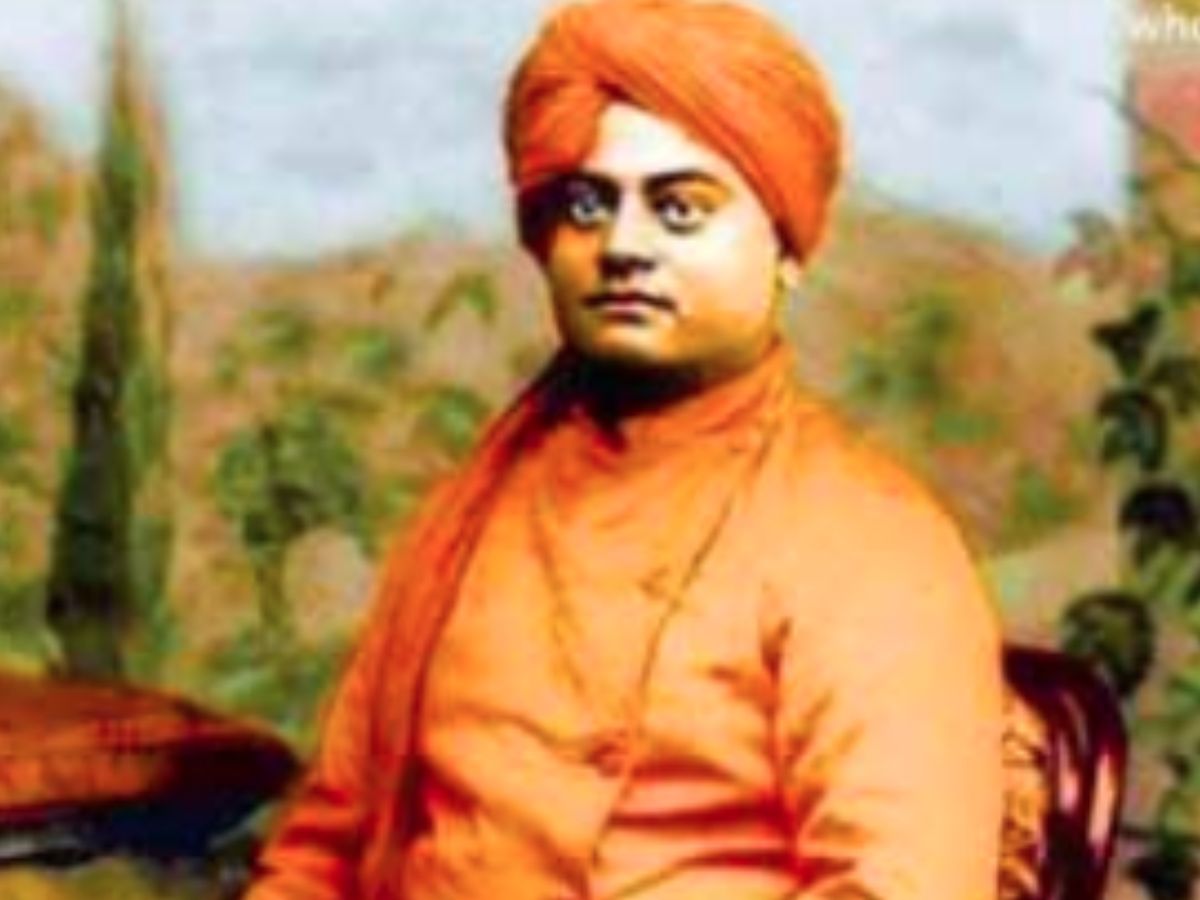
Swami Vivekananda was born on 12 January 1863 in Calcutta. By the grace of Lord Shiva, he was born into the family of the renowned advocate Vishwanath Dutta and his mother Bhuvaneshwari Devi. In childhood, he was named Narendra Nath Dutta. During his early years, he was also called Vile and Naren. After receiving initiation from Swami Ramakrishna Paramahamsa, he was initially known as Vividishananda, and later became famous worldwide as Swami Vivekananda.
He was endowed with qualities such as sharp intellect, youthful leadership, promoter of education, social reformer, religious preacher, and an inspiration for harmony. He made a significant contribution to strengthening Bhartiya self pride among the youth. Inspired by his call, many young men staked their entire lives for freedom from British rule. Swami Vivekananda became world-famous because of his speech at the World Parliament of Religions on 11 September 1893.
The Government of Bharat decided in 1984 to celebrate Swami Vivekananda’s birth anniversary as “National Youth Day.”
On the occasion of the completion of 400 years of Christopher Columbus’s arrival in America, the World Parliament of Religions was organised in Chicago (USA). Its objective was to display the material progress made over the past 400 years and to demonstrate the global expansion and superiority of Christianity. A grand and massive exhibition was also organised around Lake Michigan. This exhibition, spread over the lake which is about 494 kilometres long, was viewed by hundreds of thousands of people.
Among the important events of this grand occasion were the sessions of the Parliament of Religions. Through Swami Vivekananda’s brief speech, the entire world was introduced to Bharat’s Dharma, thought, and philosophy, as well as the conduct of Bhartiyas toward the whole world. Through his profound and meaningful address, essence of Hindutva was re-established across the world. At the same time, Swami Vivekananda himself became world-famous. The day after his speech, all newspapers published Swamiji’s photograph along with the title given to him by Americans, “Monk of Hindu Dharma.”
In his speech, he presented the Hindu view of the entire world as one family, the belief not only in tolerance but in the acceptance of all truths, the idea that while people may follow different paths, they all reach the same destination, and the Hindu approach of accepting and giving refuge to all. This was the essence of his address, which he reinforced by reciting the Shiva MahimaStotra and verses from the Bhagavad Gita. These teachings remain guiding principles for all of humanity even today.
The encroachment upon established systems in order to seize the resources of the entire Earth, humanity groaning under wars being fought among many nations, and attempts to eliminate followers of other religions for the expansion of one’s own faith are challenges that still confront all of humanity today. It was precisely this danger that Swamiji warned about in his speech, when he stated that sectarianism, dogmatism, and fanaticism have filled the Earth with violence. He had called upon the assembly, declaring that the bell that rang in honour of the gathering would prove to be the death knell of fanaticism, persecution, and mutual bitterness. That goal, however, still remains far from being achieved.
To eradicate the social evils prevalent in Hindu society, he had called upon society to reform itself. Striking at the practice of untouchability, he said, “Hinduism has been reduced to just one principle—‘Don’t touch me, don’t touch me.’ Because of this ‘don’t-touch-ism,’ society has suffered immense loss. This is a grave injustice to the divine order and to humanity.” Despite the efforts of many great leaders and institutions, this task still remains incomplete. To achieve the goal of building a harmonious society, we must continue to strive relentlessly.
Today, when attempts are being made across the entire country to alter the nation’s demography through means such as religious conversions, “love jihad,” “land jihad,” and infiltration, Swami Vivekananda’s thought becomes especially relevant: “When a Hindu abandons his religion, it is not merely that one Hindu is lost; rather, one enemy of the nation is added.” Warning Christian missionaries in America, he had said, “To take advantage of society’s poverty and helplessness and to use temptation or service as a means of conversion is not service; it is business.”
He described Lord Macaulay’s system of education as a negative form of education, one that creates a sense of inferiority in the minds of future generations toward their own traditions, culture, history, language, and great personalities. According to him, “That education which does not make you self-reliant is not education.”
Swami Vivekananda was not only a dharmic preacher; he was also deeply conscious of Bharat’s economic development. He called upon the youth to become contributors to economic progress through the use of science and technology. During his travels, he held discussions with the renowned industrialist JamshedjiTata regarding his role in Bharat’s economic advancement. The establishment of institutions such as the Indian Institute of Science (IISc) and industries like Tata Steel by Jamshedji Tata was inspired by Swamiji himself. During this meeting, Swami Vivekananda remarked, “Merely importing technology from abroad will not eliminate Bharat’s poverty; we must develop our own technology.”
Bharat has the largest youth population in the world. Addressing the youth, Swami Vivekananda had proclaimed, “Arise, awake, and do not stop until the goal is achieved” (Uttiṣṭhata jāgrata prāpya varān nibodhata). He said, “My faith is in the younger generation. From among them will emerge the workers who will build the nation.” He envisioned youth with healthy and strong bodies, sensitive hearts, and a spirit of service.
Calling for freedom from mental slavery, he stated, “Bharat’s weakness is not economic poverty, but mental slavery.” His famous declaration was, “We are not born as sinners; we are the children of immortality (Vayamamṛitasya putrāḥ).” Expressing the spirit of swadeshi and self-respect, he gave the mantra: “Say with pride, I am an Bharatiya; every Bhratiya is my brother and say that the soil of Bharat is my highest heaven.”
During his travels in the West, when questioned about equality between men and women in Bharat, he replied that in Bharat a woman has always been supreme because she is a mother. He said that Bharatiya women do not need Western fashion, but rather the strength of character of Sita and Savitri. His powerful message was: “Do not follow others; carve your own path. Imitating Western countries is not civilisation, but an invitation to one’s own intellectual death.”
Swami Vivekananda was the inspiration behind the great revolutionaries of Bharat’s freedom movement. Among many revolutionaries, Lokmanya Bal Gangadhar Tilak expressed his view about Swami Vivekananda, saying, “Swami Vivekananda was truly the second Shankaracharya. He was a great saint who awakened the sleeping soul of Bharat .” His religion was not confined to limited rituals; it was expressed through conduct and practice. Considering service to the poor as service to God, he lived his entire life accordingly. His famous saying was, “You are told to go in search of God—are these dirty, downtrodden, hungry, poor people not your God?”, “Service to humanity is service to Narayana” – this was his enduring message.
The development of any nation depends upon the character of the people living in that nation. Therefore, the foremost duty of a nation is to nurture virtuous and noble individuals. In this context, Swami Vivekananda had said, “I want men with a capital Aim.” Elaborating on this idea, he expressed his expectation thus: “What we want is men—only men. Everything else will follow of itself. We need sincere, fearless, radiant, faithful, and firm-minded young men. If we could find even a hundred such men, the world would be transformed.”
He firmly believed that “every individual and every nation comes into this world with a definite mission. Bharat’s mission is to deliver the message of humanity to the world. Therefore, Bharat cannot perish.” Even during the darkest period of slavery, he expressed unwavering faith in Bharat’s responsibility and destiny. Fulfilling that responsibility is the task of the present and future generations. To resolve to complete the great work that Swami Vivekananda accomplished in his short lifespan would be the true tribute to him on his birth anniversary.
(Shivprakash is the National Joint General Secretary (Organisation) of Bharatiya Janata Party)