Over the last three years, the State of Manipur has been trapped in a tense situation between the Meitei and Kuki-Zo communities living in a state of “violent separation,” with 60,000 people uprooted, and around 250 people lost their lives, leaving Manipur’s social fabric in tatters. Amidst this backdrop of disarray, N. Biren Singh, the 12th Chief Minister of Manipur, resigned on February 9, 2025, leading to a year under President’s Rule. (A direct rule from New Delhi)
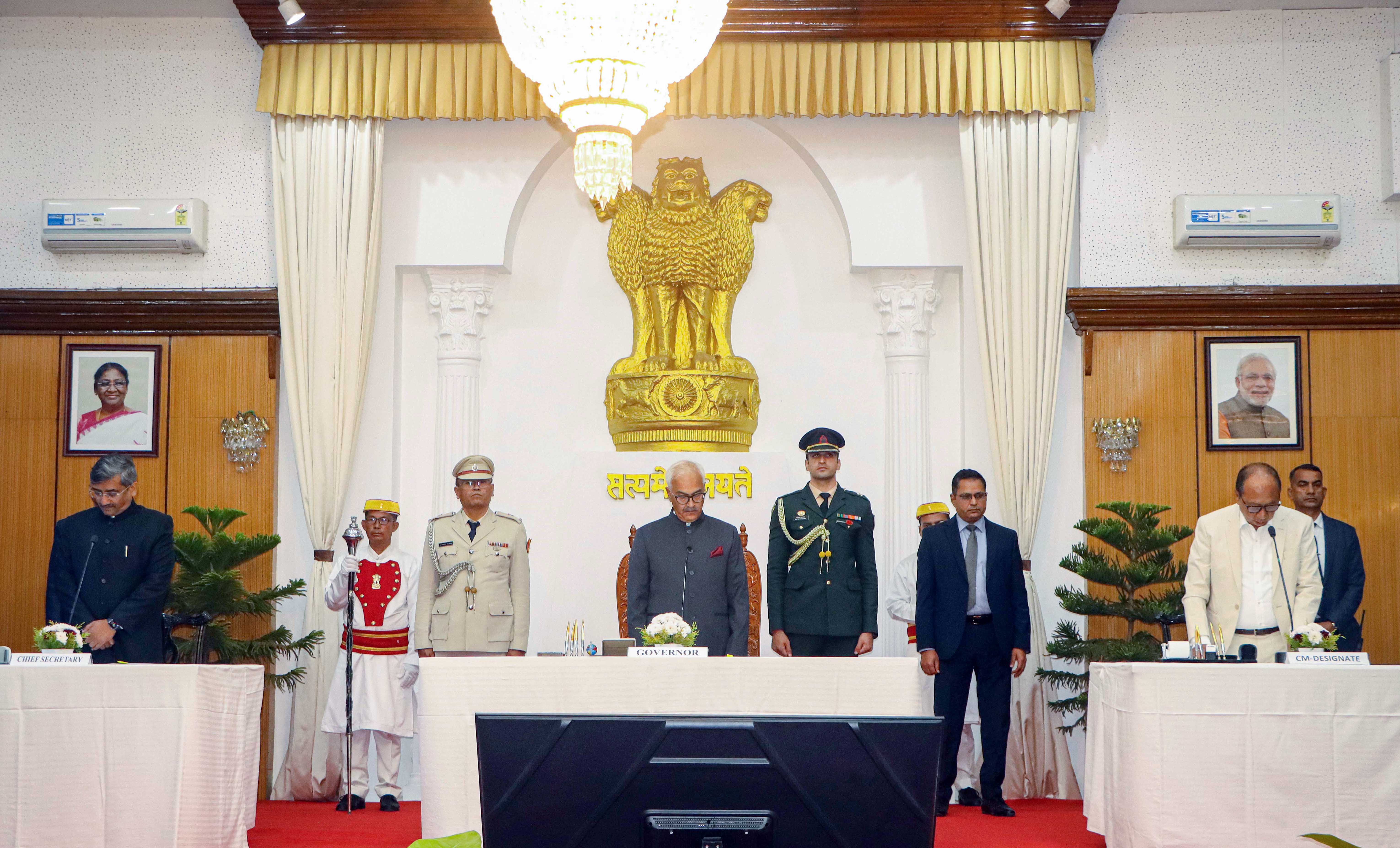
Recently, the Centre revoked President’s Rule and facilitated the swearing-in of Yumnam Khemchand Singh as the 13th Chief Minister of the 60-member legislative assembly. However, this move was immediately challenged. The Manipur Congress State President, Keisham Meghachandra Singh, has approached the High Court, arguing that the state assembly is constitutionally defunct by operation of Article 174. This raises a significant constitutional question: if the assembly is deemed “dead” or “dissolved,” then appointing a new chief minister without fresh elections undermines the very principle of democracy. A king cannot be crowned over an illusory kingdom.
THE CONSTITUTIONAL MOCKERY
Article 85(1) of the Constitution of India mandates that no more than six months can pass between two sessions of Parliament. Similarly, Article 174(1) stipulates that no more than six months can elapse between two sittings of the legislative assembly. These stand as non-negotiable procedural heartbeats for a functioning democracy. The last session of the Manipur Legislative Assembly was held on August 12, 2024. The Governor summoned the assembly for a session on February 11, 2025.
But when Biren Singh resigned on February 9, the Governor didn’t just accept the resignation; he scrapped the session entirely. Subsequently, on February 13, the President announced the imposition of Article 356. This decision came after the constitutional deadline for the next session had already passed on February 11, 2025.
This isn’t just a technicality; it’s a complete breach of Article 174(1) and the Representation of the People Act. Section 73 of the Representation of the People Act establishes a legislative house to represent the people’s will. This statutory right is implemented through the Rules of Procedure and Conduct of Business of the Manipur Legislative Assembly. Rule 3 deals with summons, Rule 16 covers arrangements, and Rule 17A mandates that the assembly hold at least three sessions annually: budget, autumn, and winter, with a minimum of 50 sitting days.
By preventing the assembly from meeting, the Governor not only violated a constitutional principle but also infringed upon the sovereign power of the assembly to manage its own affairs. Clearly, the Governor’s whims have disregarded the constitutional provisions governing the legislative assembly.
JURISPRUDENCE OF CONTINUITY
Articles 85(1) and 174(1) were borrowed from the Government of India Act, 1935, to regulate the frequency of parliamentary sessions. However, these articles only apply to a functioning House and don’t apply if the Assembly has been dissolved.
The judicial record on this is unequivocal; the Supreme Court has clarified this in In Re: Special Reference No. 1 of 2002 (Gujarat Assembly Election Matter), the Court held that the six-month rule only applies while the House is in session. Once dissolved, the obligation ends. However, if the Assembly hasn’t been dissolved, it remains a “living” constitutional body. Therefore, failing to summon it within six months directly infringes a mandatory constitutional requirement.
This principle was further reinforced in Nabam Rebia v. Deputy Speaker (2016). The Court held that the Governor’s powers under Article 174 are not discretionary. The Governor must act on the advice of the Council of Ministers. The court further states that the Governor cannot summon, advance, or delay a session at will. Similarly, unilateral obstruction of a constitutionally required session is also unconstitutional.
Furthermore, in S.R. Bommai v. Union of India (1994), the Supreme Court affirmed that a floor test is the only constitutionally valid method for determining majority support. Any endeavour to place an Assembly in “abeyance” to circumvent a floor test effectively disregards the House’s democratic will and undermines parliamentary supremacy.
Upon a Chief Minister’s resignation, the Governor’s duty is to explore the formation of an alternative government on the House floor. However, by cancelling the session, the Manipur Governor effectively blocked the Assembly’s doors, preventing a floor test.
Amidst these anxious deliberations, Rameshwar Prasad v. Union of India (2006) offers a rare voice of clarity. The Court ruled that the Governor cannot refuse to facilitate government formation based on subjective assessments of a claimed majority’s legitimacy or morality. Constitutional functionalities are prohibited from overriding legislative processes on personal grounds.
Therefore, denying the Assembly the opportunity to conduct its business after a Chief Minister’s resignation, without formally dissolving it, not only infringes upon the legislature’s institutional authority but also violates the electorate’s democratic rights. Constitutionally, an Assembly that hasn’t been dissolved remains active. Executive inaction cannot render it functionally defunct. Either it stands dissolved, triggering fresh elections, or it must be convened in accordance with Article 174(1). The Constitution recognises no intermediate state of a “living but suspended” Legislature.
HIGH COURT MUST ACT
Under Article 164, a Governor appoints a Chief Minister who must have the confidence of the legislative assembly. Nevertheless, if the assembly has already experienced a procedural expiration due to the violation of Article 174(1), there is no assembly left to support a new leader. One cannot appoint a leader to a body that no longer legally exists.
By canceling the session, the Governor chose a path that made a constitutional crisis inevitable. The most crucial question the Court must determine is the Governor’s decision to abruptly thwart the scheduled session on February 9. If the Governor had allowed the assembly to continue its scheduled sessions despite the resignation, the constitutional framework would have remained intact.
In a parliamentary system, the resignation of a leader should not paralyse the legislature. By allowing the assembly to convene, the Governor could have conducted a floor test—the gold standard of democracy. Manipur deserves a functioning House with a legitimate mandate, not a constitutional emptiness filled by administrative haste. However, while deciding this case, the Manipur High Court must remember that under Article 226, its power to protect the Constitution is as expansive as the Supreme Court’s, if not more.